
The Japan Maritime Self-Defense Force (JMSDF) commissioned its tenth Mogami-class frigate, JS Nagara (ながら), on June 29, 2026, marking another milestone in its ongoing effort to field a leaner, more technologically advanced surface fleet.
The Nagara (with pennant number FFM-10) was inducted into Patrol and Defense Squadron 2 of the newly established Patrol and Defense Group at Kure Naval Base in Hiroshima Prefecture, shortly after being handed over by shipbuilder Mitsubishi Heavy Industries (MHI) at its facility in Nagasaki City in western Japan.
Nagara was laid down on July 6, 2023, and launched on December 19, 2024 under Japan’s fiscal year 2022 procurement plan. The Nagara was built at a cost of about 52.3 billion yen ($323 million).
The Mogami class represents the JMSDF’s newest generation of multi-mission frigates. At around 5,500 tons full load, the Mogami class is a compact, highly automated surface combatant designed to maximize capability while minimizing crew requirements. Featuring a stealthy design with smooth surfaces and a reduced radar cross-section, the class is intended to replace older destroyers and minesweepers while addressing Japan’s growing personnel shortages.
Like previous ships from the seventh vessel onward, Nagara enters service equipped with a 16-cell Mk 41 Vertical Launching System (VLS). Earlier vessels, up to the sixth ship JS Agano (FFM-6), received or are expected to receive their VLS after entering service. Unmanned underwater vehicles (UUVs) and unmanned surface vehicles (USVs), however, will be installed at a later date.
Four Sailors on the Bridge
One of the most distinctive features of the Mogami class is its extensive automation.
While conventional JMSDF destroyers typically require crews of around 200 personnel, the Mogami class operates with about 90 sailors. This dramatic reduction in manpower is made possible by a high degree of automation centered on the Combat Information Center (CIC) and integrated digital ship systems.
The bridge itself has also been streamlined. According to Cmdr. Kenji Okumura, commanding officer of JS Kumano (FFM-2), only four sailors are required on the bridge during normal operations, compared with seven or eight on conventional destroyers. The four-person team consists of the officer of the deck, a helmsman, a radar operator, and a lookout.
The reduction has been achieved through the introduction of an Integrated Ship Handling System (ISHS) and the consolidation of information and control functions.
Particularly noteworthy is the ship’s one-person maneuvering capability during berthing operations. During docking, the crew uses an Integrated Ship Handling System that combines the steering gear and a tunnel bow thruster located in the forward hull into a single joystick-controlled interface.
“All steering engine and bow thruster are integrated and controlled by this joystick,” the commander explained during a foreign media tour held on June 30, 2025 in Yokosuka.
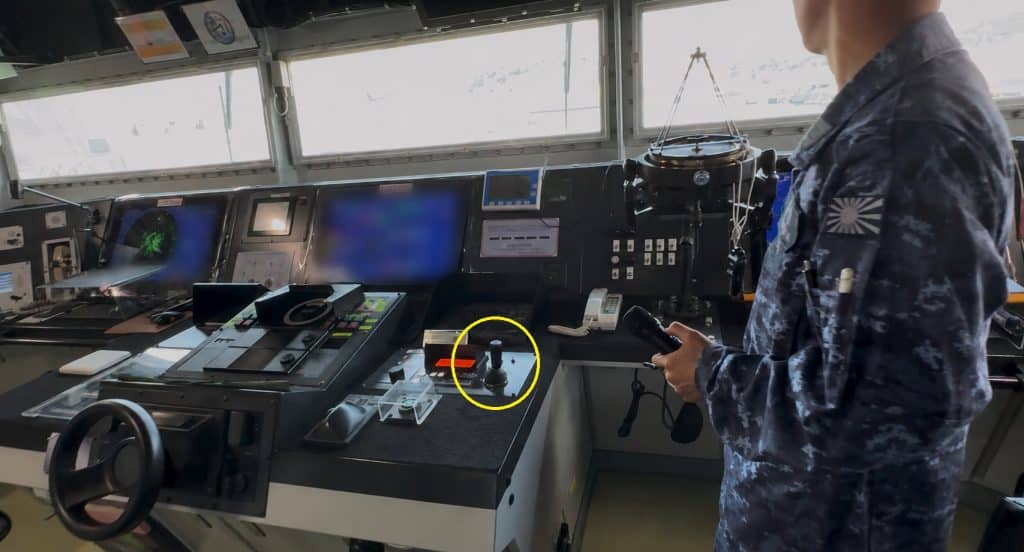
Under favorable sea conditions, the system allows the Mogami class to enter and leave a pier without tug assistance, further reducing manpower requirements and improving operational flexibility.
According to the commander, the bridge is also equipped with two Electronic Chart Display and Information Systems (ECDIS), eliminating the need for traditional paper charts. Operational logs and navigational records have likewise been digitized, removing the requirement for a dedicated bridge watchstander responsible for record-keeping.
The capability is unusual among Japanese surface combatants and reflects the JMSDF’s broader effort to field a compact, highly automated fleet capable of operating with significantly fewer sailors than previous generations of destroyers.
The JMSDF faces increasing difficulties in recruiting and retaining personnel as Japan’s demographic decline accelerates. The manpower-saving technologies pioneered aboard the Mogami class could therefore become the standard for future Japanese surface combatants.
In many respects, the Mogami class represents the embodiment of the JMSDF’s vision of a leaner, highly automated, and more efficient fleet.
The JMSDF will acquire a total of 12 Mogami-class frigates by the end of fiscal year 2027. It also plans to acquire a total of 12 New FFM (Upgraded Mogami-class) frigates by the end of fiscal year 2032.
