North Korean farmers ditch food crops for cash crops as market logic takes hold
North Korean farmers in parts of North Pyongan province are increasingly abandoning staple food crops on their private plots in favor of higher-value cash crops, signaling a broader shift in rural survival strategy from subsistence farming to market-oriented production. According to a Daily NK sourc
Daily NK
75
4 دقيقة قراءة
0 مشاهدة
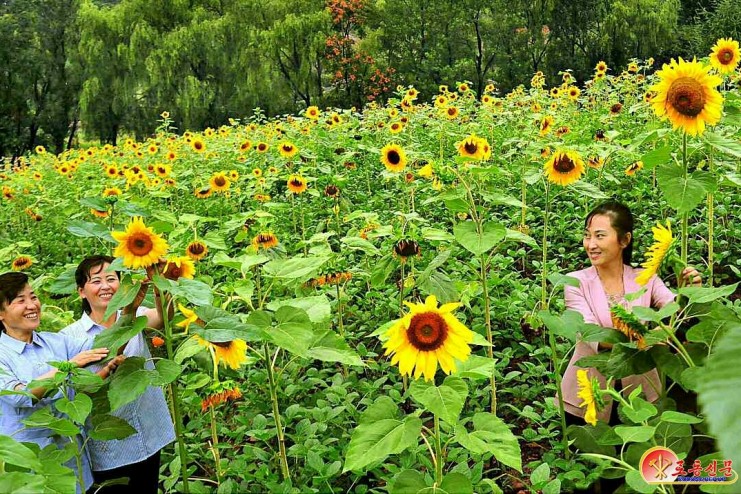
The Rodong Sinmun reported on Aug. 17, 2022, that sunflowers were being planted on a large scale in Huchon county, South Hamgyong province, to address cooking oil shortages. (Rodong Sinmun/News1)
North Korean farmers in parts of North Pyongan province are increasingly abandoning staple foodcrops on their private plots in favor of higher-value cash crops, signaling a broader shift in rural survival strategy from subsistence farming to market-oriented production.
According to a Daily NK source in North Pyongan province on Wednesday, the trend is most visible around Kujang county’s Sangri Industrial Crop Farm, a state-run facility specializing in crops used as industrial raw materials. On private garden plots and small personal landholdings known as sotoji (informal private plots cultivated outside the state plan), farmers have been increasingly growing industrial crops such as tobacco and castor bean, as well as medicinal herbs including deodeok (a native bellflower root), bellflower, yam, and gastrodia.
In the past, these plots were devoted almost exclusively to basic food crops such as corn, soybeans, potatoes, and sweet potatoes. Now, farmers are restructuring their private cultivation along practical lines: medicinal crops on hillside terraces and slopes, and industrial crops closer to home on flat garden land.
From subsistence to market: a shift in rural strategy
The source said farmers in other rural areas near industrial crop farms are closely watching farm management practices and trying to apply them to their own plots. “Rather than just growing food like before, the trend toward planting crops that make money has become unmistakable,” the source said.
Some farmers are informally obtaining seeds, cultivation techniques, and pest management know-how from state farm workers, then applying them on their private plots. The Workers’ Party of Korea promotes the principles of “right crop for the right place” and “right crop for the right time” as part of its agricultural policy, and the state’s push to expand industrial crop production has created an opening that farmers are exploiting for personal gain.
“Industrial crops fetch a higher price than regular food crops because they’re used as raw materials for local factories,” the source said, noting that sayings like “one plot of tobacco beats a few rows of corn” and “an herb field is more valuable land” have spread among farming communities.
The source added that North Korean farmers are increasingly prioritizing cash income over subsistence, focusing on what will sell at the jangmadang (informal markets) rather than what they will eat. “There’s a change where people are thinking about how to get the most out of the effort, time, and land they have,” the source said.
Observers on the ground describe the shift as more than just a change in what gets planted. They say it reflects a fundamental transformation in how rural North Koreans relate to the economy, moving away from passive compliance with state directives and toward a calculating, market-aware approach to household income.
Some voices of caution have emerged, however. Without sufficient expertise in specialty crop cultivation, farmers who fail to turn a profit could end up deepening their financial burdens rather than alleviating them. Even so, the source said the craze for cash crops is likely to continue for the foreseeable future, driven by the urgent need for ready money in North Korea’s countryside.
A Note to Readers
Reporting from inside North Korea
Daily NK operates networks of sources inside North Korea who document events in real-time and transmit information through secure channels. Unlike reporting based on state media, satellite imagery, or defector accounts from years past, our journalism comes directly from people currently living under the regime. We verify reports through multiple independent sources and cross-reference details before publication.
Our sources remain anonymous because contact with foreign media is treated as a capital offense in North Korea — discovery means imprisonment or execution. This network-based approach allows Daily NK to report on developments other outlets cannot access: market trends, policy implementation, public sentiment, and daily realities that never appear in official narratives.
Maintaining these secure communication channels and protecting source identities requires specialized protocols and constant vigilance. Daily NK serves as a bridge between North Koreans and the outside world, documenting what’s happening inside one of the world’s most closed societies.