
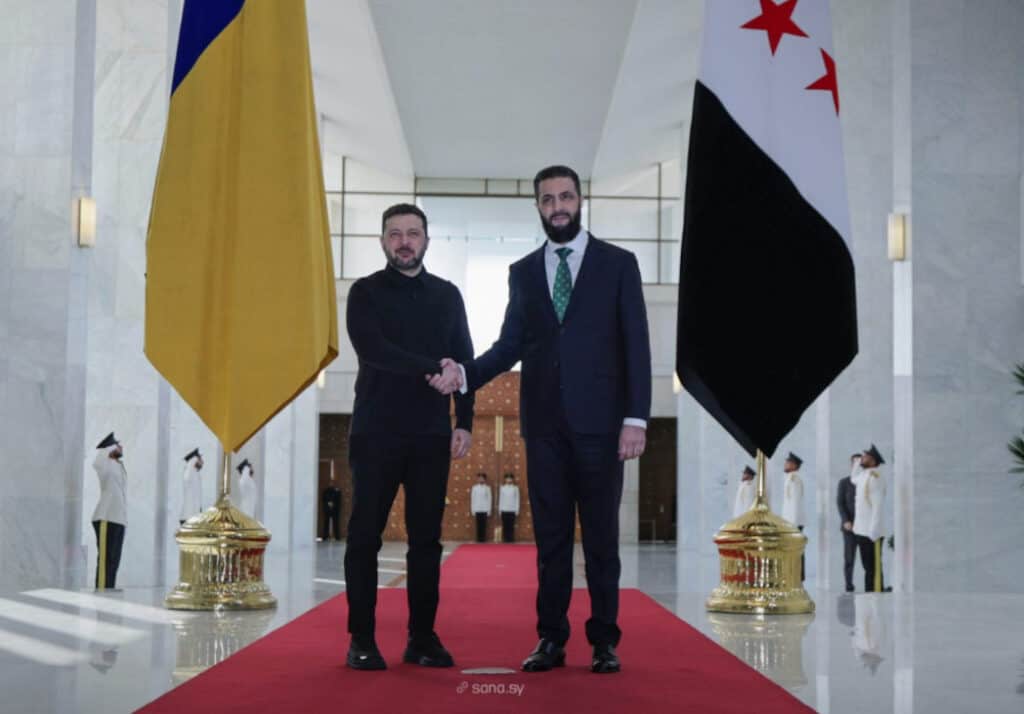
On April 9, Syrian Minister of Foreign Affairs and Expatriates Asaad Hassan al Shaibani traveled to Turkey, where he met with Turkish Foreign Minister Hakan Fidan. It was Damascus’s second meeting with Fidan in a week, after a trip by the Turkish foreign minister to Syria on April 5. The diplomatic activity, along with Damascus hosting Ukrainian President Volodymyr Zelenskyy and other delegations, illustrates Syria’s focus on diplomacy while most of the Middle East has been consumed by the conflict with Iran. Syria has remained mostly unscathed by the war, unlike its neighbors, Iraq, Israel, Jordan, and Lebanon.
Syria’s government continues to navigate a complex transition that began with the fall of Bashar al Assad’s regime in December 2024. Over the last year and a half, Syria has appointed a new transitional government under Ahmed al Sharaa and rebuilt ties with many countries. At home, the government has struggled with clashes with the Druze minority in the south and the challenge of integrating the Kurdish-led Syrian Democratic Forces in eastern Syria into Damascus’s new security forces.
Syria remained largely at peace throughout the war that began with US and Israeli strikes on Iran on February 28. However, the country faced some attacks and tensions stemming from the conflict. In one incident on March 23, rockets were fired from Iraq into Syria. The attack was likely carried out by an Iranian-backed militia in Iraq, one of hundreds of similar rocket and drone attacks in Iraq.
On April 4, dozens of people in Damascus rioted at the embassy of the United Arab Emirates, with some attempting “to storm the building.” Reuters reported that the protesters accused the diplomatic post of being a “Zionist embassy,” an apparent allusion to the UAE’s ties with Israel. The demonstrators were reportedly angered by a new death penalty law passed in Israel, though it wasn’t clear why they had singled out the UAE Embassy; other countries that have ties with Israel also have embassies in Damascus. Syria condemned the embassy incident.
In the wake of the protest, Syria’s president spoke to UAE President Sheikh Mohamed bin Zayed al Nahyan about bilateral cooperation, and Syria condemned Iran’s attacks on Arab countries in the region. The UAE has been one of the main Gulf countries targeted by Iran, suffering the most drone and missile attacks.
On April 5, Ukrainian President Volodymyr Zelenskyy arrived in Damascus along with Turkey’s foreign minister to hold trilateral meetings. The trip came in the wake of Zelenskyy’s visits to Saudi Arabia and other Gulf states, in which he shared Ukraine’s experience dealing with drone threats.
“We managed to cover everything: from security and defense issues and the situation in the region caused by developments around Iran, to energy and infrastructure cooperation between our countries,” Zelenskyy wrote on X about his trip to Syria. The Iran and Ukraine conflicts are linked by the fact that Russia has acquired Iranian drones, reportedly provided Iran drones in return, and backed the Assad regime in its fight with rebels.
The Ukrainian visit, which took place alongside the Turkish foreign minister’s visit, provided a chance for Syria to continue to deepen ties with Ankara. In his April 9 visit to Turkey, Syria’s foreign minister discussed a new “era of strategic partnership” with his Turkish counterpart. Among the topics discussed was a “Four Seas Project,” which Syria’s state media said could “position Syria and Türkiye as a key corridor for redistributing energy between the Arabian Gulf, the Caspian Sea, the Mediterranean, and the Black Sea.” Syria’s foreign minister also met with US Ambassador to Turkey and Special Envoy to Syria Tom Barrack during the visit to Turkey.
Syrian officials have been engaged in a flurry of other activity. Syrian Chief of the General Staff Major General Ali al Nassan held a call with his Turkish counterpart, Selcuk Bayraktaroglu, in April. He also spoke with his French counterpart, First Marshal Fabian Mandon. No specific details beyond general descriptions of the calls were published. In addition, on April 8, Syrian Minister of Emergency and Disaster Management Raed al Saleh traveled to Saudi Arabia.
There has also been a regional focus on Syria as an energy corridor amid the conflict with Iran. With the Strait of Hormuz closed, Iraq has been exporting fuel oil via Syria’s Baniyas refinery.
“Iraq’s state‑owned oil marketer SOMO has finalized contracts to supply about 650,000 metric tons of fuel oil per month from April to June to be trucked overland via Syria, according to a SOMO document seen by Reuters and Iraqi energy officials,” Reuters noted on March 31. Al Hurra reported on April 8 that a third shipment of Iraqi oil reached Baniyas after being trucked via Al Tanf on the Syria-Iraq border, the site of a former US military base in Syria.
Reporting from Israel, Seth J. Frantzman is an adjunct fellow at FDD and a contributor to FDD’s Long War Journal. He is the senior Middle East correspondent and analyst at The Jerusalem Post, and author of The October 7 War: Israel's Battle for Security in Gaza (2024).


