The MYRP Program Transforms Ukrainian Schools Into a ‘Place of Power’ for Students and Teachers
The Multi-Year Resilience Programme in Ukraine has become not only an important element of support for the educational sphere but also a platform for integrating leading global practices.
Kyiv Post
75
11 دقيقة قراءة
0 مشاهدة
The full-scale war has radically reshaped Ukrainian education, forcing millions of children to relocate within Ukraine and abroad, adapting to new realities.
Over the past four years, Ukraine’s education system has undergone significant transformation, and the learning losses are now so extensive that they are difficult to measure – even as they remain one of the country’s most pressing challenges for the future.
Addressing educational losses is a national priority. This is the main goal of the MYRP (Multi-Year Resilience Programme), funded by the global fund Education Cannot Wait (ECW) and implemented with the Ministry of Education and Science of Ukraine, alongside international and national NGOs.
Kyiv Post has been covering the Programme, which has evolved into more than just a tool to mitigate the war’s impact on education. MYRP has become a platform for blended learning, digital tools, tutoring, and inclusive practices – achievements made possible through the joint efforts of the state, international partners, and civil society.
Previously, coverage focused on the “hard component” of MYRP – ensuring safe learning environments, including shelters in schools, kindergartens, and vocational institutions. Now, attention turns to the “soft component,” implemented by local and international NGO consortia.
The local consortium, led by the Kyiv School of Economics (KSE), brought together the charitable foundation “savED,” the Osvitoria Public Union, the NGO Teach for Ukraine, the Projector Foundation, and EdCamp Ukraine. The international consortium, led by the Finnish NGO Finn Church Aid (FCA), works in partnership with the NGOs DOCCU, MriyDiy, and GoGlobal.
Ukraine and Russia have carried out another large prisoner exchange – 500 for 500 – among the largest in the past year.
MYRP accelerates tutoring, mentorship, blended learning, and digital solutions
The war and extended school interruptions have created a pressing need for additional academic support. Tutoring and mentorship provide this support: tutoring helps students catch up on missed subjects, while mentorship offers long-term guidance, supporting both academic and personal growth.
In frontline regions, MYRP partner Teach for Ukraine implements programs such as Educational Soup (for grades 5-11) and Impulse, designed to boost learning outcomes and motivation.
The Impulse program represents a new approach within MYRP, focusing on sustainable support for teenagers’ mental health through peer-to-peer activities. Teenagers gain skills in emotional support, self-regulation, and mutual aid, while also learning to lead similar sessions for their peers.
Additionally, Teach for Ukraine is developing teacher competencies through a dedicated training program for young educators.
Results of the special training program for young teachers. Kyiv Post Infographic.
Ksenia Kalyna, project manager at Teach for Ukraine, explains that the organization adapted international standards of competency-based mentoring in its StudMentor program, drawing on initiatives like the National Success Mentors Initiative (US) and Rock Your Life! (Germany).
“Global experience has shown us an uncomfortable truth: in crisis conditions, a child often ‘drops out’ of learning not because of the difficulty of the subject, but because of a lost sense of safety and meaning. Therefore, for us, a mentor is not a ‘tutor for an hour,’ but a stable adult nearby,” she said.
A practical example illustrates this: a student mentor noticed a child playing an online game during a lesson. Instead of reprimanding him, the mentor created a lesson in the style of that game. For the first time in weeks, the child fully engaged and focused throughout the session.
“Formally, this could be perceived as disinterest or a breach of discipline,” Kalyna said. “But the mentor reached a different conclusion: the student is trying to keep his attention where it is understandable and safe. For the next session, he prepared a lesson in the style of that game. As a result, for the first time in a long while, the child was fully engaged in the process and was able to work with focus for the entire lesson.”
MYRP also integrates blended learning – combining classroom and digital learning. Oleksandra Chubrey from the Projector Foundation emphasizes that international experiences from Sweden, Austria, Finland, and Estonia informed their approach: modular design, practice-oriented content, and a “ready-to-use” principle. For them, blended learning is not just digitalization – it’s a tool for resilience, continuity, and accessibility in war conditions.
“We integrated modular program design and practice-oriented content based on the ‘ready-to-use’ principle,” Chubrey said. “This is an approach common in international programs for countries in crisis, where a teacher can immediately apply the proposed content in their activities. For us, blended learning is a tool of resilience, not just digitalization. The main thing for us is not the mechanical borrowing of solutions, but their adaptation to the reality of Ukrainian vocational education institutions in war conditions, so that blended learning becomes a tool for continuity, accessibility, and quality of education.”
Their initiatives include online courses in Soft Skills, Entrepreneurship, and Crisis Management on the national platform Vocational Education Online, combining video lectures, webinars, interactive tasks, and consulting support. Teacher and management team training is a key element of this approach.
Digitalization within MYRP has become a key driver in transforming teaching approaches in Ukraine. Thanks to these efforts, blended learning – combining online and in-person instruction – has become widely accessible even in challenging Ukrainian conditions. Virtual classrooms and learning platforms such as Google Classroom, Moodle, and Canvas are now familiar tools for most students and teachers.
In this context, the Digital Learning Centers (DLCs) developed by the savED charitable foundation are particularly noteworthy. These centers build on experiences from regions with limited access to schools. Anna Putsova, co-founder of the foundation, emphasizes the importance of physical spaces: “In Ukraine, having children present in safe, offline locations is critical. We create educational spaces called Hives (Vulyky) – centers for children in communities heavily affected by the war. They provide not only academic education but also meaningful, engaging leisure activities. For us, physical space represents comfort and safety, which we enrich with educational opportunities and personal development.”
Inside one of the Hives. Photo: savED foundation
According to research by the savED foundation, more than 50,000 children have already passed through 150 Hives opened (25 of them within MYRP) in 10 regions (Kyiv, Chernihiv, Zhytomyr, Kharkiv, Sumy, Mykolaiv, Kherson, Poltava, Dnipropetrovsk, and Vinnytsia). Every month, these centers can accommodate over 15,000 children. Currently, the majority of Hives (93%) function based on general secondary education institutions; some of them operate in libraries, youth centers, and cultural centers.
Another striking example of an original digital solution is the EdWay platform, created by “EdCamp Ukraine” and transferred to the state free of charge, which has become a tool for forming individual professional development trajectories for teachers.
Inclusion, non-discrimination, mental health, and psychosocial support
Inclusive practices ensure equal access for all children, and MYRP partners draw heavily on international experience. The SEE Learning program (Social, Emotional, and Ethical Learning) has helped create safe, inclusive environments, fostering socio-emotional skills such as attention, empathy, mindfulness, and systems thinking. Implemented in 144 countries, including Ukraine, it reaches 6 millions students and 250,000 educators.
Daria Dolimbaieva, head of the communications unit at the EdCamp Ukraine, notes: “The SEE Learning program gave Ukrainian education not only a scientifically verified model but also a ‘language’ for discussing dignity and mutual respect.”
She also said that at the time the full-scale war began, institutions that became part of the all-Ukrainian experiment had been implementing the program for over two years. And although the SEE Learning program was not created for war realities, the socio-emotional skills formed during this time by students and teachers proved to be anindispensable support for them.
Overall, the implementation of the SEE Learning program in Ukrainian realities is also about the constant adaptation and Ukrainization of content, and permanent work on improving teaching methodology. Various partners continuously conduct work in this context within their respective areas.
Results of the SEE Learning experiment in Ukraine according to the "EdCamp Ukraine" Report. Kyiv Post Infographic.
“In war conditions, the most effective components of the program were those aimed at stabilizing the children’s state and developing psychological resilience. The most helpful parts for students were: ‘Resilience Zone,’ ‘Nurturing Resilience,’ ‘Attention and Self-Awareness,’ ‘Self-Compassion,’ ‘Compassion for Others,’ ‘Self-Regulation,’ and ‘Exploring Emotions,’” the EdCamp Ukraine representative told us.
She also spoke about another important direction for implementing inclusive practices that her organization is focused on: gender equality and non-discrimination (“EdCamp Ukraine” is the Gender Lead Organization (GLO) in the consortium). Currently, they are training 38 special advisors within the consortium, ensuring compliance with international standards at the operational level.
Daria Dolimbaieva added that, among other things, EdCamp Ukraine developed and is testing a comprehensive program within the consortium aimed at providing training for advisors on a non-discriminatory approach in education.
“Thanks to the constant cooperation of the expert circle and partner teams, each NGO in the MYRP consortium underwent a kind of audit of policies and activities for compliance with a non-discriminatory approach in education. Now they are developing their own gender policies, adapting their activities to include gender-sensitive and inclusive approaches,” added Daria Dolimbaieva.
It is worth noting that other tools also contribute to the acceleration of inclusive approach adaptation in schools, such as counseling for students by teachers of mathematics, Ukrainian, and English organized through the POVIR platform developed by EdCamp Ukraine.
Overcoming educational losses
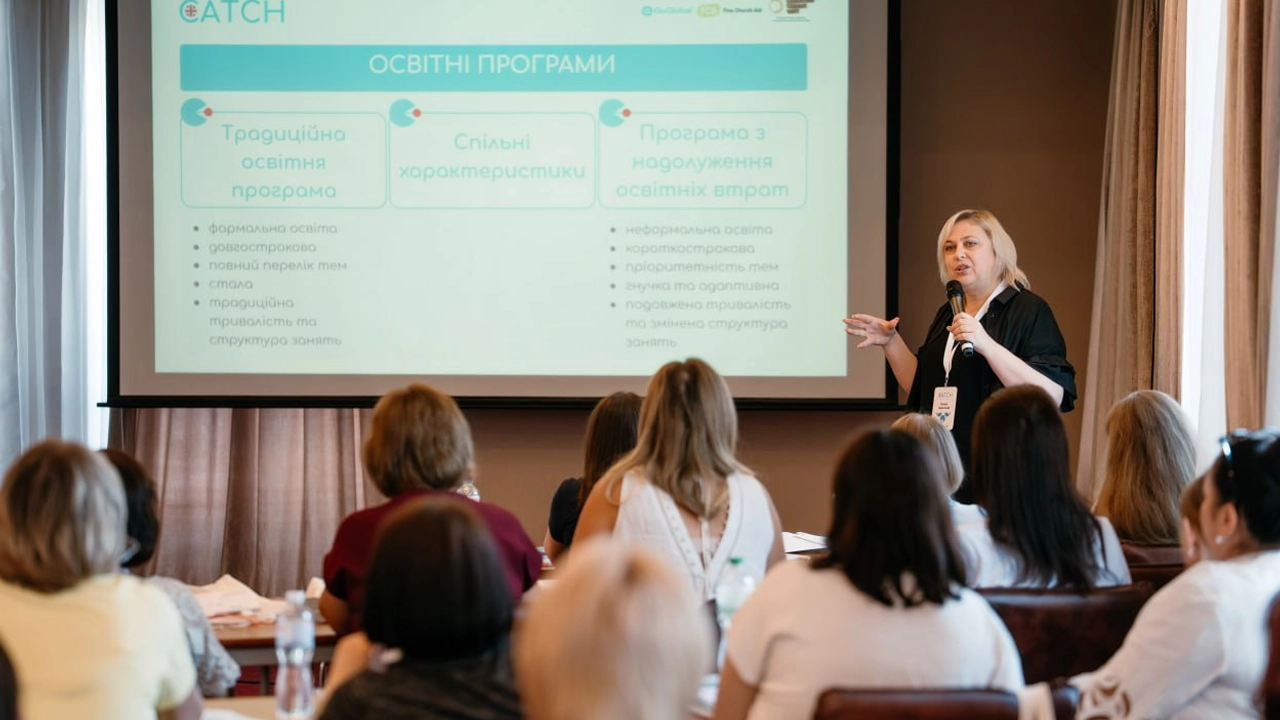
Another striking example of applying best international practices in Ukraine is catch-up activities. These are sessions aimed at quickly filling educational gaps in schoolchildren that arose due to interruptions in learning (war, pandemic). They are conducted in small groups or individually, have an interactive format (games, art therapy, speaking clubs), and focus on key subjects such as Ukrainian language, mathematics, and English.
As the results of the MYRP program show, the implementation of Catch-up education models in Ukraine is quite successful.
At one of the Catch program trainings. Photo: NGO GoGlobal
Uliana Sobolevska, a representative of the MriyDiy organization, says that her organization focuses on overcoming educational losses in primary school. Specifically, it concerns 3rd-grade students who, due to the war, did not master basic knowledge from grades 1-2 in Ukrainian language and mathematics. The foundation also implements a mentoring model for teacher support – meaning not one-time trainings, but long-term support and reflection.
Two waves of “MriyDiy” activity within MYRP covered a significant number of students and educators (see infographic).
Results of the NGO "MriyDiy" program's work on catching up with educational losses within MYRP, starting from 2024. Kyiv Post Infographic.
It should be added that other Program partners joined the implementation of Catch-up education models in Ukrainian realities. Thus, within the Catch program for primary schools, NGO GoGlobal, for example, developed a comprehensive program for catching up on educational losses for students in grades 2-4, aimed at restoring basic skills in Ukrainian, English, and mathematics.
The mentoring programs of NGO “Teach for Ukraine,” which we mentioned above, are also built on the principles of Catch-up education. As Ksenia Kalyna told us, according to this approach, sessions accompanied by mentors and tutors are built in the format of learning cycles – so-called “waves” lasting from three to 12 weeks.
Career orientation is in the focus of MYRP
Along with overcoming educational losses, another important area of MYRP partners’ activity is career orientation. This primarily concerns increasing teachers’ professional competence and helping schoolchildren with career choices.
For instance, GoGlobal conducted four waves of offline and 8 waves of online trainings, which covered 560 primary school English teachers.
In addition, over the past year, GoGlobal actively implemented the Career GPS program (for teenagers and educators), which became one of the organization’s main areas of work. In August of last year, offline camps for 8th-9th grade students were held in communities, in which 243 teenagers participated.
A significant addition to the organization’s project portfolio was the PROSkills educational product for vocational education institutions.
“PROSkills is the first set of English language teaching materials for vocational and technical education in Ukraine,” the organization said. (More details in the infographic below).
Coverage of teachers and students by GoGlobal programs within MYRP. Kyiv Post Infographic.
MYRP opened a window of opportunity for the Ukrainian school
The collaboration of the state, international partners, and civil society shows that crises can create new opportunities. MYRP has accelerated the integration of global practices into Ukrainian education, transforming schools into centers of psychological resilience – a true “place of power” where every student and teacher can find support.