2 hours ago
Ben HattonBBC News
Russian incursions into UK defences risk crossing a line, Chief of the Defence Staff Sir Richard Knighton tells the BBC.

2 hours ago
Ben HattonBBC News

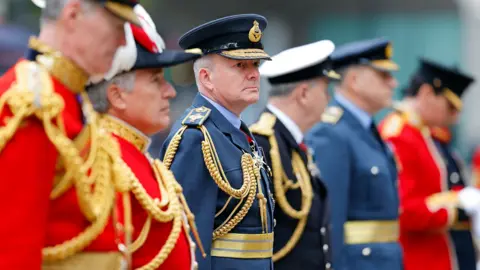 Max Mumby / Indigo / Getty Images
The risks and threats to the UK are greater now than at any time since the Cold War, the head of the military has said.
"This is the most dangerous period that I have known," Chief of the Defence Staff Sir Richard Knighton told BBC Radio 4's Today programme.
There have been as many incursions by Russian strategic aircraft into UK airspace in the first five months of this year as in the whole of 2025, he said, warning Russia risks "crossing a line".
He said last year's Strategic Defence Review was a "call to arms", and while in recent decades the armed forces have focused on preparing for short, contained conflicts, the UK needs to be ready for longer wars like the one in Ukraine.
His remarks come ahead of the expected publication of the Defence Investment Plan in the next few weeks, following repeated delays.
The document, which will set out how new equipment and defence infrastructure will be funded over the coming decade, was first due to be released in autumn 2025.
Defence Secretary John Healey said earlier this week that the prime minister is "determined to publish" it before a Nato summit on 7 July.
"Exactly as the prime minister says, we need to spend more on defence and do it faster. The challenge for ministers is to make those difficult trade-off decisions," he said.
Sir Richard also spoke about the changing nature of warfare and the need to adapt.
Drones and autonomous systems are going to become "increasingly important in the future of warfare", he said.
On the threats posed to the UK, he said: "I'm very clear that this is the most dangerous time I have known in my working life.
"And the risks and threats to this country are greater than I have known since the Cold War.
"And it is important that society and all of us recognise and understand that and that may mean that we need to make different choices and different priorities."
Russia is probing both the UK's "traditional military defences" and also through other means, such as cyber, sabotage and assassination attempts, he said.
"So Russia is definitely raising the stakes and risks crossing a line," he said.
In a hard-hitting speech in April, Lord Robertson warned that the UK's security is "in peril" and Sir Keir Starmer's government has shown "corrosive complacency" towards defence.
In a directly political intervention, Lord Robertson - who is now a key government adviser - warned in his speech: "We cannot defend Britain with an ever-expanding welfare budget."
He said: "We are under-prepared. We are under-insured. We are under attack. We are not safe... Britain's national security and safety is in peril."
He added: "There is a corrosive complacency today in Britain's political leadership."
At the time, Downing Street said: "We've set out our spending targets on defence, the UK defence budget is already rising to record levels and we're going further."

Former Ukrainian Foreign Minister Dmytro Kuleba said Zelensky’s open letter to Putin was aimed not only at the Kremlin leader, but also at Ukrainians, US President Donald Trump and European allies. According to Kuleba, the letter’s central message was Ukraine’s confidence in victory and its willingn

The US House of Representatives approved the Ukraine Support Act by a vote of 226-195. The vote represents the first major Ukraine legislation to advance over White House resistance since Trump’s return to power in January 2025 and one of the most important congressional challenges to his foreign po
A tanker and two cargo ships in Taganrog Bay in the Sea of Azov, Russia's Krasnodar Krai, came under a drone attack on the morning of 5 June.

Ukraine's president tells the Russian leader that only "direct engagement" between the two countries could end the war, with the US focused on Iran.