
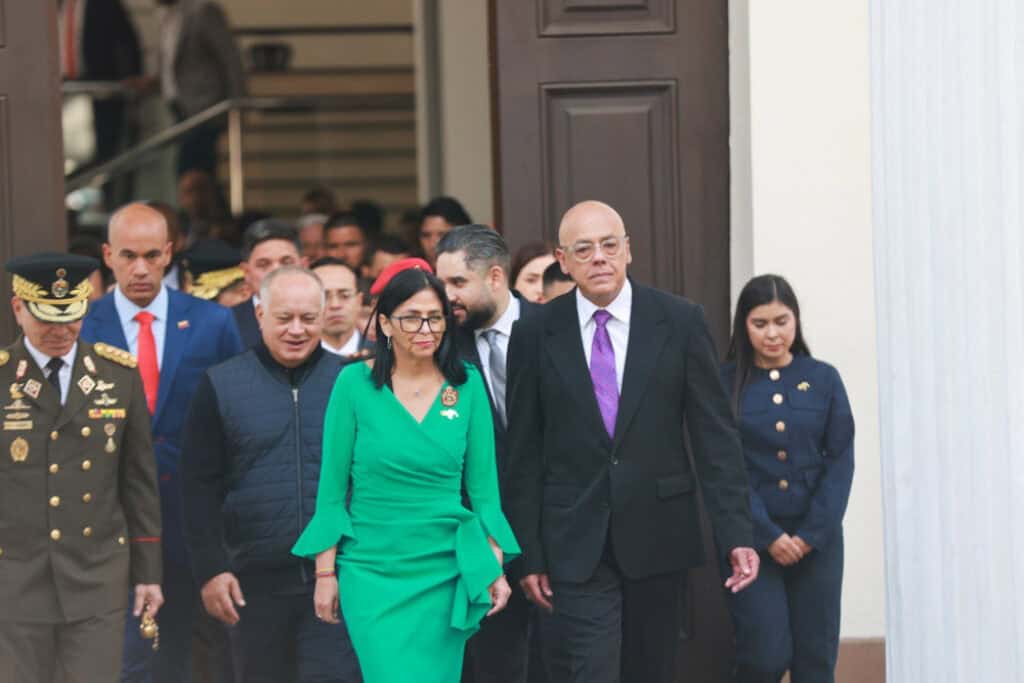
Venezuelan interim President Delcy Rodríguez declared on April 24 that the Amnesty Law for Democratic Coexistence was “coming to an end,” despite the Caracas-based human rights NGO Foro Penal reporting that 473 Venezuelans are still classified as political prisoners. While other recent developments in line with US efforts have included the further opening of Venezuela’s economy and a new US Southern Command (SOUTHCOM) unit, Rodríguez’s hesitancy to release political prisoners threatens some of Washington’s gains in Caracas.
Foro Penal’s vice president, attorney Gonzalo Himiob, claimed on April 5 that releases of political prisoners under the recent amnesty law had declined precipitously for two weeks.
“If the more than 500 political prisoners still detained, including 187 military personnel, are not fully released, it would seem evident that the interim Government lacks the true political will to put an end to imprisonment and political persecution,” Himiob has warned on March 5. The group’s April 10 census recorded 485 political prisoners; by April 20, the figure stood at 473.
Venezuela’s Attorney General’s Office on April 16 requested “alternative measures” for 51 detainees that would grant conditional release under unspecified conditions, a request that courts approved that same day. Government figures cited by Venezuelan officials assert that more than 8,000 people have benefited from the amnesty — a figure that largely comprises individuals previously subject to “presentation restrictions” rather than full incarceration and is difficult to verify independently.
The Rodríguez government has nevertheless pressed forward with an economic opening designed to attract US and European investment. On April 9, the National Assembly unanimously approved a new Organic Mining Law that opened Venezuela’s mining sector to privatization and foreign investment. National Assembly President Jorge Rodríguez, the acting president’s brother, called it a “vehicle for future prosperity.” On April 16, Spain’s Repsol announced an agreement with Petróleos de Venezuela, S.A. (PDVSA), the country’s state-owned oil and gas company, to regain operational control of its Petroquiriquire S.A. joint venture, which produces roughly 45,000 barrels per day, with plans to triple production within three years. US oilfield services giant Halliburton is also currently negotiating commercial terms to resume operations in Venezuela.
Venezuela’s cabinet and other top bodies have continued to churn members. On April 17, Rodríguez appointed Dr. Carlos Alvarado, who served as former Venezuelan dictator Nicolas Maduro’s health minister from 2018 to 2022, to head the Ministry of Popular Power for Health. Rodríguez also reassigned General Vladimir Padrino López, ousted from the Defense Ministry on March 18, to lead the Ministry of People’s Power for Agricultural Production and Land. In addition, the local news outlet La Patilla reported that Caracas’s Federal Legislative Palace was “preparing a purge of magistrates in the Supreme Tribunal” (TSJ), Venezuela’s highest court, with the National Assembly’s renewal commission reportedly considering changes to more than half of the court’s composition.
Interior Minister Diosdado Cabello, identified by US officials as the principal obstacle to a genuine democratic opening in Venezuela, remains entrenched. On April 21, Cabello told supporters during a tour of Trujillo state that sanctions relief would contribute to the country’s prosperity.
Opposition leader María Corina Machado, who remains in exile, said she “absolutely” expects to return to Venezuela before the end of 2026 and sees no contradiction with US President Donald Trump’s preference for a delay. “What I heard was President Trump praising how she follows his instructions,” Machado said of Rodríguez. “[Venezuela’s current leaders] have never been as weak as they are right now … They are starting to realize that things have changed, and this is a totally different moment.”
Brian Naranjo, a former US State Department official, confirmed that Rodríguez was running “a de facto presidential campaign” without rivals, while Venezuelan economist Asdrúbal Oliveros projected 12 percent GDP growth for his country in 2026, driven by sanctions relief and elevated oil prices linked to the US-Iran conflict. No date has been set for presidential elections, and the National Electoral Council (CNE) has not been reformed.
Meanwhile, Washington has expanded the US’s military infrastructure in the region. On April 22, General Francis Donovan, commander of SOUTHCOM, announced the establishment of the SOUTHCOM Autonomous Warfare Command (SAWC), a Miami-based unit charged with deploying drones, artificial intelligence, and unmanned platforms across the Caribbean and Latin America.
Samuel Ben-Ur is a research analyst at the Foundation for Defense of Democracies.
Tags: US-Venezuela, venezuela


