On the afternoon of March 1, a ballistic missile from Iran with a half-ton payload evaded Israeli air defenses and directly hit a densely populated Ramat Beit Shemesh neighborhood.
Directly impacting a synagogue and its bomb shelter, it remains, as of the time of writing, the single deadliest attack by Iran since the start of the current war, with nine killed and more than 20 wounded.
With widespread destruction near the site, within hours, hundreds of residents had been evacuated. In the days that followed, more than 1,000 displaced people from the neighborhood were relocated to several hotels across Jerusalem, where they now attempt to piece together fragments of routine amid trauma.
One evacuee recounted her experience for In Jerusalem.
“The missile fell on our neighborhood, at the synagogue about 100 meters away. We were in the mamad – nine souls,” she recalled. The explosion was massive, and in that instant it felt as if time itself had stopped. “We heard cracks in the walls, like the house was collapsing on top of us. The door flew open, and the shockwave briefly threw us off our feet.”

When the shaking subsided, they rushed out of the reinforced room. “The whole house was filled with glass shards. Items had fallen from their places everywhere. There was a heavy smell of smoke, and we realized it was coming from the direction of the synagogue.”
Still in shock, she began searching for her family. “I went to make sure I was with my husband and children. On the way, I saw my neighbors’ children who had suffered injuries of different kinds.”
At some point, she lost consciousness and woke up in the hospital. Weeks later, the physical effects of the blast remain. “It is difficult for me to sleep. I have trouble balancing when I try to go up and down stairs, or even when I walk. There is a ringing in my ears that comes and goes.”
The emotional toll is just as heavy. “I don’t know where to place my mental strength. On my children? Or on everything we lost?”
Soon after her discharge from the hospital, the magnitude of the tragedy became clear. “When I returned, I realized that family members and a neighbor had been killed,” she said quietly. “It is very hard for me.”
However, unlike many cases after the Oct. 7 attacks, the response was near immediate and overwhelming. There was a government response, and medical departments alongside government ministries converged in designated hotels to process and assist the evacuees.

Homes destroyed, families relocated
For Harel, a married father of three, the decision to spend the night at his parents’ home may have saved his family from physical calamity. Their residence lacked a reinforced safe room, so they had chosen to stay elsewhere that night.
When the family later returned to check the apartment, the scale of the destruction quickly became clear. “When we came back home, it was full of debris,” he said. “The entrance of the home collapsed.”
Within hours, authorities had begun organizing emergency housing for families whose homes were no longer habitable.
“They sent us to a hotel,” Harel said.
In the days since, municipal workers, social services, and government agencies have helped provide clothing, basic supplies, and ongoing assistance.
“Beit Shemesh sent us everything we need,” he said. “We have all the relevant authorities helping us. This helps us with the process of rehabilitation.”
Yulta, also evacuated due to structural damage to her home, is grateful for the assistance from the hotel staff and emergency coordinators working to maintain a sense of stability for displaced families.
“It was great to be here. They are giving us good service,” she said.
Still, the temporary nature of hotel life weighs heavily, especially for families with young children.
“We are hoping to go home soon,” Yulta said. “They say they are going to repair the damage, so hopefully they will allow that soon.”
Tispa, another evacuee, now in his second hotel, is balancing taking care of children while helping take care of his wife, who was injured at the moment of the explosion.
“My wife fell on the way to the miklat,” he said. “I was with the children. When the explosion happened, she fell backwards and needed treatment.
“Maccabi services have been taking care of her,” he said.
Life in the hotel with children, however, has its own stresses.
“It’s a bit of tension here with the children,” he admitted. “But the staff have been treating us well.”
The social workers who met them
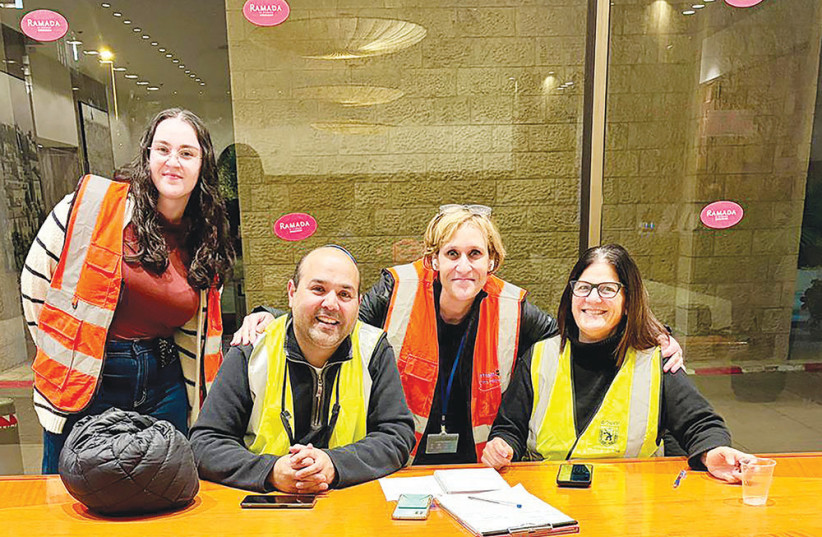
When evacuees first began arriving in Jerusalem, social workers were waiting.
Chen Derech Tirosh, a social worker who is part of the Welfare Ministry’s Miluim Chevrati program, translated as the “communal reserves,” was on the scene in Jerusalem hotels. Her program is a unique program for non-essential workers. “There are about a hundred like me in addition to 500 office workers,” she explained. “Some of the social workers are pensioners, others are independent professionals. Some are Welfare Ministry workers who can be enlisted to assist with war events.
“I got to the hotel on Sunday after the direct hit on Beit Shemesh,” she said. “With me arrived staff to two other hotels.”
The evacuees came in waves of dribs and drabs, the ones who were not severely wounded,” she recalled. Some came with almost nothing coming “as is,” some literally with only the clothes on their back, their homes structurally unlivable.
The first step was basic documentation and needs assessment.
“We processed them, recorded who they are and their circumstances, and assessed what sort of help they need.”
The work continued deep into the night.
“We were there until 2:30 a.m. because some arrived at night time.”
The following morning, the same teams returned early.
“The evacuees needed to see the same staff,” Derech Tirosh said. “We needed to map them to know who we have and what they need: clothes, essentials, and who needs emotional help.”
The processing was a full-time job, but also necessary due to the immediate trauma at hand. “I processed a family that came on Purim eve,” she recalled. “They came from the shiva and directly to us.” Another family arrived directly from the hospital. “The father was killed. The mother and child were wounded, and they needed immediate help.”
As time progressed, additional government agencies gradually joined the effort. The Welfare Ministry arrived first, followed by the Education Ministry, which worked on establishing a routine for children. The next delegation was from property tax authorities, municipal representatives, and medical teams established desks inside hotel halls.
“Doctors and nurses were coming,” she said. “Medical personnel treating hearing loss. A dentist came as well.”
Services for elderly evacuees were organized. By the last week, some hotels began organizing a children’s daycare, but not at every hotel because some didn’t have young children.
The goal was to restore a sense of structure.
“While people were coming in, we needed to understand who we had and what they needed and assemble a frame and routine,” Derech Tirosh said. “We succeeded in getting to everyone. They know they can turn to us and they will receive care.”
Despite the trauma, there were moments of celebration. “Last Wednesday, there was a bat mitzvah for a girl named Liraz,” Derech Tirosh related. “She was supposed to have her bat mitzvah event but instead found herself in a hotel.” Her mother, Revital, wouldn’t fall into a sense of despair and sprang to action. With the help of Bnei Akiva volunteers and hotel staff members, a replacement bat mitzvah party was planned as a surprise for Liraz.
“It was very emotional,” Derech Tirosh said. “In all this chaos, they succeeded in creating such a memory.”
Treating the invisible wounds
For health professionals, the evacuees’ wounds extend beyond the visible.
Tal Livneh, clinical psychologist and mental health director at Meuhedet for the Jerusalem region, said the psychological impact varies dramatically, depending on personal circumstances.
“While we see many people managing, traumatic symptoms are prevalent. Clinically, we do not diagnose PTSD until at least one month has passed since the event. However, we are seeing acute stress reactions: involuntary somatic movements due to shock, severe sleep disturbances, and children suffering from intense separation anxiety. Many individuals are in a state of ‘flooding,’ compulsively recounting their experiences.”
However, she also sees strength and signs of resilience. “Many are functioning and pushing forward; parents, in particular, are working hard to re-establish routines and a sense of order for their children. This stability is crucial.”
Early Intervention is critical and is especially true for parents with young children.
“Parents face complex challenges, from navigating whether children should sleep in their beds to explaining the inexplicable. This is where the value of ‘psychological first aid’ becomes clear. If individuals receive the right intervention immediately, their capacity for a full recovery increases substantially. This is precisely why Meuhedet intervened so rapidly. Proactive and early assistance is the key to long-term mental health.”
The quick resolution extended to bureaucratic handling of the government response.
While noting that the scale of evacuees is smaller than previous calamities, Livneh saw the quick response as a major shift, especially in light of the slow, chaotic response following Oct. 7.
“Despite the magnitude of this catastrophe, we are far more organized than we were on Oct. 7. That day was defined by a profound sense of abandonment within the evacuated communities; many of them described a feeling that the state was absent and the protective shield had failed. It was a primary trauma of the highest order.
“Today, the experiences remain harrowing, but with a major difference: The state is present. Evacuations were handled efficiently, and healthcare providers, including Meuhedet, were on the ground immediately. This has immense therapeutic value. When a patient’s world has collapsed, seeing that the healthcare system is functioning normally helps restore his or her faith. It sends a message: ‘My world is in chaos, but the system is here, and I have someone to turn to.’ From educational services in the hotels to a nurse on duty checking vitals, these structures provide the ‘holding environment’ necessary for healing,” she explained.
Unlike the chaos of the past, the subsequent escalation with Iran has witnessed unprecedented cooperation in the care field. There is a concerted effort toward seamless coordination among all relevant authorities. “Meuhedet is committed to assisting the entire community, extending care even to those who are not our registered patients. In Beit Shemesh, where we serve a large patient base, we maintain a very close and productive connection with local authorities.”
Hearing the aftermath
Another unexpected medical consequence of the blast has been hearing damage.
Hanin Karah, director of audiology for Meuhedet’s Jerusalem and Beit Shemesh region, said the problem emerged almost immediately. “At first we thought the symptoms were anxiety,” she said.
Evacuees reported dizziness, ringing in the ears, and distorted hearing. However, subsequent testing revealed a much more severe underlying problem, which at times required immediate hospitalization.
Forty-one evacuees were examined, 15 of whom were transferred immediately to emergency care. Some patients had been hundreds of meters away from the blast.
“The immediate treatment was important because we only have a limited time to treat damage as a result of an explosion; therefore, they were transferred immediately to the ER”, Karah told In Jerusalem.
The effects include loss of balance and ringing in the ears, which are sometimes overlooked and can be symptoms of underlying ear damage that must be treated as soon as possible.
Karah ended with an alert to any member of the public that is affected by a nearby explosion.
“It is important for the public to be vigilant about the effect on hearing as a result of an explosion. The following symptoms should immediately be checked: ear pain, ringing in the ears, ear pressure, inability to balance oneself, and a sensation of a loss of hearing.”
A hotel becomes a refuge
At Jerusalem’s Prima Park Hotel, manager Haim Malkubi said his staff have turned the building into a temporary refuge for displaced families.
“We have already a lot of experience with evacuees,” he said, referring to the hotel’s role hosting residents from the northern town of Shlomi after Oct. 7.
This time, however, the circumstances are different.
“The evacuees from Oct. 7 came because of war,” he said. “These evacuees came because they no longer have homes.”
About 150 Beit Shemesh residents are currently staying at the hotel. Despite government guidelines allowing reduced service levels for evacuees, the hotel chose another approach.
“Our decision is to give them full hotel service. Rooms are cleaned regularly, laundry services are provided, and meals are served throughout the day,” he said. “We give them a proper Israeli breakfast, lunch, and supper,” he said. “Room service 24/7.”
Beyond hospitality, the hotel lobby has been transformed into a central service hub.
“The hotel hall has become an exhibition of all the relevant government authorities,” he stated. “Medical providers, welfare representatives, and municipal officials now operate desks there, providing 24-hour support.”
However, unlike after Oct. 7, when evacuees were left in hotels for two years, Malkubi sees a change. Keeping evacuees in hotels is expensive, and the government is much more organized this time.
“Even though they [the evacuees] are in a hotel and receive a hotel experience, they are not here on vacation,” he said. “Their lives have been turned upside down. “We are hoping that in the next week or two, a solution will be found.”


