
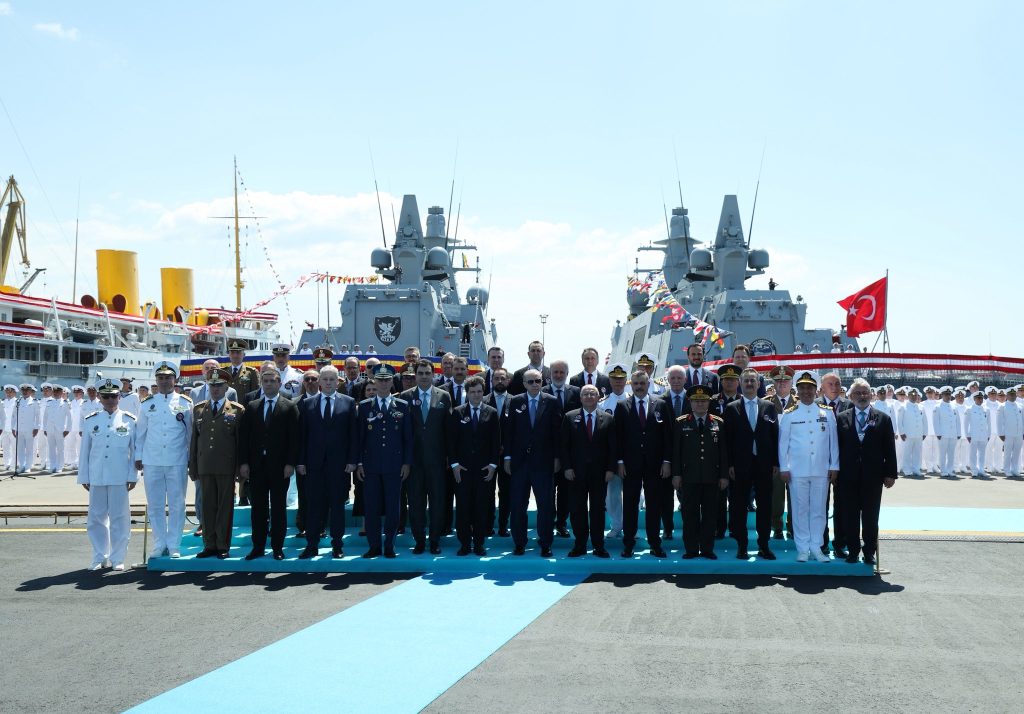
Turkish defense company ASFAT and Istanbul Naval Shipyard Command marked a significant milestone for both the Turkish and Romanian navies on 20 June with the simultaneous delivery of two sister warships: TCG Koçhisar (P-1221), the first Hisar-class Offshore Patrol Vessel (OPV) for the Turkish Navy, and CAm. Roman, a corvette delivered to the Romanian Naval Forces.
The ceremony, held at Istanbul Naval Shipyard Command, was attended by Turkish President Recep Tayyip Erdoğan and Romanian President Nicușor Dan, underscoring the strategic significance of the event for both countries and for Black Sea security.
The delivery of TCG Koçhisar represents a major step in the Turkish Navy’s force modernization program. As the lead ship of the Hisar-class OPV program, Koçhisar has been designed to perform a broad range of missions including maritime surveillance, intelligence gathering, exclusive economic zone protection, maritime security operations, search and rescue missions, and support for humanitarian assistance operations. The class is intended to provide a flexible and cost-effective platform capable of operating across a wide spectrum of peacetime and crisis-response missions.
At the same time, Romania formally received CAm. Roman, a corvette built by ASFAT at the same shipyard. The vessel is expected to strengthen Romania’s maritime capabilities in the Black Sea, where regional security concerns have intensified in recent years. According to Turkish officials, the ship is equipped for reconnaissance, surveillance, patrol, maritime security, and combat operations, offering the Romanian Navy a modern platform capable of supporting both national and NATO missions.
The Romanian delivery carries particular industrial and political significance. Turkish officials highlighted that the transfer of CAm. Roman constitutes the first export of a Turkish-built naval combatant vessel to a country that is both a NATO and European Union member. The achievement is widely viewed as an important milestone for Türkiye’s naval shipbuilding sector, which has expanded rapidly over the past decade through indigenous warship programs and increasing export success. Another export success to a EU country is STM‘s logistic support vessel export to Portugal.
Speaking during the ceremony, President Erdoğan emphasized the growing capabilities of the Turkish naval industry and its expanding role in international defense cooperation. He noted that Türkiye is currently building more than 50 naval platforms, including vessels intended for export customers, while continuing development of advanced indigenous programs ranging from offshore patrol vessels and frigates to destroyers, submarines, unmanned surface vessels, and the country’s future national aircraft carrier project.
The intergovernmental contract for Romania’s acquisition of the HISAR-class corvette from Türkiye took place on December 3 at the headquarters of the Romanian Ministry of National Defense for approximately €223 million. After signing, the outfitting of the ship, as well as trials, were conducted by ASFAT in Istanbul.
Beyond the technical achievements, the dual delivery reflects the growing strategic relationship between Turkey and Romania. Both countries are key NATO members on the Black Sea littoral and have expanded defense cooperation in recent years. Turkish and Romanian officials described the delivery of CAm. Roman as a tangible expression of that partnership and a contribution to regional maritime security.
Hisar-Class OPV Project
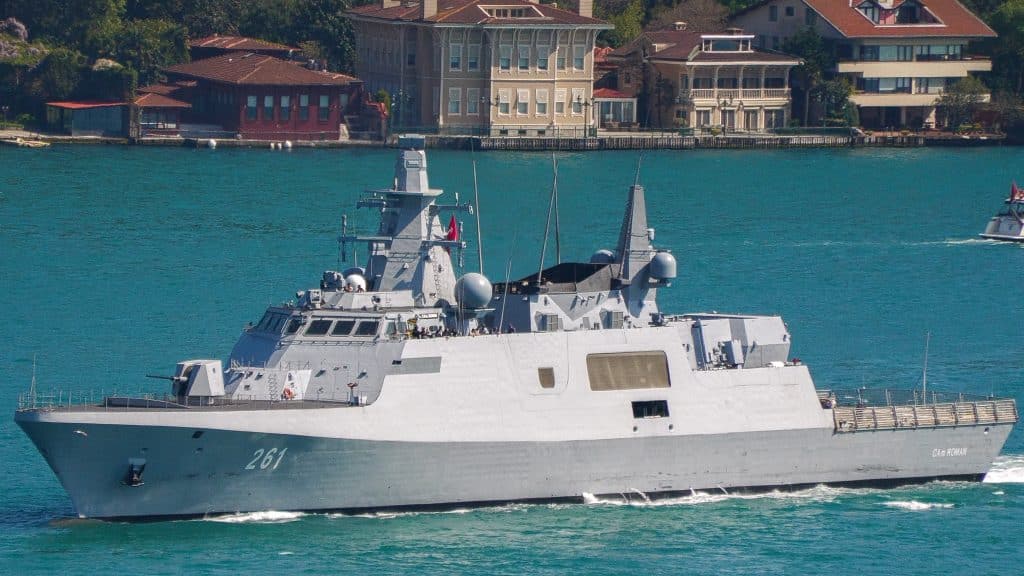
The Hisar-class offshore patrol vessel program represents an evolution of Türkiye’s broader MILGEM (National Ship) initiative, which began in the mid-1990s with the objective of developing indigenous naval platforms. The Hisar-class derives from the Ada-class corvette design but incorporates significant modifications to reduce construction time and costs while optimizing the platform for patrol and constabulary missions rather than high-intensity anti-submarine warfare.
The most substantial design change involves the propulsion system. While Ada-class corvettes employ a CODAG (Combined Diesel and Gas) arrangement with gas turbines for high-speed operations, the Hisar-class utilizes a CODELOD (Combined Diesel-Electric or Diesel) system. This configuration sacrifices several knots of maximum speed—24 knots versus the Ada-class’s 29 knots—but provides significantly improved fuel efficiency and extended range, increasing endurance by 50 percent compared to the earlier design.
The Hisar-class also adopts a “fitted for but not with” approach, allowing for modular installation of weapons and sensors as they become available or as operational requirements evolve. This design philosophy reduces initial acquisition costs and provides flexibility for future upgrades. The Turkish Navy has ordered ten Hisar-class vessels, with construction distributed among Istanbul Naval Shipyard and a consortium of private Turkish shipyards including Desan, Dearsan, and Özata.
Future vessels in the class are planned to receive enhanced armament, including vertical launch systems for HISAR-D missiles, though the first two ships lack this capability in their initial configuration.
Specifications: