
During last summer’s 12-day war between Iran, Israel, and the United States, the U.S. military supported Israeli air and missile defense operations by utilizing its regionally deployed air and missile defense assets to intercept Iranian missiles and drones. By the time the shooting had stopped, CNN reported that the United States had expended 100 to 150 upper-tier, terminal-phase missile interceptors against Iranian missiles. This means that, in 12 days of fighting, the United States expended approximately 25 percent of its total stockpile — or 150 percent of annual global production at current production rates (though production increases are anticipated). The situation goes from bad to worse in the Indo-Pacific where the United States is squaring off with an increasingly capable and assertive China. According to modelling from the Stimson Center, “the United States would likely run out of Patriot and [upper-tier, terminal-phase missile] interceptors within the first 24 hours of a military conflict.”
Sensing vulnerability, the United States and its regional allies and partners are ramping up procurement of air and missile defense assets, though progress is likely to be constrained by competing spending priorities and already overstretched defense industrial bases. These constraints underscore the need for complementary approaches that can deliver near-term gains without relying solely on expanded procurement. Networking missile sensors and interceptors across the United States and its Indo-Pacific allies and partners is one such approach. Coalition air and missile defense can generate operational efficiencies in sensing and interception that have the potential to shrink Chinese air and missile advantages. While compelling in theory, is it feasible in practice? Can the United States and its allies and partners navigate the challenging geography and politics of the Indo-Pacific to counter Chinese air and missile advantages through coordinated air and missile defense?
The Problem and a Better Way
Chinese air and missile advantages can be attributed to two factors. The first is Beijing’s unique ability to generate a mass of missiles and drones due to its enormous stockpiles and sprawling defense industrial base. The second, related advantage is its ability to generate mass at relatively low cost through its arsenal of high-volume, low-cost systems that operate alongside its exquisite platforms. If war happens, China’s deployment of massed, low-cost missiles and drones will impose upon targets unfavorable cost ratios as multiple interceptors with unit costs as high as tens of millions of U.S. dollars are expended on single targets that are 10 to 100 times cheaper and quicker to produce. The implication for the United States and its regional allies and partners is clear: Any one Indo-Pacific state acting in isolation will struggle to field the capability required to effectively defend against a massed Chinese air and missile strike.
Recognizing this, the United States and its Indo-Pacific allies and partners are increasingly looking to the force-multiplying effects of internationally coordinated air and missile defense. Such coordination can come in many forms. For example, coalition states might layer batteries of missile interceptors to provide additional magazine depth for absorbing a first strike. Or coalition states might forward-deploy sensors to partners’ territories to gain additional sensing range for early warning. Such cross-national coordination of air and missile defense has the potential to yield operational efficiencies that shift the air and missile balance toward the United States and its regional allies and partners.
However, uncertainty abounds as to what is operationally and politically feasible for coalition air and missile defense in the Indo-Pacific. In addition to extreme distances separating potential air and missile defense partners, Indo-Pacific coalition air and missile defense is likely to be constrained by the limited institutionalization of cooperative defense arrangements beyond the U.S. hub-and-spokes, sometimes fractious bilateral relations, and diverging risk tolerances vis-à-vis China.
To test the operational and political feasibility of coalition air and missile defense in the Indo-Pacific, in June 2025 our team at the United States Studies Centre convened a tabletop exercise in Hawaii attended by participants from Japan, Australia, South Korea, Taiwan, and the United States (our hypothetical coalition partners). This was a Track-2 event, meaning none of the participants were currently serving military or government personnel. They included former flag officers, academics, and senior industry experts. Together, they worked in quintilateral teams to construct air and missile defense architectures across coalition partners for defending against simulated Chinese attacks. Teams developed, on a consensus basis, jurisdiction-level recommendations as to which air and missile defense systems should be procured, where they should be emplaced, and — importantly — how systems under various commands should (or should not) be integrated in a coalition structure.
Critically, we instructed teams to account for political constraints in their deliberations. Teams could only offer recommendations that they perceived had a “better than even” chance of actually being implemented by all five coalition partners under current conditions. This constraint forced teams to balance military-technical arguments likely to favor the force-multiplying effects of close-knit air and missile defense integration with political realities that bound what can realistically be achieved in the near term.
The findings of the tabletop exercise, fully elaborated in a recently published, open-access report, offer insight into the future of Indo-Pacific air and missile defense. First, and unsurprisingly, there are upper limits as to what can realistically be achieved in the near term in operationally coordinating coalition air and missile defense. Forward deploying ground-based assets on partner territories, engaging red (hostile) targets headed for a coalition partner, and unifying the tasking and firing of interceptors under a single command (integrated fire control) were all seen as politically challenging under current conditions, despite potential operational dividends.
However, teams were able to construct air and missile defense architectures for defending against simulated Chinese air and missile attacks through (limited) integration of coalition assets in a manner that teams judged to be both politically feasible and operationally advantageous for near-term Indo-Pacific contingencies. Analysis of these architectures furnished two coalition air and missile defense operating concepts — which we label “latent link” and “long sense and short defense” — that offer promise for building cross-partner air and missile defense interoperability and closing the air and missile gap with China. We outline these two operating concepts below and discuss how coalition air and missile defense policy can be directed to support their implementation.
Latent Link
The first operating concept to emerge from the tabletop exercise centered on a form of cross-jurisdictional air and missile defense “battle management.” Air and missile defense battle management involves the networking of sensors (which detect and track incoming air and missile threats) and shooters (which fire interceptors to “kill” those incoming air and missile threats) within an area of operations. Instead of clusters of sensors and shooters operating in isolation, battle management connects all sensors and shooters across the entire theatre, effectively allowing them to talk to each other.
Air and missile defense battle management provides shooters access to more track data (i.e., from multiple sensors), which can improve battlefield awareness, early warning, and the quality of tracks on incoming threats. Having multiple, networked sensors closes gaps in coverage and provides redundancy against the failure or loss of individual sensors. And integrating shooters supports the management of interceptor inventories as command can more optimally assign its full range of interceptors against specific threats.
Players repeatedly sought these operational advantages by recommending that each of the five coalition partners network their air and missile defense assets through jurisdiction-level battle management systems. Interestingly, players also explored how these jurisdiction-level battle management systems could be integrated across coalition partners. Players reasoned that networking jurisdiction-level battle management systems (i.e., across coalition partners) would supercharge the abovementioned advantages (e.g., inventory management, early warning, etc.) by increasing the supply and geographic distribution of sensors and shooters.
While players judged that a joint command for tasking and firing one another’s shooters would be overly ambitious, they were confident of broad political support for integrating battle management functions related to track sharing across the five coalition partners. That is, players consistently recommended networking all in-theatre coalition assets such that all coalition sensors could feed track data on incoming threats to all coalition shooters, with individual coalition partners making their own decisions as to whether or not to fire on those tracks.
An architecture that one of the teams constructed for defending against a Chinese air and missile strike on the Japanese island of Yonaguni demonstrated this track sharing logic (Figure 1). To provide redundancy and depth to vulnerable Japanese sensors on the island, Australia, South Korea, Taiwan, and the United States each deployed sensors and relays to the island that could feed tracks on incoming threats to Japanese point defense assets.
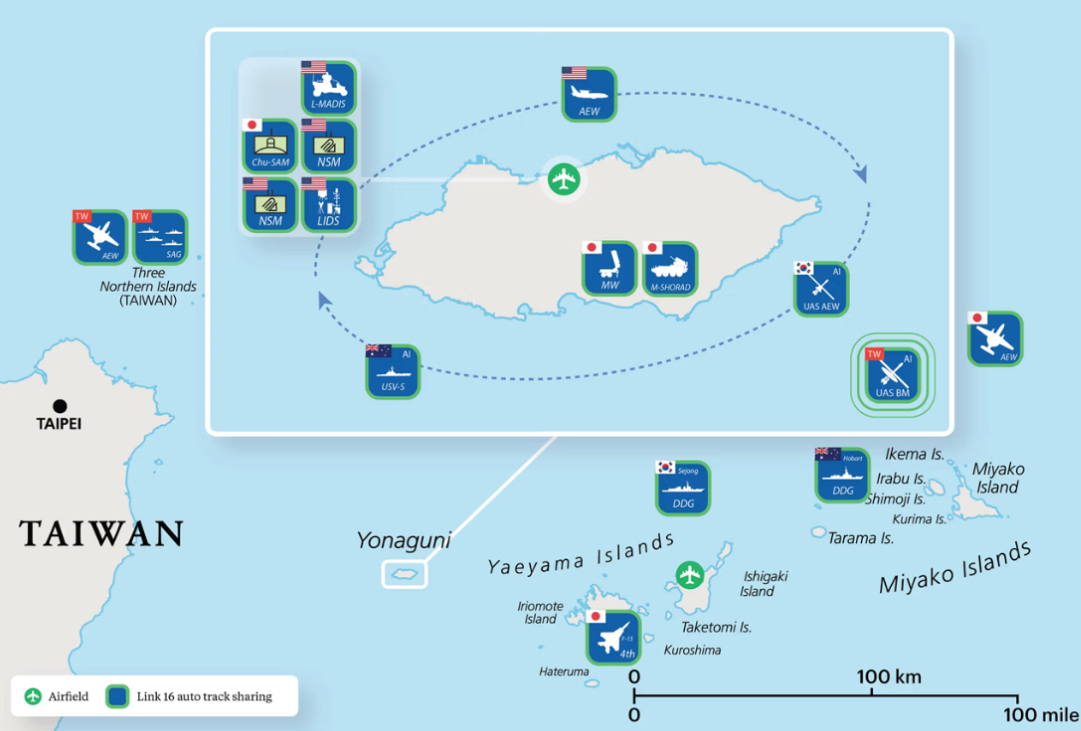
While coalition track sharing offers operational advantages, including early warning and sensor redundancy, it also introduces challenges of potential overallocation of interceptors. Without a joint command tasking interceptors, coalition partners tracking the same threats through integrated track sharing may — through lack of coordination, national command structures, and parallel decision-making cycles — simultaneously engage the same threat, rapidly depleting the collective interceptor stockpile and leaving all coalition partners vulnerable to follow-up attacks. To manage such risks, coalition partners can engage in limited coordination of rules of engagement, clearly defined engagement zones, and the prioritization of threats while still retaining sovereign fire control. Coalition partners may, for example, establish and promulgate amongst each other jurisdiction-level rules of engagement that specify, for example, the zones in which each partner will engage targets or the types of targets each partner will engage. Such insights into partner policy will facilitate both assigning assets to vulnerable or poorly defended areas while also deprioritizing areas that are dense with partner capability, thus limiting opportunities for overkill.
Importantly, players judged that, while sharing track data would find broad support during a conflict, it may be politically constrained in peacetime. This spurred thinking as to how coalition partners could rapidly stand up such a capability at the onset of hostilities. The operating concept to emerge from these discussions was what the authors term “latent link.” In it, the coalition partners establish now the capability for their respective jurisdiction-level battle management systems to share track data, for example in terms of procurement, testing, training, data and communications protocols, intelligence sharing, and cyber security. But, these cross-jurisdictional links are set, by default, in a deactivated (or “latent”) form. When the shooting starts and politics change, links between these compatible, partner-level systems can be switched on to activate coalition track sharing at a speed of relevance.
This is not to suggest that establishing coalition track sharing in even a deactivated form would be easy. Understanding that latent link signifies both closer defense integration among competitors and a potential check on Chinese air and missile power in wartime, Beijing would almost certainly resist its adoption. Thus, implementing latent link will still require a degree of political courage from coalition partners matched by clear signaling of its intent and purpose, specifically as a defensive response to rapid and extensive growth in Chinese strike capabilities. The advantage of latent link is not that it eliminates political risk, but rather that it lowers it by providing an intermediary option for coalition track sharing, sidestepping all-or-nothing decision-making that could paralyze efforts toward operationally advantageous (but politically risky) integration of air and missile defense.
Long Sense and Short Defense
Across the architectures that teams developed, a specific division of labor was consistently observed. First, the partner under direct attack would take primary responsibility for point defense. Partners in this role prioritized procurement of a mix of: (1) high-volume, low-cost-per-engagement interceptors (e.g., lasers, microwaves, etc.) that could “soak up” early waves of cheap Chinese missiles and drones designed to degrade point defenses; and (2) exquisite, high-capability interceptors that could engage subsequent advanced cruise and ballistic missile threats targeting critical assets. This layered approach (i.e., involving cheap and exquisite interceptors) was seen as critical to getting the point defense partner on the right side of the cost curve by intercepting Chinese missiles and drones at proportionate cost.
For those coalition partners not under direct attack, the priority was to task their sensors with tracking missiles and drones bound for the coalition partner under attack, and feeding those tracks to the partner’s point defense assets to ensure that the latter had sufficient warning and high-quality tracks to mount a competent defense. In a scenario involving a Chinese bomber attack on Darwin, for example, one of the teams recommended that Japan, South Korea, Taiwan, and the United States each procure and deploy to the South China Sea airborne sensors to provide early warning and feed tracks on the incoming bombers to Australia (Figure 2). This was critical for focusing Australian combat air patrols, which would otherwise struggle in the north of the country given limited inventory and the massive distances that they need to cover. Thus, even though Japan, South Korea, Taiwan, and the United States did not directly engage Chinese bombers or deploy assets to Darwin (which players judged would be politically challenging), they were able to strengthen Australia’s defense of Darwin through early warning and track sharing.
At the same time, the long-sense and short-defense concept revealed tradeoffs that can accrue when trying to balance coalition and national interests. Specifically, players questioned the extent to which their capitals would deploy sensors beyond the homeland in the context of a regional kinetic conflict. The concern was that doing so would sap capability from homeland defense if the conflict escalated, making long sense and short defense militarily and politically problematic. Here, players managed this tradeoff by prioritizing procurement of mobile and long-range sensing systems (e.g., over-the-horizon radar) that could be tasked with tracking threats to coalition partners but could operate from or be rapidly recalled to the homeland to prioritize homeland defense in case of conflict escalation.
Figure 2. Coalition air and missile defense strengthening an Australian defense of Darwin demonstrating the long sense and short defense operating concept. Source: Authors.
The Future of Coalition Air and Missile Defense
While the Indo-Pacific air and missile balance has turned against regional democracies, our tabletop exercise demonstrated that there are operationally advantageous and politically realistic options for responding through the operational coordination of air and missile defense. Our coalition air and missile defense operating concepts — latent link and long sense and short defense — are, if implemented, unlikely to independently correct the regional air and missile balance. But they have the potential to generate cross-partner air and missile defense efficiencies that mitigate China’s advantage in the short term. They will also lay the groundwork for more ambitious operational air and missile defense coordination, for example in terms of integrated fire control, basing, and standardizing/deconflicting rules of engagement.
For this reason, latent link and long sense and short defense — and coalition air and missile defense more broadly — require further policy development and evaluation in the Indo-Pacific context. Yet advancing this agenda will prove challenging, particularly as policymakers navigate relations with Beijing. Beijing still wields significant coercive influence through its economic statecraft, grey-zone activities, and military threats. This may be enough to compel partners to prioritize short-term stabilization over longer-term prospects for improving the regional air and missile balance through coalition force structures. Here, other stakeholders can play a constructive role in building momentum for coalition air and missile defense. Coalition partners’ militaries, for example, should promote military-to-military engagements that build fluency with respective air and missile defense systems and allow partner militaries to identify and seize opportunities for closer coordination. Coalition partners’ defense industry bodies should reduce barriers to interoperability between air and missile defense platforms and partners by designing and marketing next-generation systems for open architectures and coalition warfare. And academics across coalition partners should lead public discussions and convene stakeholders to develop concepts and raise public awareness and social license for coalition air and missile defense.
Christopher J. Watterson, Ph.D., is a research fellow with the United States Studies Centre at the University of Sydney, and a visiting research fellow with the Centre for Science and Security Studies at King’s College London.
Peter J. Dean, Ph.D., is the senior adviser for defense strategy with the United States Studies Centre at the University of Sydney and a professor of strategic studies at the Australian National University. He was co-lead of the 2023 Australian Defence Strategic Review Secretariat and has authored numerous books, policy papers, and articles on the U.S.-Australian alliance, Australian defense policy, military operations, and regional security.
Image: Jason Cutshaw via Wikimedia Commons


