India and Japan to Co-develop Naval Radio Antenna Based on UNICORN

India and Japan signed an agreement for the co-development of a naval radio antenna based on Japan’s UNICORN system. The announcement occurred during the visit of Prime Minister of Japan Sanae Takaichi to India. Prime Minister of India Narendra Modi revealed the development during a joint press brie

Naval News
75
3 min čtení
0 zobrazení
India and Japan to Co-develop Naval Radio Antenna Based on UNICORN

India and Japan signed an agreement for the co-development of a naval radio antenna based on Japan’s UNICORN system. The announcement occurred during the visit of Prime Minister of Japan Sanae Takaichi to India.

Prime Minister of India Narendra Modi revealed the development during a joint press briefing, stating:

In the field of defence, today we have signed an agreement for the first-ever co-development project between India and Japan. This Naval Radio Antenna project will open a new chapter in our defence technology partnership. Going forward, we will jointly develop defence technologies that will strengthen regional peace, maritime security, and a rules-based order.

This is among the most tangible outcomes of India – Japan defence cooperation, which has been limited to joint exercises and other activities so far. Earlier, Indian procurement of the Shinmaywa US-2 seaplane was discussed for years before being shelved. DRDO and ATLA had also jointly researched Visual SLAM based GNSS Augmentation Technology for UGVs.

As early as 2022 India and Japan were in discussions regarding the UNICORN. In 2024, the foreign and defence Ministers of both nations “appreciated the progress made for the transfer of Unified Complex Radio Antenna (UNICORN) and related technologies and early signing of related arrangements.”

UNICORN is currently used on the Mogami-class frigates of the JMSDF. The Indian Navy is likely to equip its next generation warships with the UNICORN derivative. In 2025, Indian shipyard MDL had also indicated preliminary discussions regarding a common destroyer designed between India and Japan.

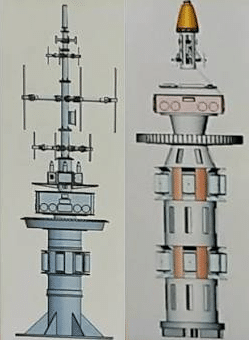
UNICORN
Details of UNICORN antenna on display on the ATLA booth at DSEI Japan 2023. Naval News picture.

UNICORN integrates various antennas into a single mast to improve stealth. From top to bottom this includes an ES-R antenna, ES-C antenna, WiFi band antenna, LINK-16 antenna, UHF antenna, IFF antenna, U/VHF antenna and TACAN antenna. UNICORN was jointly developed by three Japanese companies: NEC, Sampa Kogyo and Yokohama Rubber. The prime contractor NEC provided hardware integration and Tactical Air Navigation (TACAN) systems. Sampa Kogyo provided antenna technologies and maintenance experience while Yokohama Rubber developed the frequency selective radome. Saab had recently pitched its SLIM integrated mast solution.

During DefExpo 2022, Indian Navy’s Directorate of Electrical Engineering had showcased a project for two phase development of an Indigenous Integrated Mast (IIM) with Bharat Electronics Limited (BEL) as the production partner. The current status of the project remains unclear. It is likely that the project will be progressed or merged with the localized adaptation of UNICORN.

Schematics of the Indigenous Integrated Mast Phase-I and II displayed at DefExpo 2022. Photo by author.

IIM Phase-I was required to have a height of 11m without a radome, involving the “integration of R-ESM, COMINT, V/UHF communication and Data Link Antenna on a single mast without Radome. The final design envisages installation of data Link (L Band) antenna on top most part of the IIM, thereafter COMINT and ELINT antenna would be installed. The bottom most antenna will comprise Rhode and Schwarz make antenna for V/UHF communication.” IIM Phase-II envisaged the development of a shorter mast with a height between 8 – 11m with a frequency selective radome, integrating R-ESM, COMINT, L Band Data Link, two sets of V/UHF communication antenna and an optional WiFi antenna.

Původní zdroj

Naval News

Sdílet tento článek

Související články

Communication starts with us – SEICAM® and TRITON® II for the Next Generation of Submarines
🔬Zbraně a technologie
Naval News

Communication starts with us – SEICAM® and TRITON® II for the Next Generation of Submarines

The role of modern submarines is changing. In a security environment shaped by geopolitical tensions, advanced anti-submarine warfare capabilities and increasingly networked military operations, stealth alone is no longer sufficient. Today’s platforms are expected to exchange information securely, c

přibližně před 9 hodinami5 min
HAVELSAN’s AI-Powered Digital Lookout BLUEVISION Proves Itself Across Maritime Platforms
🔬Zbraně a technologie
Naval News

HAVELSAN’s AI-Powered Digital Lookout BLUEVISION Proves Itself Across Maritime Platforms

Türkiye’s defence solutions provider HAVELSAN unveiled BLUEVISION, an AI-powered maritime awareness system. HAVELSAN press release Maritime operators are expected to keep track of an increasingly complex environment. Small boats, floating objects, low visibility contacts and boat operating wit

přibližně před 9 hodinami3 min
🔬
🔬Zbraně a technologie
Defence Blog

Tuareg fighters shoot down Russian helicopter in Mali

Russia has lost another attack helicopter in Africa, this time to Tuareg rebel fighters in Mali rather than to the war in Ukraine that has already cost Moscow dozens of similar aircraft. The Azawad Liberation Front, a Tuareg-led rebel coalition known by its French acronym FLA, claimed its fighters s

přibližně před 23 hodinami1 min
🔬
🔬Zbraně a technologie
Defence Blog

Albania buys Turkish towed howitzers

Albania has become the third country in the world to buy Turkey’s domestically built BORAN howitzer, signing a contract with Turkish state manufacturer MKE just days before NATO leaders gather in Ankara for this year’s summit, defense outlet Ulusavunma reported. The deal covers six BORAN

přibližně před 24 hodinami1 min