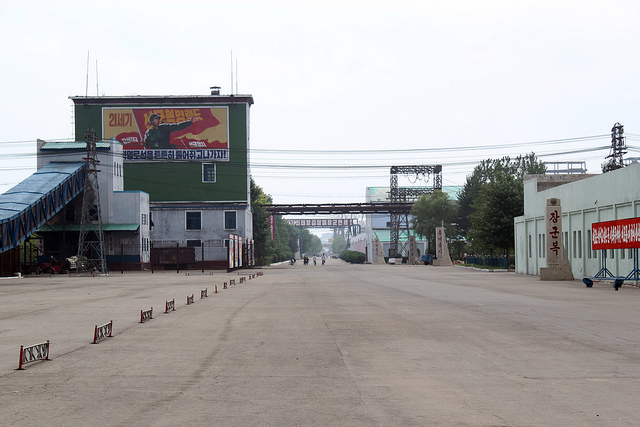
North Korean households squeezed by human waste quotas as state touts record fertilizer output
Neighborhood watch units in parts of North Korea have ordered each household to submit 50 kilograms of dried human waste as fertilizer by mid-July 2026, even as state media continues to publicize record output from the country’s fertilizer factories. The disconnect has fueled open grumbling am
Daily NK
75
5 min čtení
0 zobrazení

Neighborhood watch units in parts of North Korea have ordered each household to submit 50 kilograms of dried human waste as fertilizer by mid-July 2026, even as state media continues to publicize record output from the country’s fertilizer factories. The disconnect has fueled open grumbling among North Korean people, with many concluding that the quotas are simply a pretext for extracting cash.
A source in Ryanggang province said neighborhood watch units in Hyesan recently convened meetings to issue the directive, instructing each household to fill either two 25-kilogram sacks or one 50-kilogram sack with dried human waste and submit it sometime in July. Households unable to provide the material in kind may substitute cash, though an exact cash rate had not yet been set at the time of the meeting. The source said people were told to calculate the amount at roughly 0.8 to 1 Chinese yuan per kilogram and prepare accordingly, putting the total cash equivalent for a full quota at approximately 40 to 50 Chinese yuan (around $5.50 to $6.90).
North Korea mobilizes the entire population in human waste and compost collection drives every year, with the main winter and spring campaign treated as the first major battle of the new year. A separate summer round of dried human waste quotas is also issued regularly. This year’s round follows the same pattern, but the source said discontent is running higher than usual.
The frustration stems directly from a contradiction people themselves have identified: state media has been reporting significant increases in fertilizer factory output, yet the household quotas have not decreased at all.
“They say production at fertilizer factories has gone up — so why does the quota keep coming down?” the source quoted residents as asking. Others questioned whether the state was counting household contributions toward its factory production figures, or suggested that the authorities were simply unwilling to ease burdens even if supplies allowed. “It seems like even if there’s enough fertilizer, they don’t want to let people rest,” one reaction ran.
‘Even if we can’t eat, we still have to meet the quota’
A neighborhood watch unit in Chongjin in North Hamgyong province has issued the same directive, the source said, with similar complaints emerging among people there. Chongjin residents put it more bluntly: submitting dried human waste is effectively the same as paying cash, and many view the quota as a thinly disguised revenue collection mechanism.
The source noted that the burden of meeting household quotas falls disproportionately on women, most of them homemakers who take on the neighborhood watch unit tasks that arise while their husbands are at work. The frustration is compounded by the fact that many of these women are also the primary breadwinners, running small trading businesses to support their families. Being pulled away from income-generating activity to fulfill state mobilization demands imposes a direct economic cost.
“There is never a week or a month that goes by without the neighborhood watch unit calling for something to be submitted or someone to show up for mobilization,” the source said. “For people who are barely getting by day to day, it is a heavy burden.”
The source explained that the state’s own propaganda is part of what is stoking the anger. If authorities had said nothing about fertilizer production, people would have accepted the quotas as a familiar annual imposition and moved on. But the constant media claims of rising output make the unchanged quotas impossible to ignore.
“If production really is going up, it would stand to reason that the quotas handed down to individual households should ease at least somewhat,” the source said. “Because the propaganda keeps coming but the quotas do not go down, people suspect the state is just trying to collect money.”
The Rodong Sinmun reported on June 16, 2026, on its front page that overall industrial production in the 100 days since the party congress had grown to 105%, citing fertilizer output figures from the Namhung Youth Chemical Complex and the Hungnam Fertilizer Complex, two of the country’s flagship chemical and fertilizer enterprise units.
A Note to Readers


