
The U.S. military possesses several capabilities that it could wield to combat naval mine warfare in the Strait of Hormuz.
Iran’s Islamic Revolutionary Guard Corps Navy views the maritime weapon as a key pillar of its military strategy, according to a 2017 Office of Naval Intelligence report, and reportedly began laying mines in the sea passage last week.
Defense Secretary Pete Hegseth said in a Pentagon briefing Friday, however, that there was “no clear evidence” of mines in the strait.
RELATED
Adm. Brad Cooper, head of U.S. Central Command, said Monday that U.S. forces destroyed storage bunkers for naval mines during a U.S. strike on military targets on Iran’s oil export hub, Kharg Island, on Friday. U.S. forces also destroyed 16 Iranian minelayers last week, according to CENTCOM.
Iran is estimated to possess roughly 6,000 mines, according to a congressional report published Wednesday. The stockpile may include limpet mines, which are typically attached to a ship manually by a diver; moored mines, which float below the water’s surface and are tethered to the seabed; bottom mines that rest on the seabed; and drifting mines, which float above the water’s surface and detonate upon contact.
Here’s a look at the U.S. Navy’s arsenal of minesweepers, littoral combat ships equipped with countermine capabilities and helicopters outfitted with anti-mine technology.
Avenger-class minesweepers
The Navy currently has four Avenger-class mine countermeasure ships stationed in Sasebo, Japan, that it could forward deploy to the Middle East in support of Operation Epic Fury if necessary.
The service commissioned 14 Avenger-classminesweepers beginning in the 1980s, but has since retired nearly all of them.
The service had four deployable minesweepers stationed in Bahrain up until 2025, but they were decommissioned and replaced with littoral combat ships equipped with minesweeping and mine-hunting capabilities. Each of the minesweepers decommissioned had served for over 30 years.
These vessels, which utilize sonar and tethered remote operating vehicles to identify mines beneath the water’s surface, were used during the Gulf War to destroy over 1,000 mines off of Kuwait.
RELATED
They sweep and destroy mines by detonating them with an acoustic device that emits a noise meant to trigger sound-sensitive mines or with an electromagnetic tool that emits an electromagnetic field to trick magnetically induced mines into exploding.
They also drag cables and cutters behind them to intercept and sever the tethers attached to moored mines. Once the tether is cut, the mine floats to the top and is destroyed.
Minesweepers are constructed of wood and fiberglass in order to produce a nonmagnetic signature and low acoustic footprint that will not trigger mines to explode, allowing the vessels to operate inside and near a mine-threat zone.
Minesweepers also host two .50-caliber machine guns and two Mk 19 grenade launchers.
Independence-class littoral combat ships
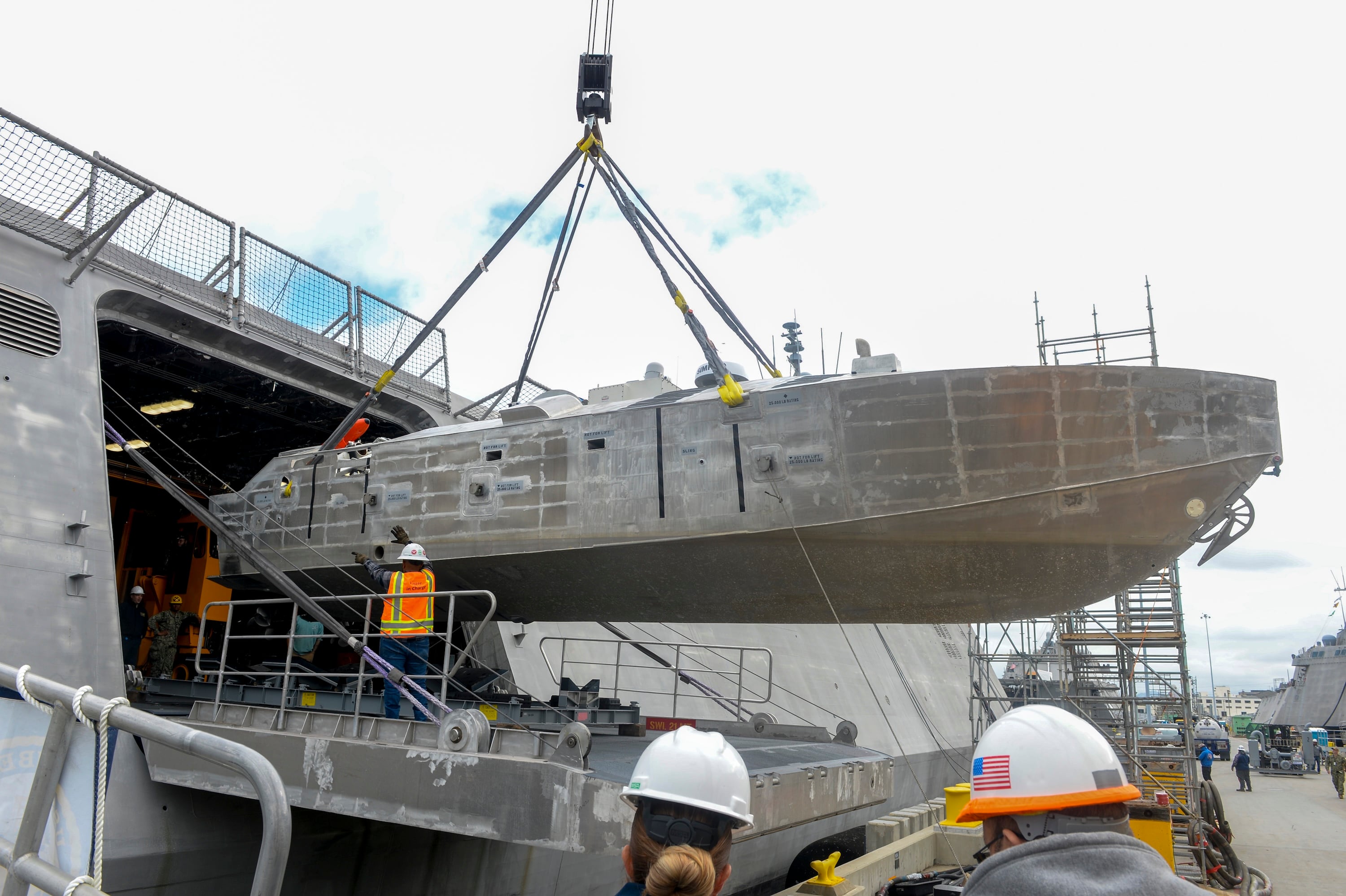
The Navy has sought to modernize its minesweeping capabilities by rotating out its aging minesweepers in Bahrain for Independence-class littoral combat ships uniquely fitted with a mine countermeasures mission package.
The USS Canberra was the first LCS with the MCM package to arrive in the Middle East on May 22, 2025. The USS Santa Barbara and USS Tulsa, two other littoral combat ships with the MCM package, joined it shortly thereafter.
All three are homeported in Bahrain.
As of Monday, the USS Canberra was operating in the Indian Ocean, parts of which fall under the U.S. 5th Fleet area of responsibility, the U.S. 5th Fleet told Military Times in an emailed statement.
The USS Santa Barbara and USS Tulsa were conducting brief logistical stops in Malaysia, according to the U.S. 5th Fleet.
“U.S. forces routinely make port calls in Malaysia as part of our operations,” the statement read.
The MCM package is used exclusively by Independence-class littoral combat ships.
Littoral combat ships are made of aluminum and do not possess the same unique ship architecture as the nondetectable minesweepers, and as a result, they can only operate outside a mine-threat zone.
The LCS employs unmanned surface and underwater vehicles to travel into an area where mines have been laid to discover and destroy the mines.
These unmanned vessels utilize the AN/AQS-20 mine-hunting sonar system, which is towed and uses sensors to pinpoint the location of bottom mines and moored mines.
There is also the unmanned influence sweep system, which provides common unmanned surface vehicles aboard the LCS with the ability to sweep or detonate mines through a magnetic sweep cable that emits a magnetic field or a towed acoustic device that emits sound.
The unmanned vehicle moves along a predetermined route but sends camera footage and radar readings back to a remote operator who can steer the vehicle away from obstacles underwater.
The littoral combat ships with the MCM package have yet to be deployed in combat.
The ships have a noticeably upgraded weapons package, compared to the Avenger-class mine countermeasure ships, including a57mm MK-110 gun system, SeaRAM self-defense system and .50-caliber machine guns.
Helicopters
The Independence-class littoral combat ship’s MCM package includes the aerial capabilities of the Sikorsky MH-60S Seahawk helicopter, which can deploy from the LCS to assist with mine hunting and minesweeping.
These helicopters are equipped with theAN/AES-1Airborne Laser Mine Detection System, which detects floating andnear-surface moored mines, as well as the AN/ASQ-235 Airborne Mine-Neutralization System, which sends an expendable unmanned underwater vehicle to intercept and destroy a mine.
Prior to the MCM package, Sikorsky’s MH-53E Sea Dragon helicopter served as the Navy’s main countermine aircraft, which was deployed during the Gulf War to help destroy mines and clear shipping lanes in the Persian Gulf.
The MH-53E uses side-scan AQS-14A mine-hunting sonar to identify mines and can tow the Mark 105 Hydrofoil Magnetic Minesweeping Sled and the Mk-103 mechanical minesweeping system to destroy mines.
The helicopter is currently out of production, with 28 aircraft in operation, according to the Naval Air Systems Command website.
The Navy is in the process of “evaluating its requirement” for future airborne mine countermeasures missions after 2025, the website states.
Riley Ceder is a reporter at Military Times, where he covers breaking news, criminal justice, investigations, and cyber. He previously worked as an investigative practicum student at The Washington Post, where he contributed to the Abused by the Badge investigation.

