
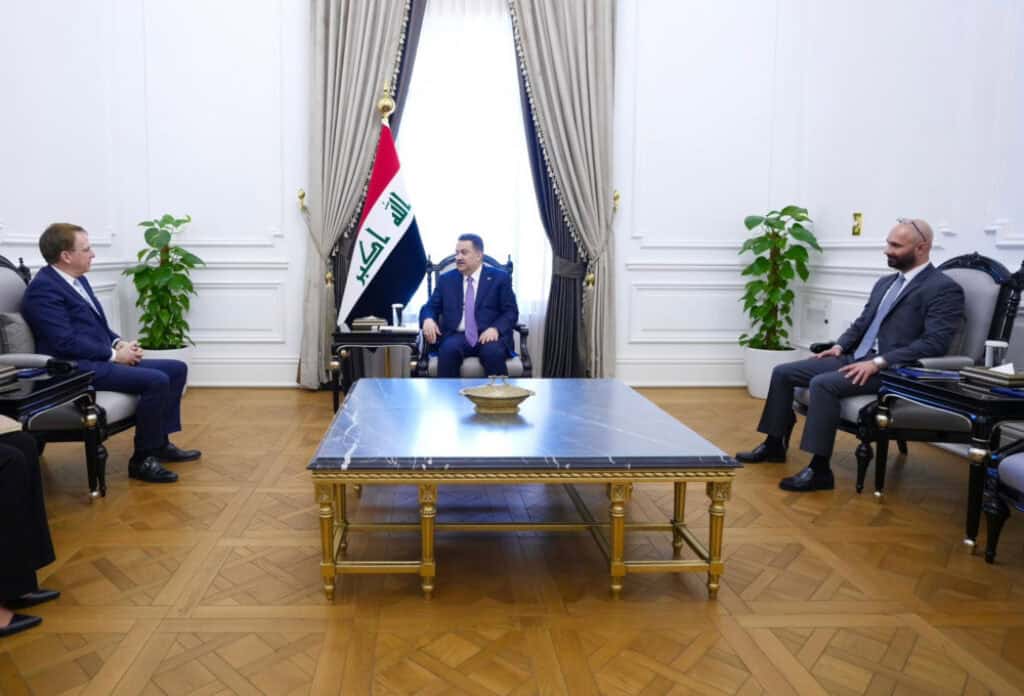
On April 14, Iraqi Prime Minister Mohammed Shia al Sudani met with French Ambassador to Iraq Patrick Durrel. “Mr. Al-Sudani emphasized the necessity for major powers to exert utmost efforts to curb escalation and avoid returning to a state of war by resorting to dialogue and de-escalation, in order to preserve common interests and enhance opportunities for stability and security across the region,” Iraq’s Prime Minister’s Office stated. The messaging to France is part of a broader trend across Iraq in the wake of the Iran war and amid the tentative ceasefire, as the country seeks to recover from being a frontline in the conflict.
After US and Israeli strikes on Iran began on February 28, Iraq quickly became a central theater in the war. Iranian-backed militias across Iraq carried out hundreds of drone and missile attacks, many targeting US diplomatic posts and forces. More than 700 of the attacks were aimed at the autonomous Kurdistan Region, targeting the US and UAE consulates, Kurdish leaders, and Kurdish Iranian opposition groups.
Iraq appointed a new president on April 11, four months after holding elections last November. Nizar Amidi is a member of the Patriotic Union of Kurdistan Party. Over the last 20 years, in the wake of the US overthrow of Saddam Hussein, Iraq has tied key political positions to the country’s major sectarian and ethnic groups: a Kurdish president, a Shiite prime minister, and a Sunni parliament speaker.
Discussions about the appointment of the president had intensified over the last month. With the new appointment, Iraq’s political parties are now expected to select a prime minister. Former Prime Minister Nouri al Maliki is seeking the office, but his bid has been opposed by the Trump administration. Shiite political parties are expected to agree on an individual soon.
In addition to Iraq’s selection of new political offices, bishops of the Chaldean Church, which represents the largest community of Iraqi Christians, gathered in Rome to elect a new patriarch. “Archbishop Amel Nona has been elected as the new Patriarch of the Chaldean Catholic Church on Sunday, April 12, following the resignation of his predecessor, Cardinal Luis Raphaël Sako, announced on March 10. The new leader has chosen the name Paul III and will request ecclesiastical communion from the Pope,” Vatican News reported on April 12. Chaldeans make up the majority of the roughly 250,000 Christians in Iraq.
As Iraqi political parties debate appointments, the country continues to face challenges to its oil exports due to Iran’s threats against shipping in the Strait of Hormuz. Iraq saw an 80 percent drop in exports in March. It has sought to adapt by exporting oil through Syria and Turkey. In the Kurdistan Region, the Khor Mor gas field, which has been targeted in the past by Iranian-backed militias, has returned to production after a pause during the recent conflict. On April 8, Iraq also reopened its airspace after it had been closed during the war.
Regardless of the ceasefire, the Kurdistan Region has continued to suffer drone attacks, according to the Rudaw Media Network. “The Kurdistan Regional Government (KRG) said several drone attacks targeted various locations in the Kurdistan Region late Thursday despite the ongoing ceasefire agreement between the US and Iran,” Rudaw reported on April 10. Kurdistan Regional Government President Nechirvan Barzani said on April 10 that there is no military solution to the Iran crisis and urged the ceasefire to continue.
Iraq continues to struggle with the aftermath of the Iranian-backed militia attacks. On April 12, the US and Iraq held a meeting of the Higher Joint Coordination Committee, which was established in March. The US Embassy in Baghdad said the committee has met five times to discuss preventing terrorist attacks on US diplomatic facilities. The US said that one of the key incidents that Iraq has agreed to investigate is an attack on US diplomats on April 8 near Baghdad International Airport.
In addition, the US State Department’s Rewards For Justice program announced on April 14 that it is “offering a reward of up to $10 million for information on” Kataib Hezbollah leader Ahmed al Hamidawi. In addition to Kataib Hezbollah conducting numerous attacks on US forces, the US-designated Foreign Terrorist Organization (FTO) and Shiite militia was behind the kidnapping of US journalist Shelly Kittelson and Israeli-Russian researcher Elizabeth Tsurkov. Tsurkov was released on September 9 last year, and Kittelson was recently freed on April 7, a week after being kidnapped.
Reporting from Israel, Seth J. Frantzman is an adjunct fellow at FDD and a contributor to FDD’s Long War Journal. He is the senior Middle East correspondent and analyst at The Jerusalem Post, and author of The October 7 War: Israel's Battle for Security in Gaza (2024).
Tags: Iraq, Iraqi elections, Iraqi politics, Kataib Hezbollah, Mohammed Shia al Sudani, Nizar Amidi, Shiite militias


