
North Korea began building and publicly unveiling its 5,000-ton destroyers starting in 2025. Recent satellite imagery suggests the vessels are not yet fully operational combat assets. Both the first ship, Choe Hyon, and the second, Kang Kon, have rarely been observed at sea following their launches. Instead, they have been seen either sitting at port or being moved by tugboat. Kang Kon in particular suffered an accident during its launch and subsequent imagery shows signs that the vessel has difficulty navigating independently. A third destroyer is currently in the early stages of assembly at Nampo shipyard. The destroyer, originally conceived to hunt and destroy fast-moving torpedo boats — with the name derived from “torpedo-boat destroyer” — has evolved into one of the most versatile surface warship types in modern navies.
Satellite imagery indicates that while North Korea’s destroyer program has been made public, actual operational capacity remains limited. The contrast with South Korea is stark. The South already operates a mature fleet that includes Aegis-equipped destroyers, while North Korea is only beginning to develop its surface combatant force. That said, the design of North Korea’s new destroyers incorporates a large number of missile launch cells, meaning the ships could eventually become a significant missile-delivery platform once fully operational. For now, however, they present as an unfinished force, one still hindered by accidents, technical problems and restricted movement.
Construction progress at Nampo shipyard
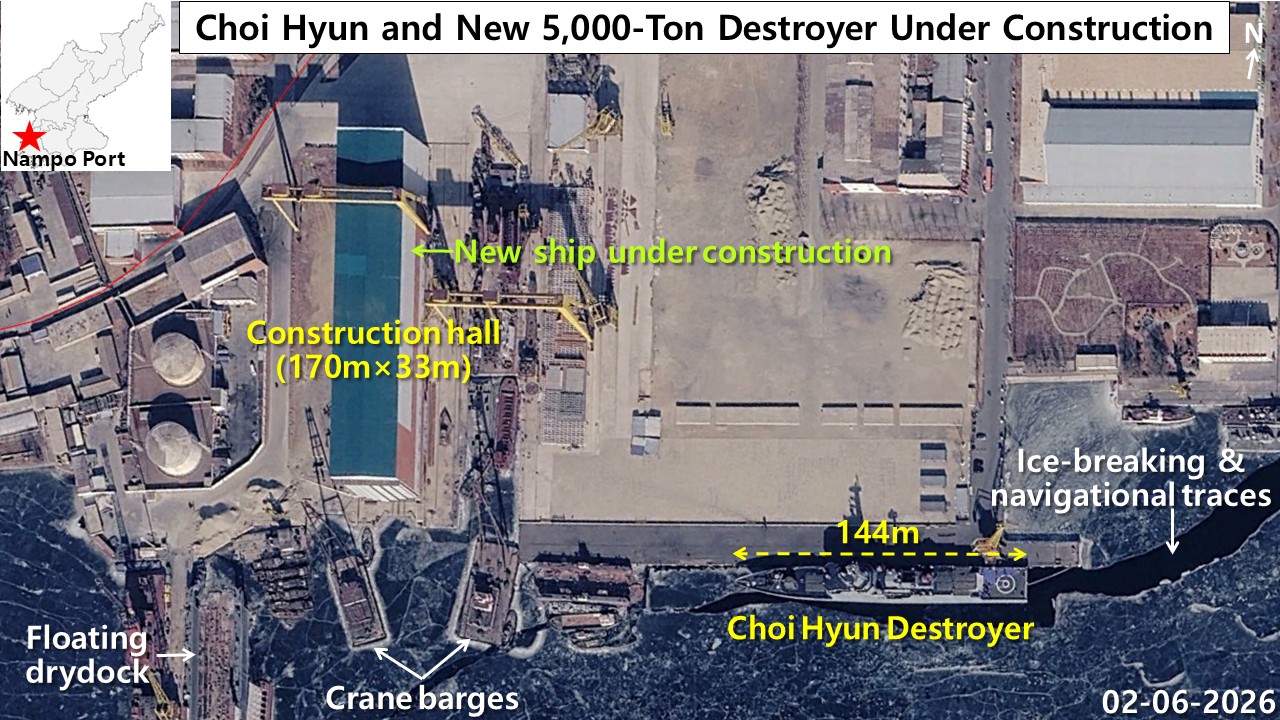
Recent satellite imagery of the Nampo port area confirms that Choe Hyon, the first 5,000-ton destroyer, is berthed at the harbor, while the third destroyer in the class is being assembled inside the construction facility. North Korea has stated its intention to complete the third vessel by October 2026, in time for the Workers’ Party of Korea founding anniversary. The imagery shows a large building with a dark green roof where hull block assembly and joining is underway, with a crane and work vessel visible in the water just ahead of the structure, suggesting active construction.
Choe Hyon was named after a figure who fought alongside Kim Il Sung in the anti-Japanese resistance. While the warship appears moored at Nampo port, surrounding ice trails and wake patterns visible in the imagery point to a recent return from sea trials. In early March 2026, Kim Jong Un personally boarded the vessel to assess weapons operation and combat capability, overseeing the test launch of sea-to-surface strategic cruise missiles as part of a live-fire evaluation.
The third destroyer under construction at Nampo shipyard is estimated to be roughly 30% complete, based on satellite analysis, placing it in the early to middle stages of hull block assembly. No superstructure or weapons systems have been fitted yet, and additional time will be required before the vessel is ready as a full combat ship. North Korea has set a political deadline of the second half of 2026 for completion, but given typical shipbuilding timelines, the vessel’s actual induction into active service is likely to come later. Satellite imagery suggests the broader destroyer program is expanding rapidly but remains in a transitional phase, with construction and testing proceeding simultaneously.
Kang Kon: questions over operational status
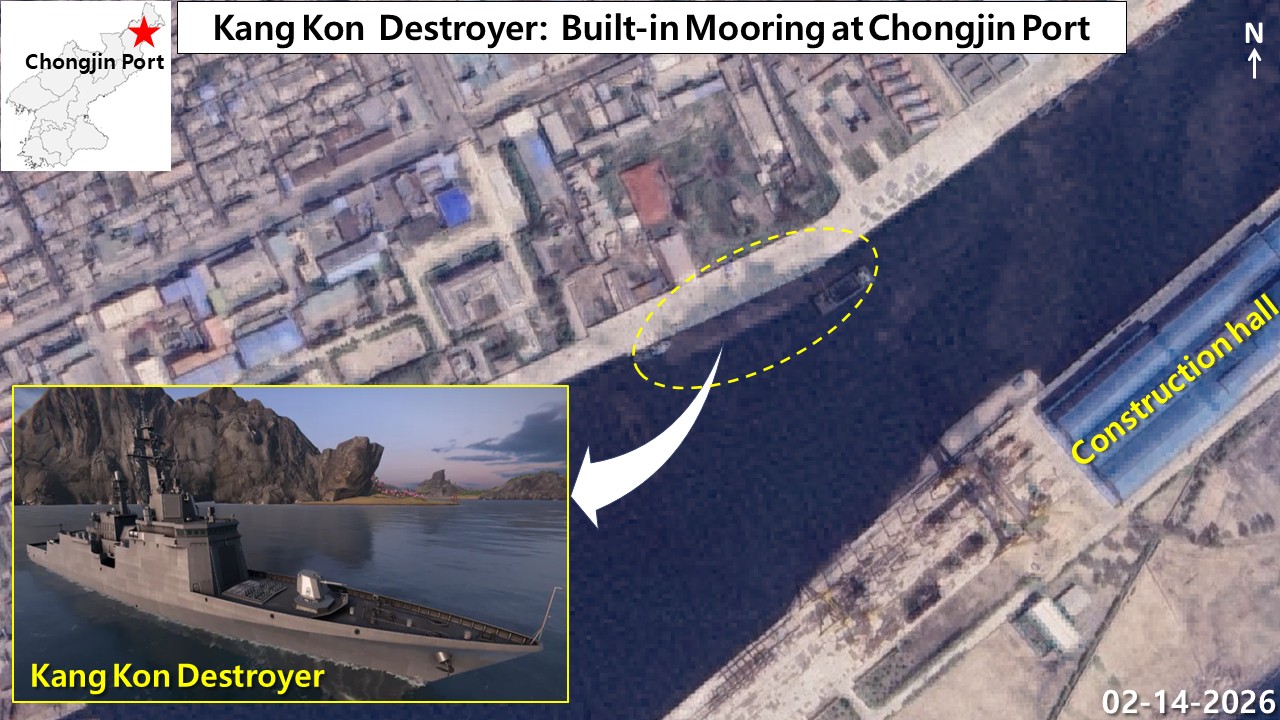
Recent satellite imagery of Chongjin port in North Hamgyong province shows Kang Kon, the second 5,000-ton destroyer, in a prolonged fixed berth with little to no observed movement. The ship was named after Kang Kon, a first-generation anti-Japanese revolutionary who played a central role in founding the Korean People’s Army, and is considered a key element of North Korea’s new destroyer force. However, satellite imagery and foreign media analysis have captured signs of the vessel being moved by tugboat, and continued stationary positioning at the same berth suggests independent navigation remains beyond its current capability. Serious questions have been raised about the ship’s operational readiness.
Kang Kon suffered significant damage when it capsized onto its side during launch proceedings in June 2025. The vessel was subsequently raised and relaunched following repairs, but has reportedly struggled to achieve normal operational status. After repairs, the ship was moved from Rason port to Chongjin port, where it has since remained in an extended berth. The ongoing standstill has prompted continued questions about the ship’s combat readiness and the functioning of its internal systems. Based on satellite imagery, Kang Kon appears formally launched but operationally incomplete, with tactical independent maneuvering still out of reach.
North Korea’s future destroyer construction plans
North Korea is pushing forward with plans to rapidly expand its destroyer force as part of a broader naval modernization drive. The primary near-term goal is to complete the third 5,000-ton destroyer at Nampo shipyard by the Workers’ Party of Korea founding anniversary in October 2026. Simultaneously, Kim Jong Un has announced that at least two destroyers of this class or larger will be built every year going forward. North Korea has indicated plans to acquire roughly 10 destroyers within the next five years, aiming to shift from a small-vessel-centered navy to one built around multiple missile-carrying surface combatants. The possibility of constructing vessels displacing 8,000 tons or more has also been raised, pointing to qualitative improvements alongside the numerical buildup. Simultaneous construction at multiple shipyards beyond Nampo is also under consideration. In short, North Korea is pursuing not merely a handful of additions but an aggressive plan to expand to fleet-scale surface combatant capability within a compressed timeframe.
North Korea vs. South Korea: destroyer force comparison
South Korea and North Korea present a sharp contrast in destroyer capability, both in scale and technical maturity. Through its Korean Destroyer Experimental program, South Korea has steadily built up its destroyer fleet, which now ranges from 4,000-ton to 10,000-ton Aegis-equipped vessels capable of long-range air defense and missile intercept. Ships of the Sejong the Great class, for example, are high-performance Aegis destroyers capable of managing multiple missile systems simultaneously, with several already in active service and more under construction.
North Korea operated a small-vessel-centered navy for decades and has only recently begun developing destroyer-class surface combatants with the launch of Choe Hyon. The ship holds potential as a threat given its large missile payload capacity, but remains in the construction and testing phase, with accidents and technical limitations already on record. With only one to two vessels in any form of service, the gap in destroyer strength between North and South Korea remains substantial. South Korea already fields a mature and capable destroyer force, while North Korea is only at the starting point of this kind of naval development.
Potential threat posed by North Korea’s new destroyers
North Korea’s new destroyers are not yet a completed fighting force, but they carry meaningful long-term threat potential. The ships are designed to operate multiple missile types simultaneously through vertical launch systems, with the capacity to carry cruise missiles and tactical ballistic missiles for direct strike missions from the sea. North Korea has stated publicly that it intends to use its destroyers to expand the navy’s role from coastal defense into offensive operations and blue-water capability. If additional hulls are completed and deployed, a scenario emerges in which vessels are stationed separately in the East Sea and the Yellow Sea, enabling surprise attacks or simultaneous multi-missile launches against targets across the region.


