
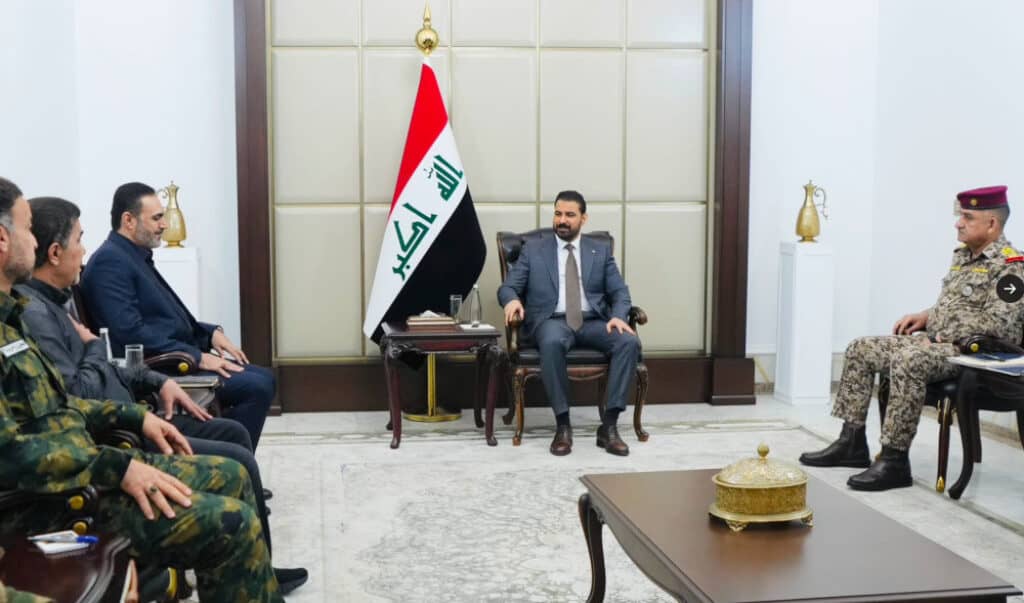
On June 3 in Baghdad, Iraqi Prime Minister Ali al Zaidi met with delegations from Asaib Ahl al Haq and Kataib Imam Ali, two Iranian-backed Iraqi militias. He thanked the group’s leadership for supporting the government’s initiative to place arms under state control. The militias said on June 2 that they would sever ties with the Popular Mobilization Forces (PMF), Iraq’s Shiite-dominated paramilitary force, and put their arms under state authority.
“During the meeting, it was decided to form a joint committee tasked with devising the appropriate mechanisms for implementing procedures to disengage from the Popular Mobilization Forces and confine arms to the hand of the state, within the next two days,” the Iraqi prime minister’s office stated in a post on X.
The latest militia moves follow a May 27 decision by Shiite cleric Muqtada al Sadr to dissolve his Saraya al Salam militia and place it under state control. Other Iraqi militias have had a mix of reactions in recent days to these developments, leaving questions about how the arms will be handed over and what the future holds for the armed groups.
On June 2, newly appointed US Envoy to Syria and Iraq Tom Barrack praised Prime Minister Zaidi for the initiative. “We likewise commend those groups whose principled decision to return all weapons to the Iraqi state will contribute to the architecture of order. Prime Minister Al Zaidi’s confidence is well-placed, for this marks only the beginning,” Barrack added. Zaidi, who was nominated to be prime minister on April 27 and sworn in on May 14, said he welcomed the decision by several groups to place their arms under state control. “This step will strengthen the role of our armed forces in all their components,” he said in a statement.
“Two Iraqi armed factions allied with Iran announced Tuesday that they were prepared to hand over their weapons to the state, in what Iraqi sources told Alhurra was the result of renewed U.S. pressure and what appears to be a shift in Iran’s position,” the US-funded news network Alhurra noted on June 2.
The PMF includes around 70 armed groups organized into dozens of brigades. Established in 2014 as part of Iraq’s war on the Islamic State, many of the militias within the PMF have origins dating back to the early 2000s and even the 1980s. Several prominent militias have been sanctioned by the US and designated as Foreign Terrorist Organizations. In recent months, the US has offered financial rewards for information on the leaders of Kataib Hezbollah, Harakat Hezbollah al Nujaba, Harakat Ansar al Awfiya, and Kataib Sayyid al Shuhada.
The statements from two of the groups provide insight into how they expect to proceed. Asaib Ahl al Haq said that it made its decision following what it called the “national will” and a decision by the Shiite Coordination Framework, the top coalition of Shiite parties in Iraq. Asaib Ahl al Haq’s political wing, the Al Sadiqoun Bloc, is part of the Coordination Framework. The Shiite bloc supports the decision to “impose state monopoly over arms and disengage the PMF from political, partisan and societal frameworks,” the London-based Asharq al Awsat newspaper noted.
In a statement similar to AAH’s announcement, Kataib Imam Ali said that it made its decision due to the Coordination Framework’s effort to strengthen the rule of law in the country. “The faction said it had formed committees to oversee the inventory, transfer, and handover of equipment under the supervision of the commander-in-chief of the armed forces, while also managing the affairs of members, wounded personnel, and families of those killed,” a report at Iraq’s Shafaq News added.
Kataib Hezbollah (KH) said on May 30 that it supports the initiative to hand over weapons to the state. However, KH also stated that it was prepared to receive specialized weapons, such as drones and missiles, and even pay for these arms, indicating the group does not intend to disarm.
Harakat Hezbollah al Nujaba has rejected the disarmament initiative. Both Harakat Hezbollah al Nujaba and Kataib Hezbollah are part of the Islamic Resistance in Iraq (IRI), an umbrella group used by militias to claim attacks against US forces, Israel, and other targets, and the PMF includes other groups with membership in the IRI. “The Islamic Resistance in Iraq emerged in the immediate aftermath of the outbreak of the Gaza war in October 2023, with its core overlap within the PMF including Asa’ib Ahl al-Haq, Kata’ib Hezbollah, Harakat Hezbollah al-Nujaba, and Kata’ib Sayyid al-Shuhada armed groups,” the Rudaw Media Network noted.
The potential changes to the role of the militias in Iraq are a focus of media coverage in Iraq and neighboring countries.
Ghazi al Faisal, director of the Iraqi Center for Strategic Studies, told the UAE’s Al Ain News that “the issue of weapons outside the state remains one of the most prominent tests facing Iraq in the next stage, and the government’s success in addressing it will be a decisive factor in strengthening political and security stability and consolidating the concept of a modern state based on the monopoly of force and the application of the law to everyone.”
Iraq’s Shafaq News emphasized US support for the initiative in two articles on June 3, noting posts from the US Embassy in Baghdad and comments by US Envoy to Syria and Iraq Tom Barrack.
Reporting from Israel, Seth J. Frantzman is an adjunct fellow at FDD and a contributor to FDD’s Long War Journal. He is the senior Middle East correspondent and analyst at The Jerusalem Post, and author of The October 7 War: Israel's Battle for Security in Gaza (2024).
Tags: Asaib Ahl al Haq, Harakat Hezbollah al Nujaba, Iraq, Kataib Hezbollah, Kataib Imam Ali, PMF, Saraya al Salam, Shiite militias


