9 hours ago
Sahnun Ahmed,BBC News Somaliand
Scarlett Barter,BBC World Service
Somalia became a key part of IS's global network after fighters were driven out of strongholds in Syria and Iraq.

9 hours ago
Sahnun Ahmed,BBC News Somaliand
Scarlett Barter,BBC World Service

 BBC/Amensisa Ifa
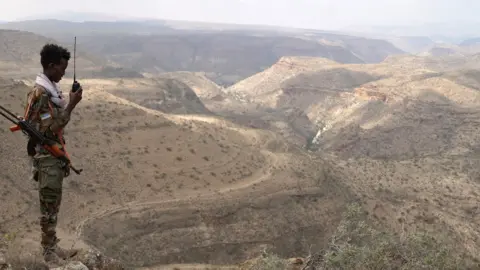
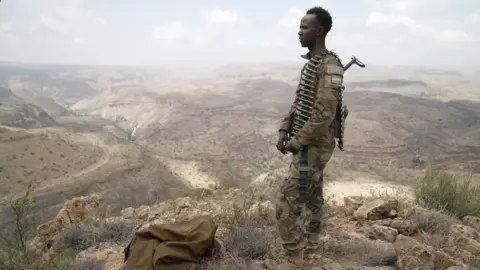
In Somalia's remote al-Miskad mountains, a group of soldiers huddles around a small hand-held screen, tracking Islamic State group fighters on a drone feed.
A figure appears in the picture, moving through a valley. "He has been to fetch water for his friends," says the drone operator. "He is running and carrying something on his back," adds another soldier.
The man on the screen is near a cave, which the army believes is a hideout for 50 to 60 IS fighters.
The Puntland Defence Forces have about 500 soldiers stationed at this base in the north-east of Somalia. Ten years ago the barren and inhospitable landscape was home to only a few nomadic communities, but that changed when IS established a foothold here, shifting its focus to Africa as its fighters were driven out of their strongholds in Syria and Iraq.
By April 2025, Gen Michael Langley, who was then the commander of United States Africa Command (Africom), told the US Congress that "ISIS controls their global network from Somalia".
And in recent years, the US has supported Somalia's fight against IS, repeatedly bombing insurgents hiding in Somali caves – in 2025 the Pentagon carried out 60 attacks on IS-Somalia.
 BBC/Amensisa Ifa
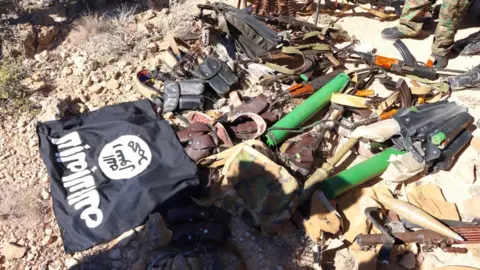
Now, on a local level, IS's "ability to stage attacks in Somalia has been degraded" and it "does not pose a significant threat to Puntland or Somalia today", says Tricia Bacon, director of the Policy Anti-Terrorism Hub at American University in Washington DC.
However, IS-Somalia still "plays a critical role in terms of providing resources, support, and facilitation for other Islamic State affiliates, both in Africa and further afield, like Afghanistan", she explains.
IS-Somalia, based in the semi-autonomous region of Puntland in the north-east of the country, was established by a Somali national, Abdulqadir Mumin. He once lived in Sweden and the UK and held British citizenship.
In 2015 he appeared alongside 17 men in a video pledging allegiance to IS.
Mumin had previously been a member of the militant group al-Shabab, which has been battling the government for two decades and still controls large parts of southern Somalia.
IS-Somalia forced al-Shabab out of Puntland's al-Miskad mountains, bringing in foreign recruits and gradually becoming a training and financial hub for IS's wider network.
The group had influence in the port city of Bosaso and a US treasury report stated that in 2022 IS-Somalia "raised $2m [£1.5m] from extortion payments from local businesses, imports, livestock, and agriculture".
The Puntland Forces managed to push IS-Somalia out of Bosaso at the start of 2025, but the militant group still controlled villages and small towns in the nearby al-Miskad mountains.
 BBC/Amensisa Ifa
One of those was Dardar, home to 600 people.
With IS came brutality and fear.
People living here say strict rules were written on a blackboard in a nearby village prohibiting men and women from mixing in public, forbidding men from wearing long trousers below their ankles or having stylish haircuts. Women had to wear a specific type of hijab with gloves and socks to cover their hands and ankles, and music was not allowed.
Its harsh regime and ideology left deep scars.
"Life became very difficult," says Said Mohamud Ibrahim, the local imam, sitting on the floor of his mosque. "People were afraid. Some were kidnapped and are still missing."
While some people fled the village, he stayed, but says IS kicked him out of the mosque. "They said: 'We are the imam now. And if you do not follow our instructions and leave the mosque right now, you will get what you deserve.'
"I understood that to mean they would either behead me or kidnap me."
Among the worshippers in the mosque is Mahad Jama. Two years ago his niece, Shukri, was kidnapped and killed by IS fighters.
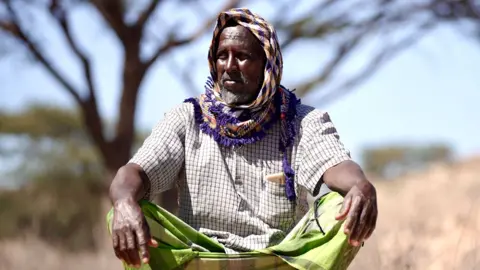
"She was a good girl, a very loving daughter, she cared for her mother. She was a practising Muslim," he says, lowering his head beneath his black and white scarf to shield himself from the midday sun.
Shukri was pregnant when she was killed. She left behind two children and a sick mother.
"You can't imagine what it feels like to lose your niece… and not even know why she was killed. When you receive news of a child's death, it is almost impossible to accept," Jama adds.
Shukri had a seven-year old son called Said. The little boy was deaf and rarely left his mother's side. The night IS came to their home he was with her. He was killed too.
After many months of fighting, the village was taken by the Puntland Defence Force in February 2025. The Americans had helped, targeting and killing three IS militants in May 2024.
 BBC/Amensisa Ifa
However, IS still has bases in the area.
At their mountain post, as soldiers hear a clash with IS is imminent, the mood shifts and machine guns are readied.
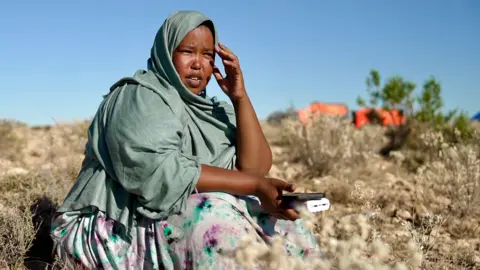
Muna Ali Dahir, who is a 32-year-old officer, is one of a handful of women among the soldiers here.
She has fought in battles before: "We fought hard and won… because this is our land," she says.
This time though, she is staying at the base, preparing for potential casualties.
One young soldier shows us a picture on a phone of him gripping the arm of an IS fighter he had captured. The prisoner is taller and bigger than him, with a thick black beard and long hair. Another soldier is holding the other arm.
"This is Hassan. The Turkish man that we captured," says 24-year-old Abdikhair Abdiriza Jama.
In June 2025, the UN estimated that the Islamic State group had up to 800 fighters in Somalia, more than half of them foreign.
The Puntland Forces claim to have killed hundreds of members of IS over the past 16 months, and have released images of more than 50 captured foreign fighters, from countries including Ethiopia, Morocco and Syria.
Puntland authorities say those who are detained face trial and, in some cases, the death penalty.
Human Rights Watch has previously raised concerns over due process and the treatment of prisoners accused of being part of an Islamist armed group. A UN report in 2022 noted that Somalia was working to ensure "those held in custody for questioning was done in a coordinated manner so that the rights of detainees were upheld".
 BBC/Amensisa Ifa
Abddikhair Jama was 14 when IS first came to this region. "I didn't believe that they existed. At first, I thought it was just propaganda," he says. "But when I held one of them… I realised that foreign fighters were attacking our country."
As we talk, the sharp crack of test fire echoes across the camp. Heavy machine guns and supplies are loaded onto camels and soldiers stream out of the base in small groups for the assault on IS positions.
An army commander explains that an American surveillance drone is in the air gathering intelligence, helping determine where to fire.
Mortar rounds roar through the valley, slamming into the IS caves and explosions echo off the mountainside. There is no return fire.
The drone is sent up again, this time to assess the damage and, on the small screen, the cave entrance appears scorched.
The man who had been spotted running through the valley earlier is nowhere to be seen and, looking down from the mountain, it is impossible to know how effective the assault has been.
The Puntland Defence Forces found out that American drones had later got involved and had struck fighters inside the caves - it's not clear how many.
The fight against IS in Somalia is not over.
Tricia Bacon at American University warns that although IS-Somalia is "currently constrained… it has proven to be a resilient organisation, capable of recovering and regrouping from losses".
And Abddikhair Jama says: "We won't stop until the last fighter is captured.
"Whether it takes 10 or 15 years, we will go wherever they move or hide. Only when the land is fully cleared will we rest."
Meanwhile, he and the other soldiers continue to live in harsh conditions. There is no running water or electricity and they sleep in makeshift tents made of branches, orange tarpaulins and rocks. They survive on the goats they rear and supplies brought twice a day by helicopter.
In the quiet moments between battles, Dahir calls her family – she has eight children but has only seen them twice in the past year.
She says her children are her motivation: "They say: 'Mum is coming back and we will win.' It makes me feel that I am doing the right thing.
"I own this country and those who invade are wrong."
More about Somalia from the BBC:

Bobi Wine says from an undisclosed location: "It was clear that the regime wanted to eliminate me."

Eleven people were rescued overnight after a minibus taxi got stuck in rising floodwaters in Nairobi.
The Angolan Navy launched its first BR71 MK II Combattante corvette, the NRA Ekuikui II, in Cherbourg, France, on 4 March 2026 to begin a new era of maritime surveillance […]
French shipbuilder CMN Naval launched the NRA Ekuikui II (F300), the first of three BR71 MKII Combattante corvettes for the Angolan Navy, during a ceremony in Cherbourg on March 4, […]