
On 18 June 2026, Chile launched the first of four 8,000-ton LPD for the Chilean Navy, a key milestone in the Escotillón IV program and the PNCCN naval modernization plan.
On 18 June, 2026, after 46 weeks of construction, Chile launched the first of four planned 8,000-ton multipurpose landing platform dock (LPD) ships for the Armada de Chile. The vessel is the lead ship of the Escotillón IV program, under which the first two ships are currently under contract valued approximately US$410 million. The event marks one of the most significant milestones in the Continuous National Naval Construction Plan (PNCCN), a strategic initiative designed to strengthen the country’s naval and industrial capabilities.
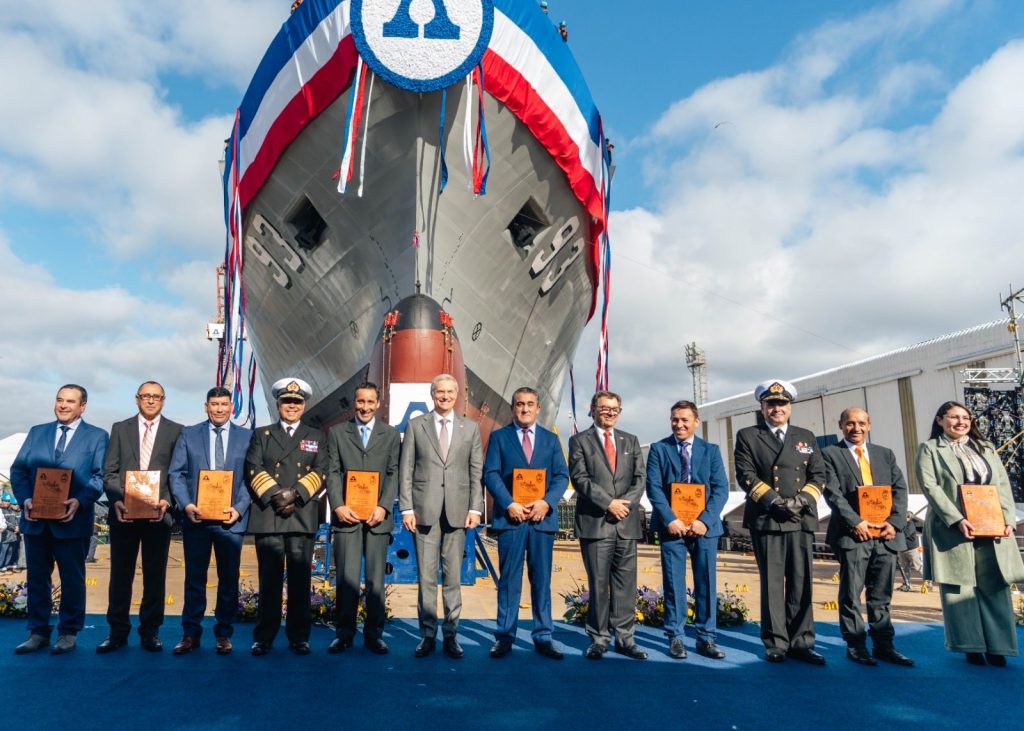
Construction of LPD-93 Magallanes began at Astilleros y Maestranzas de la Armada (ASMAR)’s Talcahuano shipyard in southern Chile on February 27, 2022, with the vessel scheduled to enter service in 2027. Work on the second ship, Rapa Nui, commenced in August 2025 with the ceremonial first steel cutting, and it is expected to be launched in the first half of 2029 and to be delivered by 2030.
President of the Republic José Antonio Kast and the Minister of Defense, Fernando Barros, participated in the christening and launching ceremony of Magallanes at ASMAR Talcahuano, alongside the Commander in Chief of the Navy, Admiral Fernando Cabrera, Director of ASMAR Rear Admiral José Miguel Hernández, the undersecretaries Rodrigo Álvarez and Christian Bolívar, government and naval officials, and representatives from academia and industry.
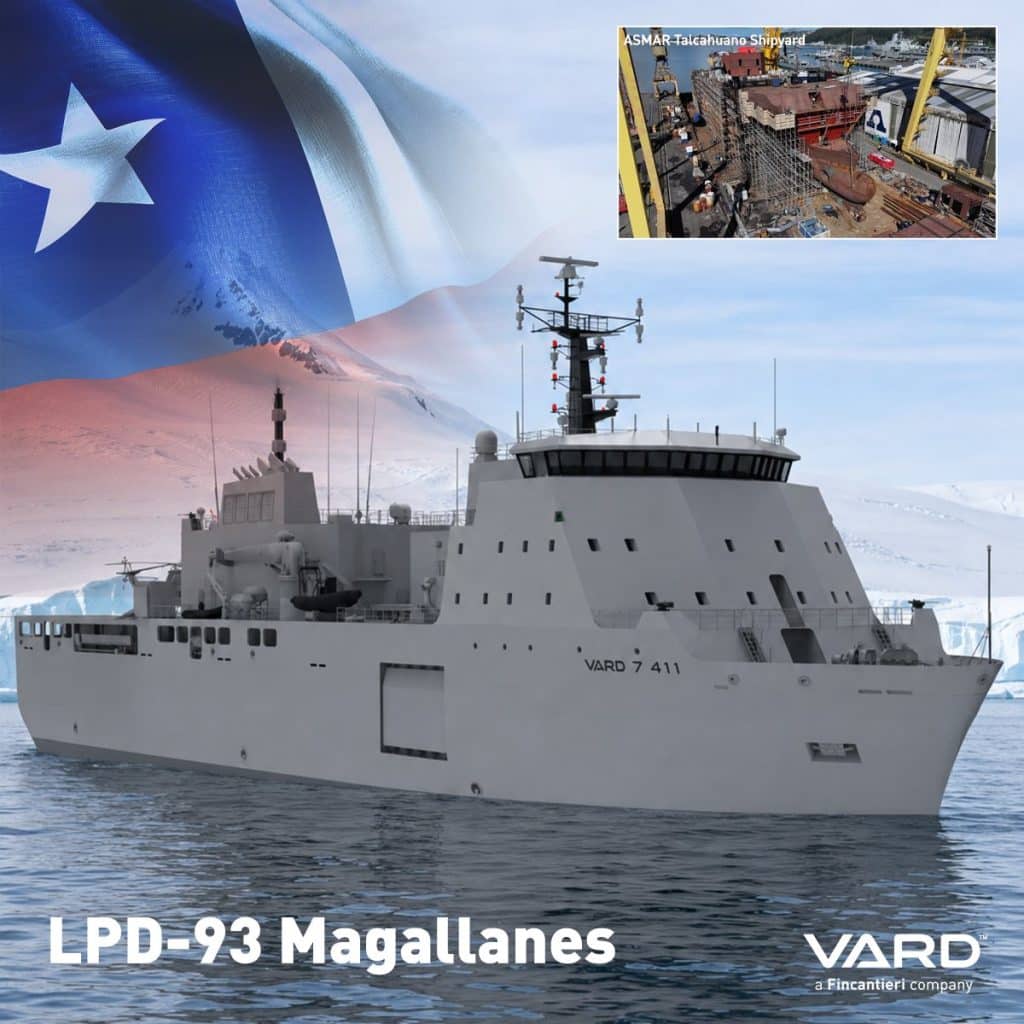
The program is based on a design developed by the Canadian company Vard Marine, which was awarded the design contract in 2020. The launch marks the fourth collaboration between Vard Marine and Chile’s state-owned shipbuilder ASMAR, following the successful delivery of the Vard Marine-designed 10,000-ton icebreaker Almirante Viel in 2024.
The 110-meter multi-role amphibious warfare ship is based on Vard Marine’s Vard Series 7 design, which was modified to meet the Chilean Navy’s operational requirements and designated Vard 7 411 Amphibious Support Ship. Designed for operations across the Pacific and Southern Ocean, the vessel is capable of supporting a wide range of missions, including logistics support, Antarctic operations, search and rescue (SAR), amphibious troop and equipment deployment, and humanitarian assistance and disaster relief (HADR).
To support these missions, the ship features a roll-on/roll-off (Ro-Ro) cargo deck, a well dock for landing craft operations, aviation facilities for helicopter operations, and accommodation for embarked personnel. It is capable of transporting and deploying a wide variety of containerized cargo, military vehicles, landing craft, helicopters, and rescue boats, providing significant flexibility across military and humanitarian missions.
After Peru, Chile becomes the second country in Latin America to build a large-scale multipurpose vessel intended for amphibious operations and logistical support. The ships will replace the two Batral-class LSTs and the sole Elicura-class LSM.
Technical Characteristics of Magallanes Class
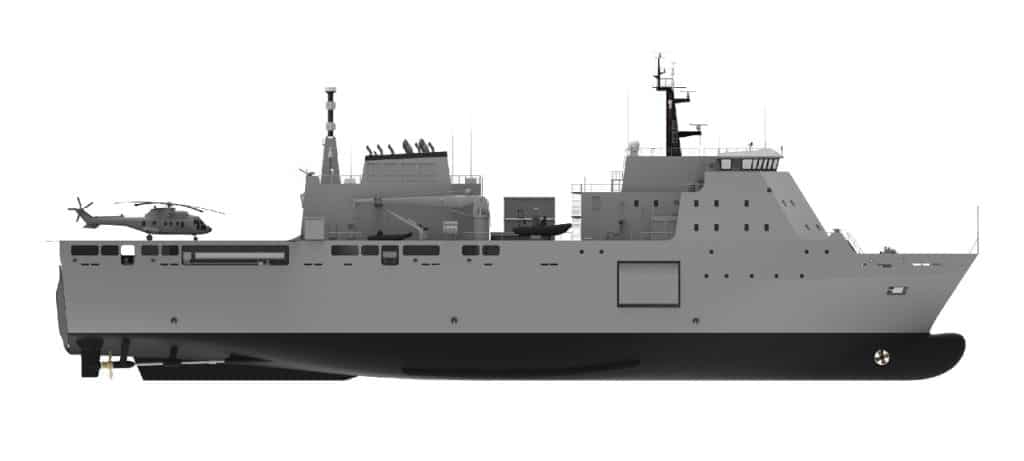
The Magallanes Class has an overall length of 110 meters, a beam of 21.8 meters, a depth of 13.8 meters, a draft of 5.8 meters and a displacement of 8,000 tons. The vessel has a standard complement of 95 crew members and can accommodate up to 250 embarked troops. Powered for sustained expeditionary operations, the ship has a maximum speed of +17 knots, a range exceeding 7,000 nautical miles with 12 knots, and an endurance of up to 40 days, enabling extended deployments across the Pacific, Southern Ocean, and Antarctic regions without frequent replenishment.
The vessel is equipped with a comprehensive suite of deck and lifesaving equipment, including two rigid inflatable boats (RIBs), each capable of carrying 12 personnel, two workboats, and two rescue boats. Cargo handling is supported by two deck cranes, each rated to lift 20 tonnes at a 20-meter outreach. The ship’s armament will comprise four remote weapon stations (RWS) fitted with 20mm guns and 12.7mm heavy machine guns.
The ship offers substantial transport capacity, with space for 22 ISO 20-foot containers or 12 KM-500 heavy vehicles. Its aviation facilities include a full-length flight deck capable of supporting the landing of one 10-ton helicopter, while the hangar provides maintenance facilities for one 10-ton and one 4.5-ton helicopter, or alternatively two VTOL aircraft.
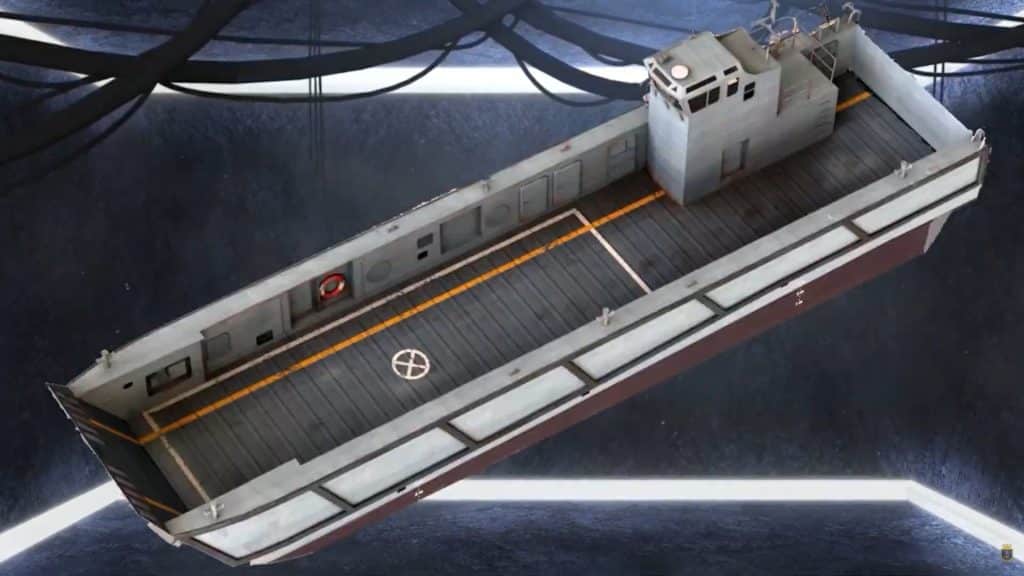
A floodable well dock, equipped with an organic ASENAV 20-meter landing craft mechanized (LCM), enables the transport and deployment of 30 tons of vehicles, equipment, and personnel from the mother ship to the shore, significantly enhancing the vessel’s amphibious and logistical capabilities.
