
The Japan Maritime Self-Defense Force (JMSDF) is procuring compact patrol ships at a rapid pace to strengthen maritime surveillance around Japan amid growing regional security pressures, particularly China’s expanding maritime activities.
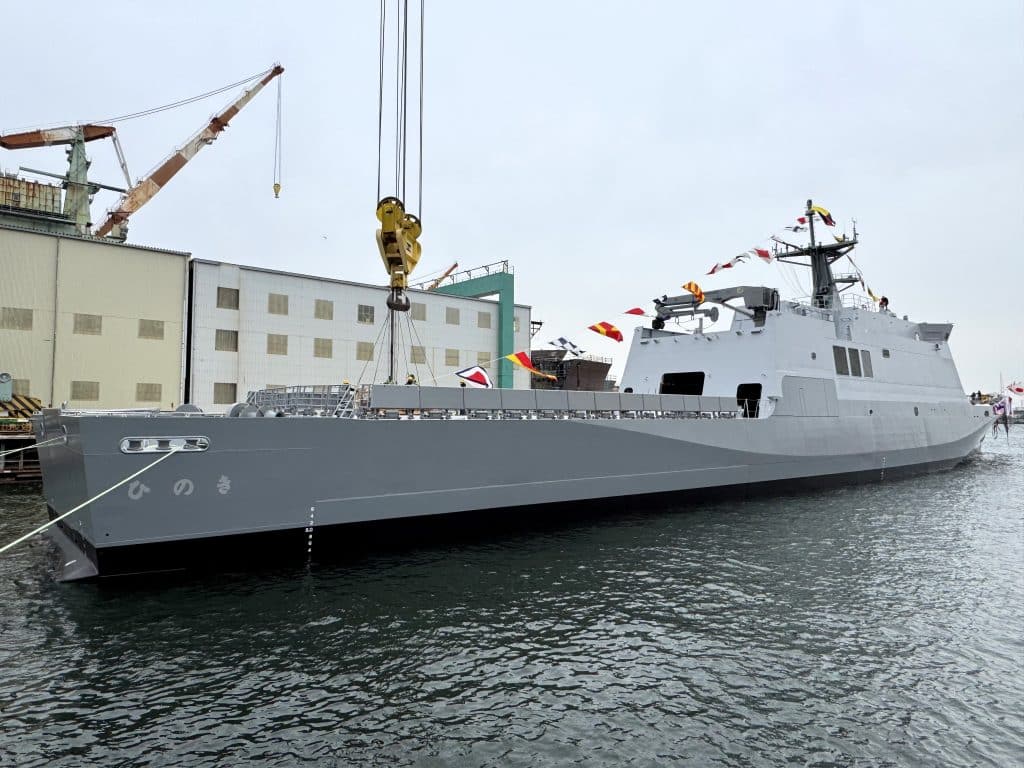
On March 13, Japanese shipbuilder Japan Marine United (JMU) launched the third and fourth ships of a planned 12-ship fleet of new Sakura-class offshore patrol vessels (OPVs) for the JMSDF during a ceremony at its shipyard in Yokohama City, Kanagawa Prefecture, south of Tokyo.
The third vessel was named Hinoki (ひのき) after the Japanese cypress tree (檜). The name Hinoki has a long lineage in Japanese naval history. It follows the first Hinoki, the third ship of the Imperial Japanese Navy’s Momo-class destroyers, and the second, the 16th ship of the Matsu-class destroyers, making this the third vessel to bear the name.
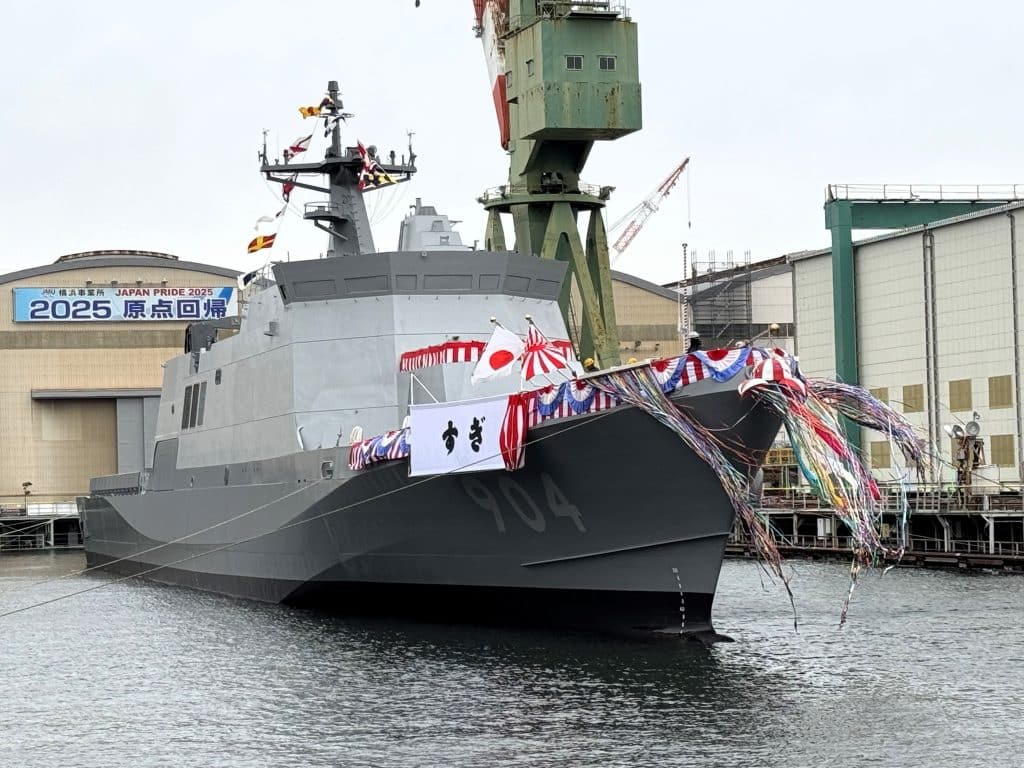
The fourth ship was named Sugi (すぎ), after the Japanese cedar tree (杉), a conifer species native to Japan. Once commissioned, it will be the fourth Japanese naval ship to carry the name. It follows the first Sugi, the ninth ship of the Imperial Japanese Navy’s Kaba-class destroyers, the second, the seventh ship of the Matsu-class destroyers, and the third, a Kusu-class escort ship leased from the United States Navy in 1953.
It has been standard practice for JMSDF destroyers to be named after celestial and meteorological phenomena, mountains, rivers, or regions. However, the newly introduced patrol vessel class adopts tree names. The ship names were chosen following an internal solicitation and review process within the JMSDF and were finalized by Defense Minister Shinjiro Koizumi.
The Sakura-class represents a new type of vessel for the JMSDF and marks the service’s first use of the OPV (Offshore Patrol Vessel) designation.
Hinoki (OPV-903) and Sugi (OPV-904), like the lead ship Sakura (OPV-901) and the second vessel Tachibana (OPV-902), were all laid down on February 14, 2025. Sakura and Tachibana were launched back on November 13, 2025. According to the JMSDF Maritime Staff Office, all four vessels are scheduled to enter service around March 2027.
The office said each of Hinoki and Sugi cost about 8.9 billion yen ($56 million) to build. However, construction costs have risen. In the fiscal year 2026 defense budget, 28.5 billion yen was allocated for the construction of the fifth and sixth vessels, equivalent to about 14.25 billion yen per ship.
Under Japan’s Defense Buildup Program, adopted in December 2022, the Ministry of Defense plans to acquire 12 patrol vessels over about a decade. The government initially allocated 35.7 billion yen in the fiscal year 2023 budget to build the first four ships.
Designed for routine surveillance missions
The Sakura-class represents a new category of vessel optimized for routine patrol and surveillance missions in Japan’s surrounding waters.
The ships measure 95 meters in length with a standard displacement of 1,900 tons, a depth of 7.7 meters, a draft of 4.2 meters, and a top speed of about 25 knots. Like the Mogami-class frigate, their hulls feature stealth-oriented shaping.
Automation technologies are extensively employed to reduce crew requirements. Each vessel will operate with a crew of only 30 personnel, roughly one-third the complement of Mogami-class frigates, which typically carry around 90 sailors.
Although the ships have a displacement comparable to the Abukuma-class destroyer escort, their armament is minimal, consisting primarily of a 30 mm cannon, with no anti-air or anti-ship missiles installed.
Each OPV features a combined diesel-electric and diesel (CODLAD) propulsion system in which an electric motor and diesel engine drive a single propeller.
Japan’s Acquisition, Technology and Logistics Agency (ATLA) says the vessels will incorporate a modular architecture that allows flexible mission configurations while enhancing surveillance capabilities through automation, adaptability, and sustainability.
In the fiscal 2025 defense budget, the Ministry of Defense allocated 4 billion yen to procure six V-BAT unmanned aerial vehicle systems from U.S. defense technology firm Shield AI for deployment aboard the OPVs. The UAVs will be installed at a later stage.
Strengthening surveillance amid regional tensions
Japan is introducing the new patrol vessels as China continues expanding its naval presence and military activities in waters surrounding Japan, particularly around the Nansei Islands, the southwestern island chain that includes Okinawa.
Japan possesses vast territorial waters and an exclusive economic zone (EEZ), ranking as the sixth largest in the world.
According to Japan’s 2025 Defense White Paper, as of March 31, 2025, the JMSDF operates 51 destroyers and 22 submarines. In comparison, China fields 94 modern destroyers and frigates and 55 modern submarines, enabling it to expand operations in waters near Japan.
At the same time, the JMSDF faces growing operational demands, including overseas deployments and multinational exercises, while also confronting potential manpower shortages due to Japan’s declining birthrate.
To address these challenges, the service is emphasizing compact, highly maneuverable vessels capable of operating efficiently with smaller crews, including the Mogami-class frigates and the new Sakura-class OPVs.
Future operational structure
Once commissioned, the patrol vessels are expected to be assigned to a newly planned Patrol and Defense Group (哨戒防備群)under a future a new Fleet Surface Force (水上艦隊). to be established by the JMSDF later this month. The group is also expected to include Mogami-class frigates. The V-BAT UAV selected for the OPVs is also considered a leading candidate for the upgraded Mogami-class, or New FFM (also known as 06FFM). The current Mogami-class frigates are not equipped with UAVs.

