
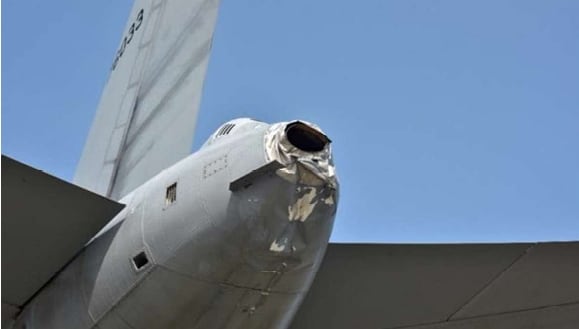
A U.S. Air Force investigation found that incorrect manual control inputs by a KC-46A’s boom operator, as well as a F-22A Raptor pilot not accounting for the other aircraft’s “stiff boom characteristics,” led to last year’s mishap in which the KC-46A’s refueling boom was severely damaged.
On July 8, 2025, a KC-46A Pegasus refueling tanker had to conduct an emergency landing after its refueling boom was damaged over the Atlantic Ocean when refueling a F-22A Raptor.
During a breakaway, a “nozzle binding event” occurred and resulted in the air refueling boom striking the tail of the KC-46A and breaking off and falling into the ocean, according to a release.
Air Mobility Command released a report June 12 of the Accident Investigation Board’s investigation into the mishap, which involved a KC-46A assigned to the 22nd Air Refueling Wing and an F-22A Raptor assigned to the 1st Fighter Wing.
The report estimated nearly $10 million in damages to the KC-46A aircraft. There were no fatalities, injuries or damage to civilian property, the report says.
The KC-46A was scheduled to conduct a training mission of aerial refuelings for seven F-22s on the day of the mishap.
The AIB found two main causes of the accident. Primarily, a mistake with the boom operator’s manual control inputs to the air refueling flight control stick resulted in an “excessively out of trim” air refueling boom, which triggered a “radical force” to be applied to the refueling boom’s nozzle. This caused the nozzle to be bound inside the receiver’s air refueling receptacle.
“This subsequently produced an unrecoverable boom fly-up rate upon release from the receptacle, striking [the KC-46A] and causing a critical failure of the boom structure which then departed [the KC-46A] in flight,” the report states.
Additionally, the failure of a F-22A pilot to account for the stiff boom caused an excessive closure rate and “substantially contributed to the mishap.”
The boom operator was a qualified instructor with over 1,000 hours flying the KC-46A and KC-135, the release states. The F-22 pilot involved in the mishap was a student with 13 flight hours in the Raptor at the time.
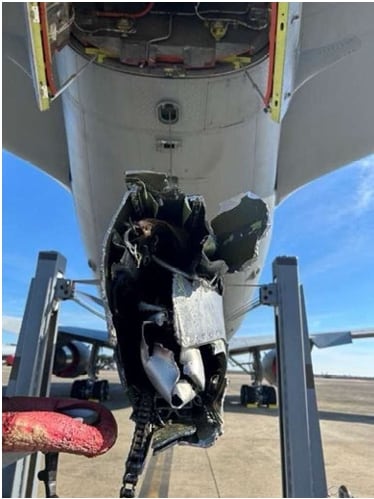
The two structural tubes of the boom were so stressed during the incident that they cracked and separated slightly forward of the U-Tail assembly, which caused the Aft end of the boom, along with the U-Tail and telescoping tube, to detach and fall into the ocean, the report reads.
The separation caused all the wiring, hydraulic tubing and telescoping chains and cables to tear, leaving only a small portion of the chain to hang freely from the outer tube.
The report says that the KC-46A suffered damage to the APU access doors, exhaust, exhaust deflector and the aircraft’s tail section.
Cristina Stassis is a reporter covering stories surrounding the defense industry, national security, military/veteran affairs and more. She previously worked as an editorial fellow for Defense News in 2024 where she assisted the newsroom in breaking news across Sightline Media Group.

