
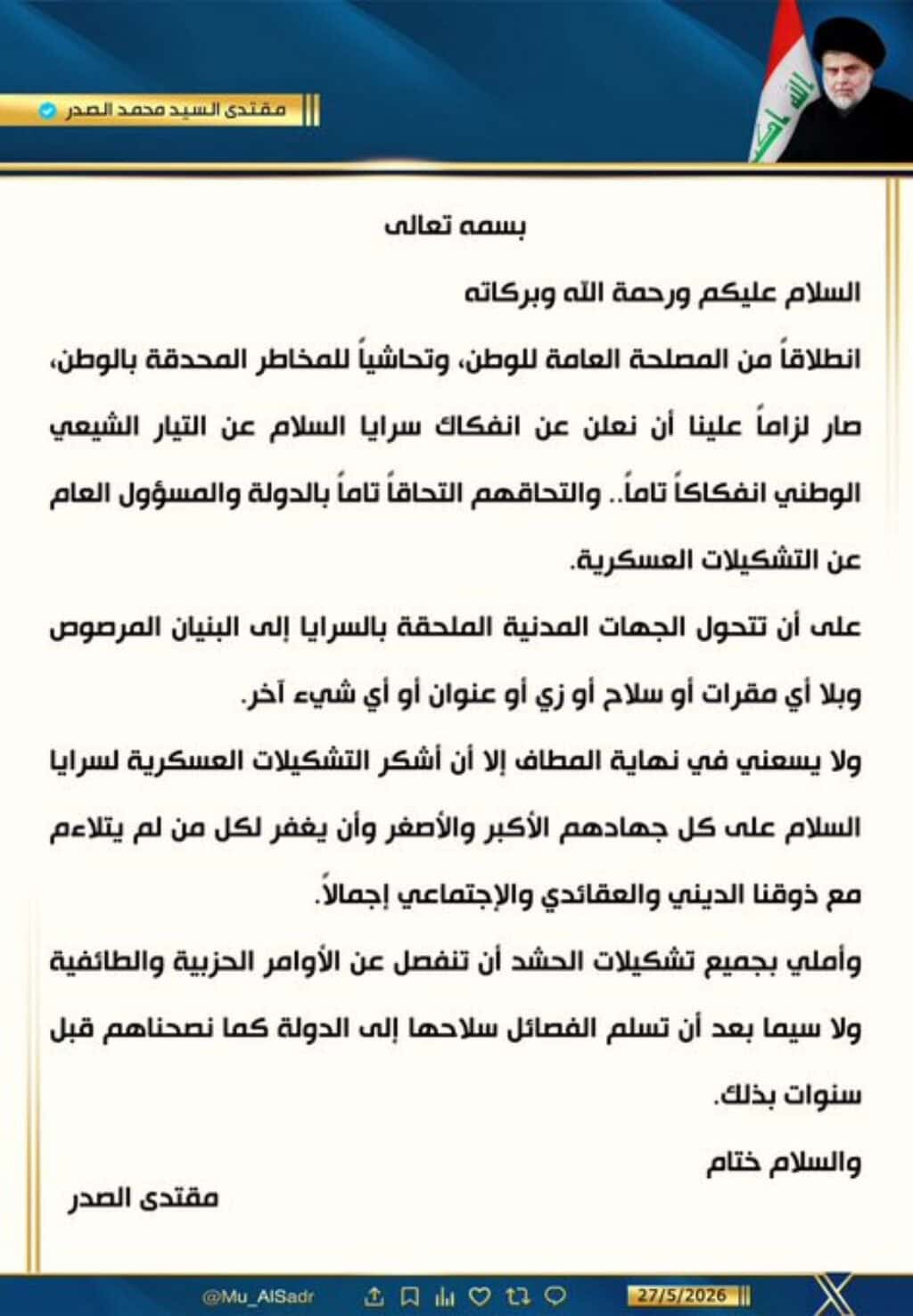
On May 27, Muqtada al Sadr, the well-known Iraqi Shiite cleric and popular leader, announced the dissolution of his militia, Saraya al Salam (the Peace Brigades). “It has become necessary for us to announce the dissolution of Saraya al-Salam from the Shia National Movement— a complete dissolution— and their full attachment to the state and the general authority over military formations,” Sadr stated in the announcement.
Saraya al Salam is Sadr’s latest militia that was formed in 2014 in response to the Islamic State’s offensive in Iraq. The group largely came from Sadr’s earlier Mahdi Army militia. The Shiite National Movement, formed in 2024, is Sadr’s latest political organization. Saraya al Salam was involved in violent clashes between different Shiite factions following the 2021 parliamentary elections in which Sadr won the most seats but was ultimately unable to form a government and withdrew his party from parliament. While Sadr has been a partner of Tehran, he has resisted Iraq’s complete subjugation to its neighbor, a position that has irritated Tehran and its Iraqi proxies.
Sadr did not provide more details on the mechanism for integrating his fighters into state institutions. However, a document from his office said that the handover process would be completed by Eid al Ghadir on June 4. A committee of representatives from the government and Sadr’s movement tasked with overseeing the implementation of the Shiite cleric’s directive began work on May 29.
Iraqi Prime Minister Ali al Zaidi welcomed the announcement. “We affirm that this initiative represents an important step toward strengthening internal stability, enshrining the principle of confining weapons to the state’s hands, and supporting the security agencies in carrying out their national and constitutional duties,” Zaidi said. The first major challenge for the prime minister’s new government, which took office on May 14, is the disarmament of militias, particularly those backed by Tehran.
Zaidi called for “all armed factions to follow the same responsible national path and work under the umbrella of the state and its official institutions.” Sadr also urged other militias to follow his path, saying, “I also hope that all formations of [the Popular Mobilization Forces] will separate from partisan and sectarian orders, especially after the factions hand over their weapons to the state, as we advised them years ago.”
So far, the militias are split on relinquishing their weapons. Kataib Sayyid al Shuhada, an Iran-backed militia and a US-designated Foreign Terrorist Organization, rejected the idea of disarmament. However, another militia and US-designated terrorist group, Asaib Ahl al Haq, which also has a major political party, said that it supports state control of weapons. Both of these groups, among others, were involved in attacks by Iran-backed militias on the US presence in Iraq, including the embassy in Baghdad, during the recent conflict with Iran.
Iran’s militias in Iraq are part of the Popular Mobilization Forces (PMF), an official Iraqi security institution comprised of a network of militias, the most powerful of which are backed by Tehran. As such, they claim to be part of the Iraqi state security apparatus and thus entitled to possess weapons. However, in practice, the militias frequently launch attacks outside of directives of the Iraqi commander-in-chief, the prime minister, and some even overtly say they answer to Iran.
Iran’s partners have hoped to satisfy the requirement for state control of weapons by strengthening the PMF, which would enable them to continue acting as Tehran’s partners while existing under a veneer of legitimacy.
Bridget Toomey is a research analyst at the Foundation for Defense of Democracies focusing on Iranian proxies, specifically Iraqi militias and the Houthis.
Tags: Iraq, Mahdi Army, Muqtada al Sadr, PMF, Saraya al Salam, Shiite militias, Shiite National Movement


