
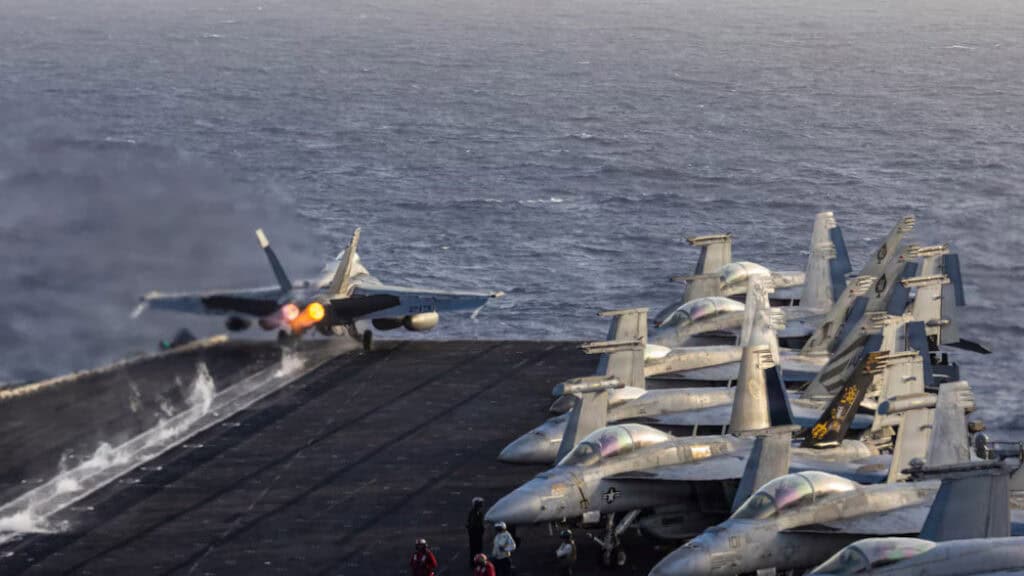
United States Central Command (CENTCOM) announced on July 7 that it had launched an attack wave on targets in Iran “to impose heavy costs” in response to the Islamic Republic’s strikes against three ships passing through the Strait of Hormuz. Although anonymous US officials told CNN that the latest kinetic campaign is a “punishment” and added that “it won’t be over for a bit,” the targets were limited to military installations on Iran’s southern coast and not major cities like Tehran.
Later that day, media affiliated with the Islamic Revolutionary Guard Corps (IRGC) reported “explosions in the cities of Bandar Abbas, Qeshm, and Sirik,” located near Iran’s southern coast. Footage circulating on social media shows strikes hitting targets across Bandar Abbas.
The Tehran regime had struck three tankers earlier on July 7, including a Qatari natural gas carrier and a Saudi crude tanker. The United Arab Emirates, Saudi Arabia, and Qatar condemned the attack.
Tehran claimed responsibility for striking the Qatari Al Rekayyat tanker, with official state broadcasting stating that the vessel was hit as it “ignored repeated warnings” and “intended to transit the Omani route through the Strait of Hormuz under the protection of the U.S. Navy.”
A cargo vessel was also struck on June 25 off the coast of Oman via “an unknown projectile,” likely a drone. Later that day, the IRGC Navy declared that only vessels using its designated shipping lanes would be permitted to transit the chokehold and all ships must coordinate with the force before entering the waterway. Iran’s Persian Gulf Strait Authority (PGSA), an IRGC-controlled entity established in May to regulate and enforce transit through the Strait of Hormuz, warned later that day: “The consequences of transiting unauthorized routes shall be borne by the vessel owner, operator and master.”
Prior to the recent conflict, ships transited the Strait of Hormuz through internationally recognized traffic lanes adopted under the International Maritime Organization. After mines and attacks by the Islamic Republic disrupted navigation, Oman and the International Maritime Organization established a temporary maritime corridor to allow commercial shipping to continue transiting the strait.
Tehran protests sanctions waiver revocation
General License X, issued by the US Treasury Department on June 22 to implement the Memorandum of Understanding (MoU) between Tehran and Washington, temporarily suspended the application of penalties under 11 Iran-related sanctions authorities for transactions ordinarily incident to the production, sale, delivery, offloading, and payment of Iranian crude oil, petroleum products, and petrochemicals through August 21. It authorized buyers, shippers, insurers, ports, financial institutions, and other service providers to participate in those transactions, including direct payments to Iran that otherwise would have been sanctionable.
However, Treasury downgraded the waiver on July 7 in response to Tehran’s aggression and issued General License X1 revoking those authorities. It no longer permits new purchases, loading, or shipments of Iranian oil after July 7. Instead, only transactions necessary to complete deals already authorized under General License X through July 17 are allowed, and any payments to blocked persons must be placed into interest-bearing blocked accounts in the United States rather than remaining available to Iran.
Iran’s Ministry of Foreign Affairs condemned the decision as a violation of Article 10 of the MoU, which states that Washington “will issue waivers for the export of Iranian crude oil, petroleum products, and derivatives, and all associated services, including banking transactions, insurances, transportation, etc.”
The Ministry of Foreign Affairs’ statement also noted that Tehran “warns of the consequences of the United States’ breach of its commitments and states that Iran will take whatever measures it deems necessary to safeguard its national interests and national security.”
Janatan Sayeh is a research analyst at the Foundation for Defense of Democracies focused on Iranian domestic affairs and the Islamic Republic’s regional malign influence.
Tags: Iran, Iran sanctions, MOU, Strait of Hormuz, US-Iran


