1 hour ago
Koh Ewe
The thousands of "ghost kitchens" - online shops that don't actually exist - have spooked Chinese consumers.

1 hour ago
Koh Ewe

 Getty Images
Chinese authorities have taken aim at a new target as they rein in the country's cut-throat food delivery industry: "ghost kitchens", or restaurants that don't actually exist but appear on apps.
The "ghost kitchens" outsource orders to third-party vendors, which fulfill them at lower costs, allowing merchants to push down prices and maximise profits.
Authorities have found thousands of these "ghost kitchens" across China, raising concerns that the cheap prices are coming at the cost of food safety.
Starting this week, apps must verify restaurants' licences and addresses, while merchants must ensure the listing online matches the physical business and specify if it offers dine-in services.
The scrutiny of "ghost kitchens" began last year, after a man in Beijing lodged a complaint over an unsatisfactory cake topped with inedible flowers. He had ordered it on a food delivery app, state media reported.
Officials found that the cake chain he had ordered from listed nearly 380 locations on major e-commerce platforms but did not have a single physical store. Its online shops also allegedly used forged business licences.
As the investigation continued, it revealed that the chain accepted orders which were then transferred to a different platform - and that is where the orders were outsourced to various third-party vendors, depending on who had the lowest bid.
Authorities found a total of 3.6 million cake orders across two order-transfer platforms, state news agency Xinhua reported last month.
They also recorded 67,000 "ghost shops" across seven major food delivery apps, which together with the order-transfer sites "formed an illegal supply chain through mutual collusion", according to Xinhua.
Food delivery platforms were complicit in these arrangements, it added. "If we're too strict in our review, the merchants would go to other platforms," a staff member from one delivery app reportedly told officials.
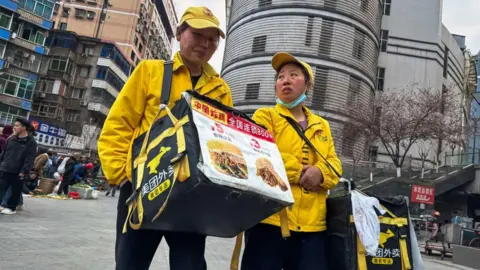
Online food delivery is a fiercely competitive industry in China.
Last year, a price war among major delivery apps led to government warnings about a race to the bottom. Bearing the brunt of ever-speedier takeouts are delivery riders scrambling to meet tight deadlines for a pittance.
In April, the State Administration for Market Regulation said that they have fined seven e-commerce platforms - including Taobao, JD.com, Meituan and Pinduoduo - a total of 3.6bn yuan ($530m; £400m), mostly over deliveries from "ghost kitchens".
As the campaign against "ghost kitchens" continues, merchants are trying to assure consumers of food safety.
According to a Xinhua report, more than 20 takeout stalls in the eastern city of Hangzhou have installed "transparent kitchens" with live broadcasting features, allowing consumers to view food preparation in real time.
In nearby Anhui province, authorities announced last week that they have signed a food safety agreement with Meituan, Taobao and JD.com, which includes using AI models to monitor kitchens and rewarding delivery riders for whistleblowing on illegal restaurants.

Chinese academics specialising in Tibet must find more creative ways to shape the global conversation about the region while remaining strictly aligned with the Communist Party’s ideology. That was the message Li Ganjie, head of the Communist Party’s United Front Work Department, had for researchers

Some people living with spinal muscular atrophy (SMA) have never been able to stand on their own. SMA is a genetic disorder that causes the nerves that connect the brain and muscles to deteriorate over time, making it challenging or even impossible for those affected to contract their muscles. Over

Beijing could conduct military operations, bolster its electronic warfare strength and roll out trade sanctions in response to Tokyo and Manila’s deepening defence cooperation, according to Chinese experts. Last week, Manila and Tokyo announced they would launch negotiations on the maritime boundary

The need for Beijing and Washington to pursue “reconciliation and cooperation” and avoid war is the central message of her US trip, Taiwan’s main opposition leader Cheng Li-wun said in San Francisco. Cheng, leading a delegation from the Kuomintang (KMT), arrived in San Francisco on Monday evening, b