
Japan began developing a domestically produced unmanned amphibious armored vehicle (AAV) in 2024, and materials recently disclosed by the Ministry of Defense have revealed its detailed performance characteristics.
For more than a decade, Japan has been pursuing measures to strengthen its maritime defense capabilities in response to China’s expanding military power. Among these efforts, the defense of the Nansei Islands, including Okinawa, has become an urgent priority, as these islands are considered vulnerable to attack and amphibious assault by the Chinese military in connection with a possible Taiwan contingency. Against this backdrop, in 2018 the Japan Ground Self-Defense Force (JGSDF) established the Amphibious Rapid Deployment Brigade (ARDB) in Nagasaki Prefecture, located in the Kyushu region of southern Japan. The ARDB is the first unit in the history of the JGSDF specializing in amphibious operations and is often described as having a Marine Corps-like character. Its mission is to recapture remote islands occupied by an enemy force.
The ARDB has three infantry-based regiments, known as Amphibious Rapid Deployment Regiments, under its command. To support their landing operations, the brigade also includes a Combat Landing Battalion equipped with U.S.-made AAV-7 amphibious assault vehicles. The Combat Landing Battalion operates 52 AAV-7s, which are used to transport infantry units to remote islands and to support the seizure of beachheads through their protection and firepower.
However, the AAV-7 faces several challenges. First, many of Japan’s islands are surrounded by coral reefs, yet the AAV-7 has only limited ability to traverse such reefs. As a result, landing operations are largely restricted to gently sloping sandy beaches, greatly limiting the number of potential landing points. In addition, the AAV-7’s armament consists only of a 12.7 mm machine gun and a 40 mm automatic grenade launcher. If an enemy were to respond with armored vehicles or similar assets, the AAV-7 would be unable to effectively counter them.
To address these shortcomings, the Ministry of Defense decided to proceed with the development of a domestically produced Amphibious Assault Vehicle (AAV). The new Japanese AAV is designed to generate substantial propulsive force by using both its tracks and water jets mounted at the rear of the hull in order to overcome coral reefs. This capability would allow landing operations to be conducted from a wider variety of locations on remote islands. In terms of armament, the vehicle is expected to be equipped with a remote weapon station (RWS) capable of mounting not only a conventional 12.7 mm machine gun, but also a 30 mm automatic cannon. This would enable it to engage and counter enemy armored vehicles as well.
AAV for MUM-T
What is particularly interesting about this domestically produced AAV is that development is proceeding with the aim of enabling not only direct operation by onboard crew members, but also remote control from another vehicle and autonomous maneuvering. A concept known as Manned-unmanned teaming (MUM-T). This is intended to minimize personnel casualties by unmanning the first wave of the landing force, which would likely suffer the heaviest losses when attempting to break through enemy positions established on a remote island and secure a beachhead along the coastline.
Japanese military expert Santaro Iwamoto(X ID: @Military_Hobbys) obtained materials on this domestically produced AAV through a freedom-of-information request submitted to the Acquisition, Technology & Logistics Agency (ATLA), which is responsible for the development of defense equipment, and provided them to Naval News. According to these materials, ATLA plans to manufacture four prototype vehicles ahead of practical testing scheduled to begin in 2027. All four vehicles will be equipped with remote-control and autonomous-maneuvering functions. However, the fourth vehicle will also be fitted with enhanced power-generation capacity, with a view toward future capability upgrades.
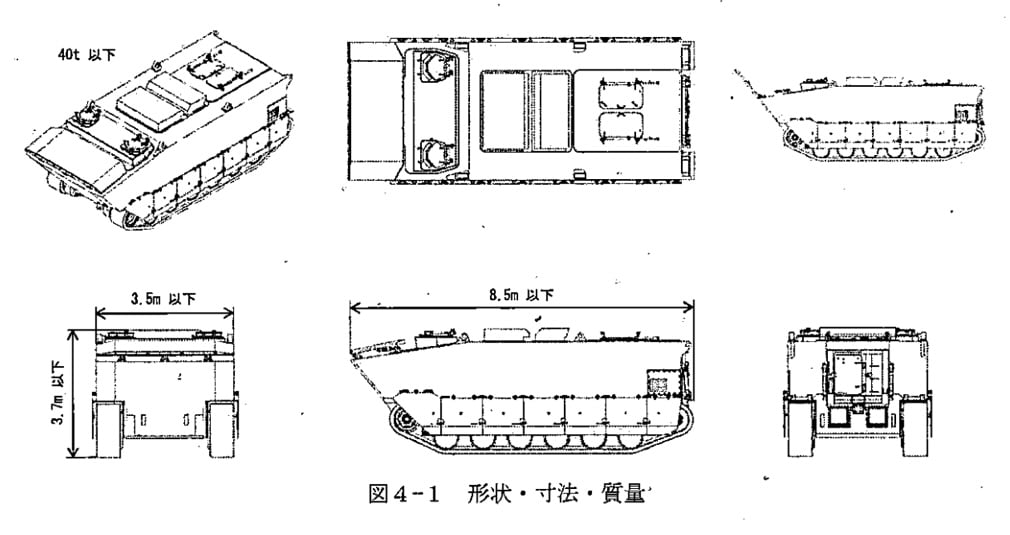
The vehicle body will be equipped with visible-light and infrared sensors, among other systems. By sharing data from these sensors with other AAVs, remote operation will be made possible. The vehicle will also be capable of autonomous maneuvering by following a route set in advance by the crew, based on predesignated waypoints. In addition, to enable networked combat operations, the vehicle is expected to be fitted with a command-and-control system based on the system installed on the JGSDF’s Type 10 main battle tank. This is expected to allow the location data of targets detected by individual vehicles and other assets to be shared across the force, while also enabling the transmission of operational instructions and the allocation of targets for engagement.
Japan’s Ministry of Defense is believed to be planning to field around 97 of these domestically produced AAVs. After completing various tests during 2027, deployment is scheduled to begin in 2028.
