
Executive Summary
Women’s political participation in Yemen is declining. It is also taking place within a political system that is increasingly fragmented, informal, and dependent on closed power-sharing arrangements. Before the outbreak of the current conflict, the institutional pathways through which women could build political experience and advance into leadership roles were already limited. Today, these pathways have narrowed further, as political authority has become more concentrated within elite power-sharing arrangements, and key political discussions, negotiations, and decision-making take place outside formal institutions.
Following the official dissolution of the Southern Transition Council (STC) at the start of this year, the newly restructured Presidential Leadership Council (PLC) announced a new government that included three women ministers among its 35 members. While these appointments revived hopes for more substantive female participation in government, their broader political significance must be assessed against a landscape shaped by armed actors, regional calculations, shifting alliances, and the continued fragmentation of institutional authority.
Drawing on interviews with women and men active in the Yemeni political landscape, this policy brief examines formal political institutions, traditional political parties, and regional political movements that have emerged in recent years, using the experience of women working for the Consultation and Reconciliation Commission (CRC), the political body formed to support the PLC, as a primary case study. The analysis examines how women are nominated to and positioned within these arenas, how they use limited access to exert influence, and whether any pathways to sustained and meaningful political participation remain viable for Yemeni women.
This policy brief argues that without stronger institutional pathways, collective political platforms, and more predictable mechanisms for representation, women’s participation risks remaining constrained by elite decision-making rather than being cumulative and transformative. Supporting women’s political engagement in Yemen requires rebuilding representative political systems, strengthening party structures and internal inclusion, addressing informal barriers to influence, and ensuring that women’s participation is built into political processes rather than relying on ad hoc deals or individual appointments.
Selected Recommendations
1. Move from symbolic inclusion to meaningful participation
Ensure women’s representation extends beyond symbolic inclusion to meaningful influence in decision-making across the government, including in leadership positions related to peace negotiations, governance, and the development of state-building policies.
2. Institutionalize women’s participation through binding mechanisms
Adopt formal quotas and establish procedural rules for the government, political parties, and transitional bodies to guarantee women’s inclusion in leadership positions, delegations, and decision-making processes.
3. Reform informal political practices that exclude women
Minimize reliance on informal gatherings for key decisions, and transition to structured, transparent processes that ensure equal access to information and participation.
4. Strengthen protections for women in politics
Establish and enforce legal protections and safeguards, both online and offline, against harassment, defamation, and emerging AI-enabled abuse, while ensuring the financial, logistical, and institutional support necessary for women’s safe and effective participation in the political sphere.
5. Invest in women’s political leadership and collective power
Support mentorship, leadership development, and cross-party women’s networks to strengthen women’s long-term political engagement and enhance their collective influence across institutions.
6. Align international support with measurable gender inclusion outcomes
Condition international engagement and funding on clear benchmarks for women’s participation and leadership.
Introduction
“The aspiration is for women to reach a stage where female representation is natural and rooted in political culture.” [1]
Yemeni women were highly visible and politically active during the 2011 uprising and the subsequent 2013-14 National Dialogue Conference (NDC). Their achievements at the NDC, including a recommendation for a 30 percent quota for women’s representation in state institutions, established an important normative shift in women’s political participation. Although Yemen still lacks formal gender quotas, the NDC recommendation established a benchmark. Following the outbreak of the current conflict in late 2014, this commitment and many others were put aside as political authorities and competing factions prioritized military competition, territorial control, and institutional survival.[2] In the transitional political bodies formed since the war began, including the internationally recognized government’s Presidential Leadership Council (PLC) and its advisory body, the Consultation and Reconciliation Committee (CRC), women are either absent or significantly underrepresented.
While existing research has documented the persistent marginalization of women in Yemen’s peace processes and political parties, few studies have examined women’s participation within governing institutions. This policy brief examines the broader political landscape in which women currently participate, including formal institutions such as the PLC and the CRC, as well as traditional political parties and new political movements that have emerged during the war. It explains how women are nominated, represented, and positioned in these different arenas, and assesses whether pathways for sustained and meaningful political participation remain available for women in Yemen.
This policy brief argues that the restructuring of Yemen’s political system has narrowed the institutional channels for women’s political engagement. The conflict has disrupted and reshaped the pathways through which women can enter and navigate political life. Women’s participation is increasingly reliant on individual appointments that are detached from broader political processes. While such openings offer opportunities, they can also limit the accumulation of political experience, weaken collective networks, and make women’s collective political influence more fragile and difficult to sustain over time.
1.1 Methodology
This paper draws on ten semi-structured interviews with Yemeni women involved in formal political institutions. Participants included members of the CRC, representatives of political parties such as the Yemeni Congregation for Reform (Islah), the General People’s Congress (GPC), and the Yemeni Socialist Party, as well as women active in more recently created political movements, the Southern Transitional Council (STC) and the Hadramawt Inclusive Conference (HIC). The CRC is used as a case study to examine broader trends, institutional challenges, and evolving risks affecting women’s political participation in Yemen. Participants were selected through purposeful sampling to ensure diversity in background, political affiliation, and leadership experience.
Interviews were conducted between February 2024 and October 2025, with most taking place between July and October 2025. Follow-up discussions were held when clarification or updates were needed. Conversations were conducted in person when possible, or via Zoom and WhatsApp, depending on availability, accessibility, and security. All interviews were conducted under conditions of confidentiality. The findings were analyzed thematically and contextualized through existing research on women’s political participation in Yemen.
Women’s political participation in Yemen involves more than just their numerical representation; it encompasses their access to decision-making spaces and the exercise of influence in practice. While “critical mass” theory suggested that women’s collective impact increases once they reach a certain threshold (30 percent),[3] other research indicates that simply increasing women’s representation does not translate into greater influence over political agendas or outcomes. Scholarship on “critical actors”[4] challenges the assumption that numbers alone drive influence; individual women (and sometimes men) can shape political agendas and advance women’s interests regardless of how many women are present. In many cases, influence depends less on numbers and more on the actions, strategies, and positioning of these actors.
In Yemen, where women’s formal representation remains limited and political institutions are fragmented and often highly informal,[5] this distinction is particularly important. Women’s influence is often exercised through informal networks, strategic alliances, and efforts to promote specific issues and policy priorities. In this paper, the authors draw on the “spaces and power”[6] framework to examine how access, roles, and influence are shaped by those who control political spaces, the purposes those spaces serve, and the conditions under which women are able to act within them.
Women Navigating Fragmented Political Arenas
Yemen’s political structure has undergone dramatic institutional changes in recent years, especially after the creation of the PLC in 2022. The council was formed through elite political negotiations held in Riyadh and resulted in an eight-member body that replaced then–President Abdo Rabbu Mansour Hadi as the country’s executive authority. The PLC’s establishment represented a significant departure, not only from democratic processes but also from the formal marginalization of traditional political actors such as political parties. Significantly, the council included no women.[7]
Alongside the PLC, the CRC was created as an advisory body intended to support the council and broaden political consultation. While the CRC includes five women among its 50 members, it does not exercise executive authority and primarily serves a consultative role. The cabinet formed in 2020, which included no women among its 24 ministers, remained in place after the PLC was created. Yemen’s House of Representatives has likewise remained without women’s representation since 2003, the last year parliamentary elections were held.[8]
The creation of the PLC, followed by the announcement of the CRC, raised important questions about the implications of this transition for political and civic life in Yemen. Representation within the PLC appeared largely determined by power dynamics on the ground. With parliament effectively paralyzed,[9] the CRC was established partly to accommodate the political parties that had been excluded from representation in the new executive structure. As one party leader described it, “the body functioned as a form of political compensation for marginalized actors.”[10]
Recent political developments have added new layers to Yemen’s complex political landscape. Following the official dissolution of the STC in January 2026, a new government was formed that included three women ministers among its 35 members: Afrah al-Zuba as Minister of Planning and International Cooperation; Ishraq al-Maqtari as Minister of Legal Affairs; and Ahed Jaasous as Minister of State for Women’s Affairs. Along with a speech from PLC member Abdullah al-Alimi emphasizing the importance of women’s inclusion,[11] these appointments revived hopes for more substantive female participation in government.
Table 1
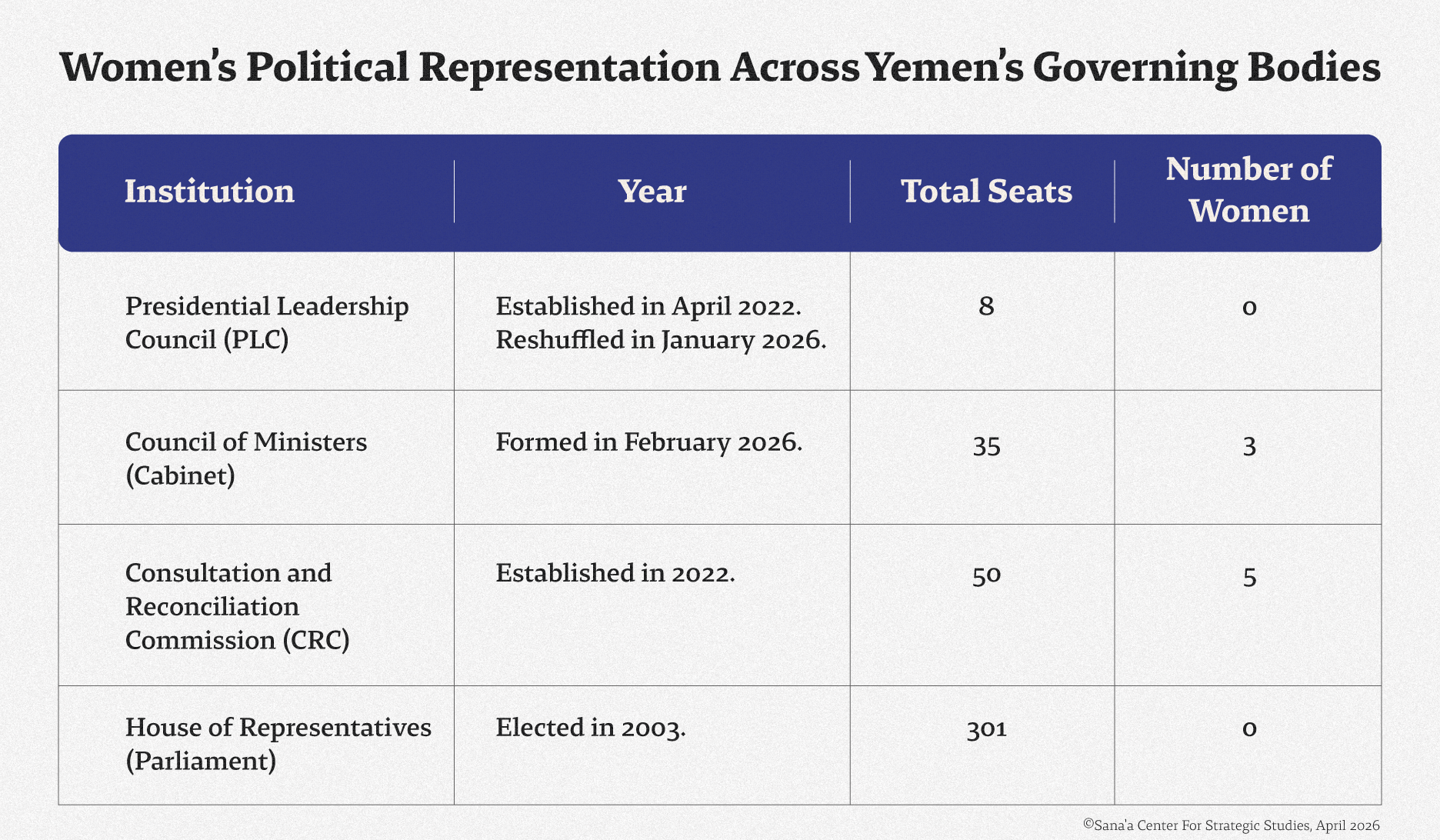
The recent appointment of women to the cabinet should be understood within the broader political environment. These isolated gains place a small number of women in visible positions, while leaving broader structures of exclusion largely unchanged. Without institutional mechanisms that support women’s pathways to political access, influence, and collective representation, women’s political participation in Yemen will remain symbolic and tokenistic rather than transformative.
2.1. Eroding Political Pathways
Beyond formal national institutions, women’s political participation in Yemen has historically been mediated through political parties and partisan networks. Traditional parties have long played a central role in organizing political life and served as a main entry point for women to engage in politics. The Yemeni Socialist Party (YSP), the Yemeni Congregation for Reform (Islah), the General People’s Congress (GPC), and the Nasserist Unionist People’s Organization have served as pathways for women’s political careers, in some cases introducing internal quotas for women ranging from 15 to 25 percent.[13] But women’s access to leadership and decision-making roles remained low.
The war has further curtailed these limited opportunities. As political parties weakened in the absence of a centralized government and formal party structures, the pathways through which women previously engaged have become increasingly limited. In response, Yemeni women joined civil society organizations, which, at the start of the war, were safer and more accessible avenues for public engagement. For some, civil society has proved a useful vehicle for remaining active in public life at a time when political roles were not only reduced but also exposed them to harassment and intimidation. The expansion of humanitarian operations in Yemen also opened new opportunities for women to work through civil society and humanitarian initiatives, allowing many to remain engaged in the public sphere even as the opportunities within party politics declined.[14]
Since the start of the war, Yemen’s political landscape has also seen the emergence of new political movements and regional political formations, including the STC and HIC.[15] These developments have created new spaces for negotiating and contesting political authority and legitimacy. In some cases, they have opened new avenues for women to engage in political life, but for the most part, the underlying social, institutional, and political barriers that limit women’s participation remain unchanged.
The challenges of war are often cited as reasons for excluding women from top political roles. A leader from the STC explained that Yemen’s unstable and highly fragmented political climate makes it difficult to assign women to more influential or decision-making roles.[16] While some male representatives from other political movements acknowledge the importance of women’s participation in political and peace processes, many argue that the ongoing conflict and its surrounding dynamics make it challenging to prioritize their inclusion[17]. Externally brokered arrangements, the sidelining of traditional political institutions, and the empowerment of armed actors have created an environment in which women’s political participation is contingent on elite negotiation rather than stable institutional pathways.
Beyond questions of representation, the sustainability of women’s political participation has become a question of safety. Women active in politics and public life increasingly face harassment, smear campaigns, and intimidation, both online and offline, and, in some cases, targeted violence by armed actors. Reports from the past decade document growing threats against politically active women, with some forced into exile and others pushed out of public life, despite holding formal positions.[18] Such patterns suggest that violence and intimidation have become tools for shaping and restricting political participation, particularly for women.
In today’s political environment, the question is no longer whether women can access political institutions, but whether the limited institutional pathways that once enabled political participation and representation still exist. Without restoring meaningful channels of participation and ensuring protection for those who remain active in public life, women’s inclusion risks remaining symbolic.
Case Study: The Experience of Female Members of the CRC
3.1. Top-Down Appointments
The women appointed to the CRC come from diverse and established backgrounds spanning politics, academia, civil society, human rights advocacy, and public policy. Together, they bring extensive experience in political processes and civil society leadership, including involvement in national dialogue initiatives. While their appointments represent a positive step toward women’s participation in high-level politics, the procedural opacity of their selection raises broader questions about the nature and substance of such inclusion. All female members of the CRC interviewed reported having no prior knowledge of how or by whom they were selected, despite emphasizing that their professional and civic records likely informed the decision.[19] “I did not even know I was nominated until the announcement,” said one. “We only heard after the fact — no one consulted us,”[20] remarked another. A third recalled learning of her appointment when she “heard [her] name on television while [she] was in Cairo.”[21] Some of their male counterparts justified the closed-door selection as a necessity of wartime politics. A male political leader from the STC explained, “We are in a state of war. Reality has imposed military forces over political ones […] balance was prioritized over representation.”[22]
One female member described the personal and professional dilemma she faced when her appointment to the CRC was announced: “When I woke up to the news of my selection, I felt torn,” she explained. “I hadn’t been consulted, and part of me wanted to decline because of my existing commitments. But I also felt it was my duty not to step back. It’s not easy for women to break the glass ceiling in Yemen. Being among the five women in the CRC was already a win for the women’s movement. I had advocated for women’s inclusion for so long, I just couldn’t find myself refusing when it finally happened.”[23]
Despite these constraints, women appointees framed their appointments as their civic duty, rejecting suggestions of tokenism and arguing that their presence provides a vital foothold for influence. For them, the CRC serves as a practical arena for translating decades of grassroots and political experience into institutional policy.
3.2. Bottom-up Influence: Building Collective Leverage in the CRC
“I believe our role is significant; we’ve proven that Yemeni women are capable, as shown during the National Dialogue Conference (NDC). We are not only defending women’s rights; we are deeply engaged in the complexities of Yemeni politics.”[24]
Women members of the CRC described entering a political space that had not been designed with women’s participation in mind. In the early stages of the CRC’s operation, some male members appeared to view the women’s appointments as “ticking a box” imposed by external pressure.[25] Some men questioned the women’s political experience, assuming their backgrounds were limited to work in civil society. Despite what female interviewees describe as biased perceptions based on deep-seated gender assumptions, the five women have actively participated in the CRC’s work, asserting their roles as political actors.[26]
Within the Commission, women have taken on crucial leadership roles, chairing committees and helping to establish formal procedures for internal processes. Several male and female interviewees described their role as instrumental in improving the CRC’s operational structure. By contributing to the development of standardized protocols and formal internal systems, they believe women members have helped transition the CRC from informal, relationship-based politics toward a more structured, accountable framework, with institutionalized practices.[27]
Some of the women on the CRC have also gained influence within the Commission by capitalizing on their political backgrounds, personal networks, and access to senior decision-makers. Many female members found that this has been accompanied by a perceptible shift in attitudes among male counterparts, who increasingly recognize their contributions. External observers echoed this sentiment. A Yemeni journalist noted how women’s determination and technical competence in the CRC have led to greater acceptance and recognition of their pivotal role within the institution.[28]
Solidarity among the women has been central to this trend. “The five of us are in full agreement and coordination; there are no disputes among us,” said one.[29] “Such harmony has reflected positively on the Commission. Whenever we take part in meetings, we do so in full coordination among us women […] if we were to participate individually, our voices would be lost amid the opinions of political actors.” Collective engagement and strategic collaboration have enabled them to incorporate their perspectives into the deliberations of various committees. “We agreed from the very beginning that we would not work separately,”[30] added another member, explaining the formation of “the women’s bloc,” where each took positions on different committees to ensure their presence across decision-making spaces.[31] This coordination has also functioned as a source of leverage. It has enabled them to stay informed, remain involved in key discussions, and push work forward, while navigating partisan politics and the influence of dominant political factions. As one member shared: “The women’s bloc has given us an important role and strength vis-à-vis others.[32]
In practice, this leverage has proved consequential. When key outputs – such as the Commission’s internal bylaws and a framework intended to guide the government’s position in future peace talks – faced delays due to political disagreements, female members collaborated to apply pressure to move the process forward. One interviewee mentioned that “many committee outputs were stalled, particularly by representatives of [a particular political movement],”[33] adding that “women expedited things.”[34] Several members agreed that coordinated efforts by CRC women proved decisive in breaking the deadlock. In their view, core functions of the CRC would have remained stalled without their contributions as political brokers.[35]
3.3 Gender Dynamics in the CRC: Participation and Barriers to Advancing Women’s Issues
“Given the circumstances and situation [in Yemen], the CRC’s work remains limited, and sometimes seasonal […] This affects us all, our roles, and our effectiveness, not only as women but as Commission members.”[36]
Female leaders at the CRC pointed out that the constraints they face are often rooted in the wider political environment surrounding the CRC. Several women said that their opinions are valued in committee discussions and that mutual respect characterizes everyday interactions. One member remarked, “To be fair, we feel our opinions are heard, and there is mutual respect; we haven’t had confrontations that made us feel our proposals were ignored because they came from women.”[37]
Interviewees, however, were careful to distinguish between participation and influence over decision-making, especially in relation to advancing women’s issues. A consistent theme that emerged during interviews was the distinction between personal respect for women as political actors and support for the women’s issues they seek to advance. As a female journalist noted, “Respect is not the same as valuing [the] women’s agenda.” [38] She explained that male colleagues may appreciate women’s work ethic and perspectives on political issues, but do not necessarily view women’s issues and priorities as political.[39] When female members of the CRC raise such issues, these are often “brushed off” or “laughed off” as not constituting political priorities.[40]
One CRC member captured this tension, stating: “Have we single-handedly [as women] shifted major outcomes yet? No – but we have presence and leverage.”[41] This ultimately reflects a dual reality: while women’s contributions, in some cases, helped shape major outcomes, they tend to be more limited in final decision-making authority or in advancing women-specific issues.
3.4. Structural and Institutional Challenges for Women on the CRC
Women on the CRC pointed to structural constraints that undermined their participation and influence, citing unequal access to information, inconsistent meeting schedules, political partisanship, and limited resources as key barriers. A particularly prominent theme across interviews was unequal access to information. This included not only CRC-related information, but also other political updates that male members could more readily access. One female member noted that “because most Commission male members represent political components, they meet with their groups, while we, except for one female member, are not affiliated with parties. This leaves us uninformed about some discussions and what is being circulated. We are surprised in Commission meetings when political forces’ viewpoints are presented – many members are already in the know, while we are not.”[42]
Much of the Commission’s decision-making occurs in informal settings, such as closed-door meetings, sideline conversations, and through personal networks. Several women reported feeling excluded from these circles, where agreements are often shaped before being brought to the table. One of the most critical avenues for these sideline discussions is the CRC’s majlis, a dedicated informal space for members to socialize and chew qat. Because these discussions are usually limited to men, the use of the majlis[43] has become an additional obstacle for women on the Commission. Sensitive political updates and negotiations are often discussed informally in qat sessions among senior male actors, limiting women’s access to information due to the segregation of spaces in Yemen. A female CRC member shared her view on this: “I sometimes find myself facing party and political blocs, when they have already debated their ideas in qat sessions and come ready to Commission meetings with an agreed position representing their bloc.”[44]
Other women shared similar challenges, “When we go to Aden, members go to qat gatherings where many issues are discussed, and ideas and information are shared.”[45] Women have had to overcome this exclusion by creating their own informal spaces for outreach and follow-up. “We women also meet, but our numbers are limited, and the broader information is with the other members,” said one female member. “We can’t obtain the additional, important information, so we have to follow up and hold meetings with other members to get it. Information reaches male members smoothly and easily, while we acquire it with difficulty.”[46]
Another female member of the CRC shared how some female members were overcoming these challenges: “One of my female colleagues makes a huge effort and dedicates most of her time to meeting people [separately] to obtain information. We have to exert great effort, while men obtain information easily and without all this trouble.”[47]
Some female members have begun to enter qat and majlis gatherings, breaking traditional gender boundaries to access information and strengthen relationships. “We have begun to ‘break into’ qat councils,” reported one female interviewee. “The Commission has a diwan and qat majlis, and we started attending them; that way, we hear the discussions and become informed, especially since this majlis setting prompts people to talk and share information.”[48] While these strategies enable women to access information, they also expose the underlying structural inequalities in the CRC.
Access to political and financial resources is another challenge noted by the interviewees, with one citing a declined funding request to advocate for women’s participation in the newly formed government. “There may be a meeting in Amman, and it’s important that women be informed and close to what’s happening there, yet we don’t get funding to participate and travel.”[49] Such experiences echo women’s participation in Yemen’s peace processes. During the Riyadh Agreement negotiations in 2019 and the government-STC ceasefire talks in 2020, no women were present. At the UN-led Stockholm talks in 2018, women made up only 4 percent of delegates, and none served as mediators. The highest level of women’s representation occurred at the Kuwait talks in 2016, where women accounted for 12 percent of delegates, but their influence on negotiations remained limited.[50]
At the CRC, however, some women have turned their lack of party affiliation into influence. As one interviewee observed: “Most of us women are not hardcore loyalists. That gives us flexibility to push for practical, consensus-based outcomes rather than ideological clashes. I’d say that makes our collective influence quite substantial for our numbers.”[51]
Overall, the appointment of five women to the CRC marked a positive step for women’s political participation, with these members actively leveraging their positions to influence processes. But as prominent academic Deniz Kandiyoti warns, when such appointments come from above, women’s presence can serve to bolster regime legitimacy, while genuine political commitment to support women’s meaningful participation remains limited, leaving such gains fragile and easily reversible.[52] This dynamic is visible in Yemen in several ways. While individual appointments may create the appearance of inclusion, they risk fragmenting women’s political engagement by limiting the accumulation of collective experience, institutional memory, and shared networks. When participation becomes individualized, lessons learned and relationships built remain confined to single actors, limiting women’s broader political influence. Gains achieved through closed-door appointments can dissipate quickly as political winds shift, a recurring pattern in Yemen’s political landscape over the past decade.
Traditional Parties and New Political Movements
“Women in traditional parties hold decision-making positions, while in the new movements, women have yet to hold such a position. But we have hope this will change.” [53]
Women’s participation in the CRC cannot be understood in isolation from broader transformations in Yemen’s political party system. Traditional parties once served as key entry points into politics for women, but the war and fragmentation of authority have reconfigured these pathways. Parties such as Islah, the GPC, and the YSP provided women with paths to political leadership, allowing some to serve as ministers, directors-general, or diplomats. One female party member noted that, in the past, Yemen’s traditional parties provided women with visible roles and a clear path into politics, but added that those opportunities have now almost disappeared.[54] The war and deepening political divisions have closed most of those doors. Many of the women interviewed said that the parties that once gave them a voice now protect male leadership circles and exclude women.
During the war, newer movements such as the STC and the HIC[55] have created new political spaces accessible to women. But while women are entering these arenas, their authority remains limited. Unlike the rigid hierarchies of traditional parties, these new political movements were perceived by some interviewees as alternative avenues for political engagement. Reflecting on this distinction, a female politician described the difference between the two entities from her experience as follows: “A political party [hizb] is a national entity, while a political movement [al-haraka al-siyasiya] is specific to a certain region. These movements have created more inclusive spaces for women and given them a presence, but not real influence […].”[56]
Female members of the STC and HIC described being included in different departments and regularly participating in meetings with senior leadership. In these settings, they have been asked their perspectives on what women need, indicating a degree of agency within the organizations. However, compared with traditional parties, where women have held decision-making roles, women members of these newer political movements have yet to institutionalize their influence.
In both the STC and the HIC, women’s participation is largely confined to administrative roles or “soft” portfolios, such as social affairs or women’s issues. Deliberations on security, defense, and economic issues tend to be male-controlled. The result is a persistent skills gap and a cycle of marginalization that prevents women from building political credibility, visibility, or influence. Nevertheless, women within these movements expressed cautious optimism, aspiring to eventually secure decision-making positions that reflect their capacities and political experience.[57]
Across all interviews, participants consistently pointed to the emergence of a dramatically different political landscape since the war began. One female leader described it plainly: “While women once became ministers or directors-general through the parties, today exclusion is sharper — no party leader says: ‘I will send a woman instead of myself.’ That mentality does not exist.”[58] Although movements such as the STC and HIC appear to offer alternative entry points for women into politics, their inclusion remains limited.
5. Conclusion
Women remain active across government institutions, political parties, and emerging political movements in Yemen, but their participation is often dependent on personal nomination and informal access to power rather than on institutional processes. As political parties weaken and appointment-based mechanisms expand, opportunities for women to build sustained leadership trajectories or collective political influence have become more limited and uneven.
Women’s political participation has not only declined during the ongoing conflict, but has also been fundamentally restructured. The institutional pathways that once enabled women to accumulate experience through party work, elections, or ministerial roles have eroded. In their place, elite-driven nomination processes and informal political negotiations now play a larger role in determining who gains entry into national bodies and how long they remain politically relevant. While the inclusion of women in structures such as the CRC represents an important symbolic gain after years of exclusion, this participation remains precarious and weakly connected to broader mechanisms of representation.
Women’s influence within transitional institutions is shaped not only by formal mandates but also by unequal access to information, exclusion from informal decision-making spaces, and limited organizational backing. Male-dominated networking arenas, factional alliances, and opaque nomination processes continue to determine political leverage. In such an environment, there are few opportunities to consolidate or transmit political experience across generations of women leaders, and representation is at perennial risk of reversal.
Our findings show that social respect for individual women does not necessarily translate into support for women’s political agendas or gender-related priorities. While some women gain recognition for their professional contributions, efforts to advance women’s concerns are often sidelined or framed as secondary to security and power-sharing negotiations. At the same time, women are not passive actors. Many actively build alternative networks, negotiate across factional divides, and position themselves as facilitators of consensus. These strategies allow them to exercise influence at specific moments. However, the impact of a few individuals rarely translates into durable institutional change or clearer political pathways for other women.
In Yemen’s complex political landscape, formal political inclusion and access to decision-making spaces are increasingly shaped by power-sharing arrangements and factional interests. Yemen’s patriarchal political culture, the influence of regional actors, and a zero-sum approach to power have produced a glass ceiling with multiple layers. Women continue to navigate these constraints with skill and persistence, carving out influence where possible. Yet their access to the political sphere remains fragile.
While women-led civil society organizations and networks have played an important role in keeping women at the table, lasting progress will depend on internal political reform. Moving beyond symbolic inclusion requires a shift toward political accountability, where women’s participation is recognized as essential to institutional credibility and long-term stability. As a female member of the HIC noted, “The aspiration is for women to reach a stage where female representation is natural and rooted in the political culture.”[59] Turning this aspiration into reality will require both domestic reform and sustained external advocacy that prioritizes women’s meaningful inclusion across all decision-making spaces.
6. Policy Recommendations
Recommendations to the Government of Yemen
Recommendations to Political Parties and Movements
Recommendations for Women in Politics
This publication was produced as part of the Supporting Political Dialogue for Peace in Yemen program, implemented by the Sana’a Center for Strategic Studies and CMI-Martti Ahtisaari Peace Foundation and funded by the European Union.
Endnotes


