
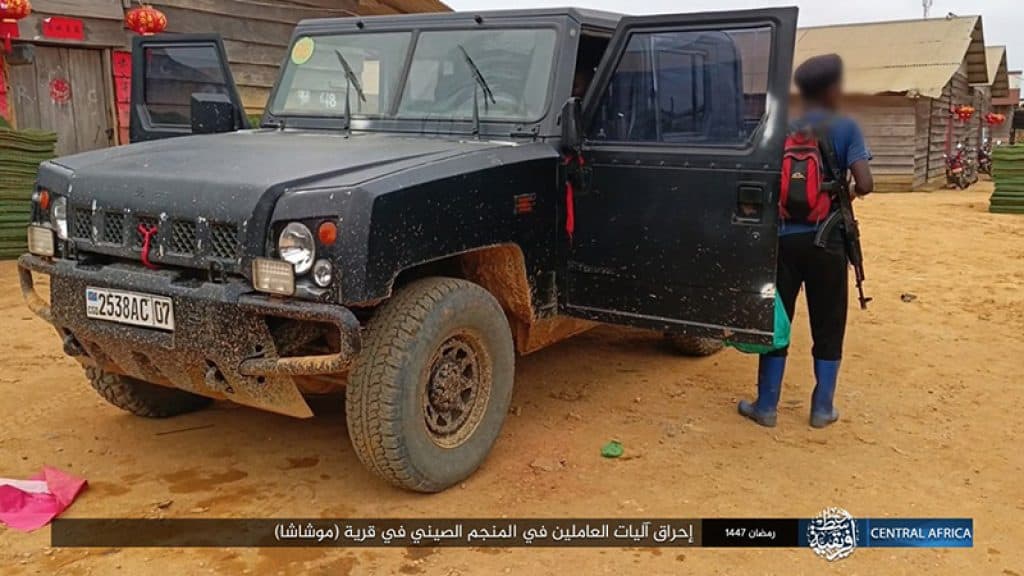
Between March 11 and 12, the Islamic State’s Central Africa Province (ISCAP) attacked and destroyed a Chinese-owned mine in Muchacha in Congo’s Ituri Province, more than 50 kilometers outside of the jihadist group’s past areas of operation. In addition to being the first attack of its kind perpetrated by ISCAP—now putting Congo’s mining sector into its crosshairs—the incident also shows the group’s resilience and ability to conduct major operations, despite almost five years of sustained combat operations against its forces.
According to local accounts, militants from ISCAP, many of whom were children, began their attack by targeting positions of the Armed Forces of the Democratic Republic of the Congo (FARDC) adjacent to the Muchacha gold mine. The mine is operated by the Chinese-owned company Kimia Mining. Videos posted on social media detailed the chaos of the scene, with hundreds of Congolese civilians, as well as dozens of Chinese workers, seen fleeing down and across the Ituri River. In the background of the videos, large fires are visible at the site.
ISCAP fighters then attacked the mine itself, including the civilian living quarters, killing at least 17 people and burning houses and vehicles. The gunmen also abducted at least another 100 civilians, though some have reportedly already been released, likely because such a large number of hostages would slow down the group’s rapid movements. Rumors on social media of Chinese casualties have, so far, been unsubstantiated.
Photos from the attack published by Islamic State show the bodies of three FARDC soldiers killed by the jihadists, and the group took credit for killing seven soldiers, alongside the 17 civilians. A large amount of captured FARDC weapons and ammunition was also shown in the Islamic State’s propaganda from the incident.
Female members of the jihadist group, as well children, were also seen looting goods and supplies from civilian houses (photos on file with the authors). ISCAP militants also raided the mining facility itself, with photos released by the group showing its men burning bulldozers, trucks, and other heavy equipment.

A day after the attack on the mining site, a nearby FARDC patrol that was attempting to reinforce the area also fell into an ambush near the locale of Penge, just across the Ituri River from Muchacha. According to local reports, at least one FARDC soldier was killed in this attack, though pictures published by Islamic State show two FARDC soldiers killed and one captured, along with looted weapons and ammunition.
The Islamic State claimed that seven soldiers were killed in total. Additional attacks on civilians not far from Muchacha have also since been claimed by ISCAP.
According to local officials, the Muchacha attack (and subsequent assaults in the area) was carried out by a reconnaissance group led by Tanzanian Arab commander Ahmed Mahmood Hassan, better known as Abuwakas. According to these officials, Abuwakas left the group’s largest camp in the northwestern Lubero territory, moving north along the Lenda River towards Muchacha.
Abuwakas has led the group’s primary offensive unit in Lubero since first entering the territory in June 2024, likely accounting for a large majority of the at least 952 civilians killed by the group in the territory since then, according to data kept by the Bridgeway Foundation.
The assault on Muchacha was followed four days later by an attack on Babesua village, located 13 kilometers north of Muchacha, along the Mambasa-Badengaido section of National Road 4. The attack killed 19 civilians. The direction of movement indicates that Abuwakas’s mobile group was heading toward ISCAP’s “Madina” headquarters camp near Nduye, another 100 kilometers away through the Okapi Wildlife Reserve to the northeast.
Abuwakas is known for the wanton use of child soldiers (even more so than other ISCAP camps, which all utilize children to varying degrees) and for a particular brand of extreme violence. In general, defectors have consistently reported that ISCAP commanders prefer abducting male children and teenagers for forcible recruitment due to the relative ease of indoctrinating them into the group’s radical ideology.
In response to ISCAP’s assault, Kimia Mining, through its local Congolese partner MCC Resources, announced that mining activities at Muchacha were suspended “until further notice.” This is likely to be a substantial financial loss, with as much as 3-5 kilograms of gold reportedly being extracted from the mine per week, accounting for roughly $25-42 million a year in revenue. In 2021, authorities seized 31 kilograms of gold, worth $1.9 million, that was mined from the site, which is located in a disputed part of the Okapi Wildlife Reserve that the company maintains is outside the reserve.
It is unclear whether other mines in the same general area, many of which are also owned by Chinese companies, have also suspended operations. Likewise, it is unclear if ISCAP was able to loot any gold from the mine.
An unprecedented attack
ISCAP’s assault on the Muchacha mine represents one of the group’s most surprising operations. While ISCAP has previously raided remote artisanal gold mines, Muchacha is operated by thousands of workers and has required millions of dollars of investment in equipment, infrastructure, and protection paid to the FARDC’s 311th Battalion, most of which has been deployed to protect mines owned by Kimia Mining in the area since at least 2022.
Until last week, the jihadist group did not specifically target large semi-industrialized mines in this manner; instead, it operated taxation or protection schemes on smaller artisanal gold mines within its core areas of operation (AO). That ISCAP was able to travel so far out of its normal AO undetected and then assault a fortified mining complex protected by FARDC soldiers, now potentially puts other large-scale mines, many of which also operate in Ituri Province’s Mambasa territory, within the group’s crosshairs.
Though ISCAP has always relied on mobility as one of its core strengths, a movement of this scale is only possible through advancements in the group’s technological toolbox.
Over the last two years, ISCAP has been systematically acquiring, distributing, and utilizing commercial drones for forward reconnaissance, hand-held GPS devices to track positions and navigate through the thick jungle, and Starlink satellites to remain in contact with both the group’s leadership in other camps and Islamic State elements elsewhere in the world.
These tools have now been distributed to almost all of the ISCAP’s disparate camps in what is clearly a centrally organized technological upgrade, likely costing tens of thousands of dollars.
Since the launch of Operation Shujaa in November 2021, the group’s tactical structure has shifted toward smaller mobile groups. Larger semi-mobile camps containing leaders, wounded and sick combatants, and hundreds of abductees and other dependents have moved deep into Congo’s interior, away from the ISCAP’s historical base areas that are closer to the Ugandan border.
These larger camps have attempted to carve out fiefdoms where nearby farmers and artisanal miners are taxed, while the mobile units based in those camps embark on “safaris,” or multi-week or even multi-month campaigns in which dozens of villages are attacked in rapid succession.
These campaigns attempt to divert security forces from offensive operations against the larger base camps, loot medicine, food, and other valuables, and abduct hostages, who are used to transport the goods back to the main camps.
The mobility of these larger semi-mobile camps, such as the jihadist group’s “Madina” headquarters camp in Mambasa territory, where ISCAP emir Musa Baluku and many top religious and financial figures reside, is comparatively limited by the presence of large numbers of women and children.
However, particular commanders like Abuwakas, previously attached to the larger camp of Mzee Tabaani (another Ugandan ISCAP commander) in North Kivu’s Lubero territory, typically operate in much smaller mobile groups. It is these mobile units that are responsible for the vast majority of ISCAP’s violence against civilians.
According to defectors, Abuwakas’s mobile unit consists of 30-50 combatants accompanied by a similar number of dependents and hostages. Defectors have reported that these groups, highly mobile and equipped with handheld GPS devices, Starlink terminals, and quadcopter drones for reconnaissance, can traverse 10-20 kilometers per day, even through thick forests.

As such, additional attacks far from ISCAP’s main AO must now be considered a real possibility. This means that Congolese authorities will need to be cognizant that other key civilian infrastructure, potentially including more large-scale mines, as well as military sites, could be targeted by ISCAP in the future.
Additional Congolese military and intelligence resources dedicated to the anti-ISCAP fight could greatly reduce this threat, particularly as ISCAP has exploited Congo’s repositioning of troops and assets to combat the March 23 Movement (M23), a rebel paramilitary organization.
As the United States seeks to formally enter the Congolese mining sector, particularly through a “minerals for security” scheme, officials will need to consider the threat posed by ISCAP. Though most of the mines and critical minerals that Kinshasa have offered American companies are either in the relatively peaceful “copper belt” in southeastern Congo or exist closer to the conflict with M23, mines for other minerals, particularly gold, are now well within ISCAP’s striking range—and could offer the group a lucrative source of looted revenue.
The overall resiliency of ISCAP
The Muchacha attack demonstrates that despite almost five years of sustained military operations against the group, ISCAP retains the capability to pull off such assaults. As stated above, this capacity is partially due to its adoption of better technology that facilitates greater movement.
At the same time, defectors have consistently reported that ISCAP has long implemented strict discipline in how and where it constructs its camps to prevent them from being seen from the air, further hampering efforts to detect the group’s movements.
However, ISCAP’s capabilities are also due to gaps within Operation Shujaa, the joint Ugandan-Congolese military operation against the group; namely, persistent issues with intelligence, surveillance, and reconnaissance (ISR).
Though both Uganda and Congo operate military drones, such as FARDC’s Anka-S and CH-4B and the Uganda Peoples’ Defence Forces’ (UPDF) Hermes 900, FARDC is preoccupied with operations against M23, and even advanced electro-optical/infrared sensors have limited ability to penetrate the deep jungle canopy.
While the thick canopy offers ISCAP respite from drones carrying visual and thermal imaging systems, synthetic aperture radar (SAR) mounted on small planes and other signals intelligence (SIGINT) capabilities could potentially penetrate the group’s forest sanctuaries. Other tools could also possibly triangulate handheld radio signals or locate Starlink terminals, potentially turning ISCAP’s impressive technological adaptations into a vulnerability.
UPDF has also deployed additional troops as part of Operation Shujaa to combat a completely separate armed group further north of ISCAP’s normal AO, diverting troops who might have been deployed against ISCAP and risking political tensions with Kinshasa.
As such, renewed political attention and military efforts against ISCAP, especially in terms of better technology and refocused manpower from both Congo and Uganda, would greatly benefit the effort to combat the Islamic State wing. Allies of Congo and Uganda, including the United States and several European countries, may also need to consider Operation Shujaa’s shortage in proper ISR as military partnerships and business deals are being inked with Kinshasa.
Caleb Weiss is an editor of FDD's Long War Journal and a senior analyst at the Bridgeway Foundation, where he focuses on the spread of the Islamic State in Central Africa. Ryan O'Farrell is a senior analyst at the Bridgeway Foundation, where he focuses on the spread of the Islamic State in Central Africa.


