Calling North Korea a separate state raises a constitutional question
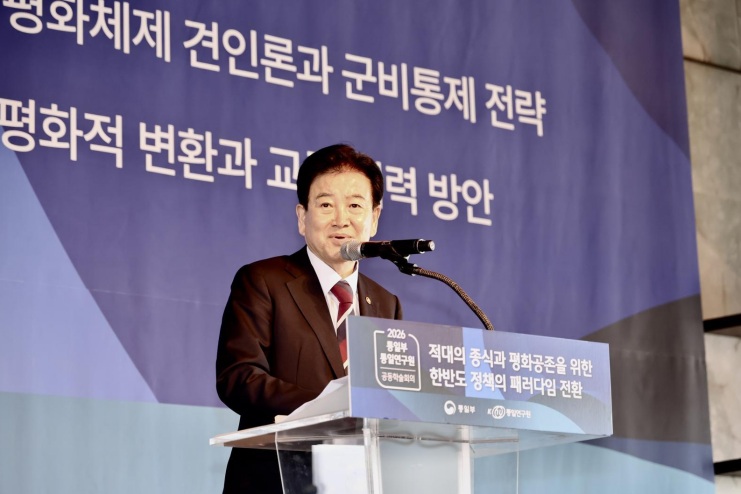
The South Korean government’s unification minister touched off a controversy last week when he used the term “Han-Jo relations” — shorthand for a relationship between two separate states — at an official academic forum, signaling a possible shift in how Seoul frames its relationshi
Daily NK
75
4 min read
0 views

The South Korean government’s unification minister touched off a controversy last week when he used the term “Han-Jo relations” — shorthand for a relationship between two separate states — at an official academic forum, signaling a possible shift in how Seoul frames its relationship with Pyongyang.
Chung Dong-young used the expression during his opening remarks at a joint symposium hosted by the Ministry of Unification and the Korea Institute for National Unification on March 25. It was the first time a sitting minister responsible for inter-Korean affairs had used the term in an official public setting.
The choice of words did not go unnoticed.
The two-state framework and what it concedes
When Kim Jong Un formally declared South Korea and North Korea to be “two hostile states,” the nature of inter-Korean relations changed fundamentally. The two Koreas were no longer framed as a divided nation moving toward reunification but as adversarial states in a state-to-state relationship. In a system where the leader’s directives carry the force of constitutional law, Kim’s declaration effectively foreclosed the possibility of inter-Korean summits from the moment it was issued. His characterization of South Korea as the most hostile state and his stated goal of completing war preparations were not rhetorical flourishes — they were institutionalized as constitutional direction.
Against that backdrop, treating dialogue and cooperation premised on an inter-Korean summit as a realistic near-term prospect reflects a disconnect from the current situation. Even if Pyongyang were to agree to talks, those talks would almost certainly proceed within a state-to-state framework between South Korea and “Chosun” — not within the special inter-Korean relationship that has historically defined engagement. The format and substance of any such dialogue would be fundamentally different from what came before.
The current government continues to emphasize peaceful coexistence and co-prosperity, maintaining a policy posture oriented toward engagement. The concern is that this approach, rather than reflecting present realities, may actually entrench permanent division. The minister’s public use of “Han-Jo relations” and his explicit invocation of North Korea’s full official state name — the Democratic People’s Republic of Korea — as a sign of respect for its political system illustrate the point clearly.
For the head of the ministry mandated to pursue constitutionally grounded reunification, openly using language that presupposes a two-state relationship is a matter of a different order entirely. It raises a fundamental question about the ministry’s purpose and identity. If inter-Korean relations are to be treated as a fully normalized state-to-state relationship, the logical institutional consequence is that those affairs belong with the Ministry of Foreign Affairs, not the Ministry of Unification.
More troubling is the prospect that this framing becomes policy. The fact that a government ministry and a state-funded research institute jointly convened an academic symposium under the theme of “pursuing a peaceful two-state arrangement” is not something to pass over lightly. Academic freedom deserves protection, but when policy discourse that runs counter to the constitutional principle of reunification is underwritten with public funds, that warrants serious scrutiny.
Reducing this to a progressive-versus-conservative dispute misses the point. The core issue concerns South Korea’s constitutional values and national identity. The principle of pursuing reunification is not merely a policy preference — it is a normative foundation of the state.
What must not be forgotten is the reality faced by North Korean people. For those living under the Kim Jong Un regime without the guarantee of basic freedoms, the concept of “peace between two states” demands a hard question: peace for whom? Peace is not simply the absence of conflict. It encompasses conditions in which human dignity and freedom are secured.
South Korea stands at a consequential fork in the road: whether to uphold the principle of reunification or to revise or abandon it in the name of realism. Either choice must be made through thorough public deliberation and deep reflection on constitutional values.
The current trajectory invites a more pointed question. Is this still the country worth defending? Where, precisely, is South Korea headed?


