
Japanese troops launched a fiery volley of two Type 88 anti-ship missiles against a decommissioned ship in a landmark drill during Exercise Balikatan 2026 in the Philippines.
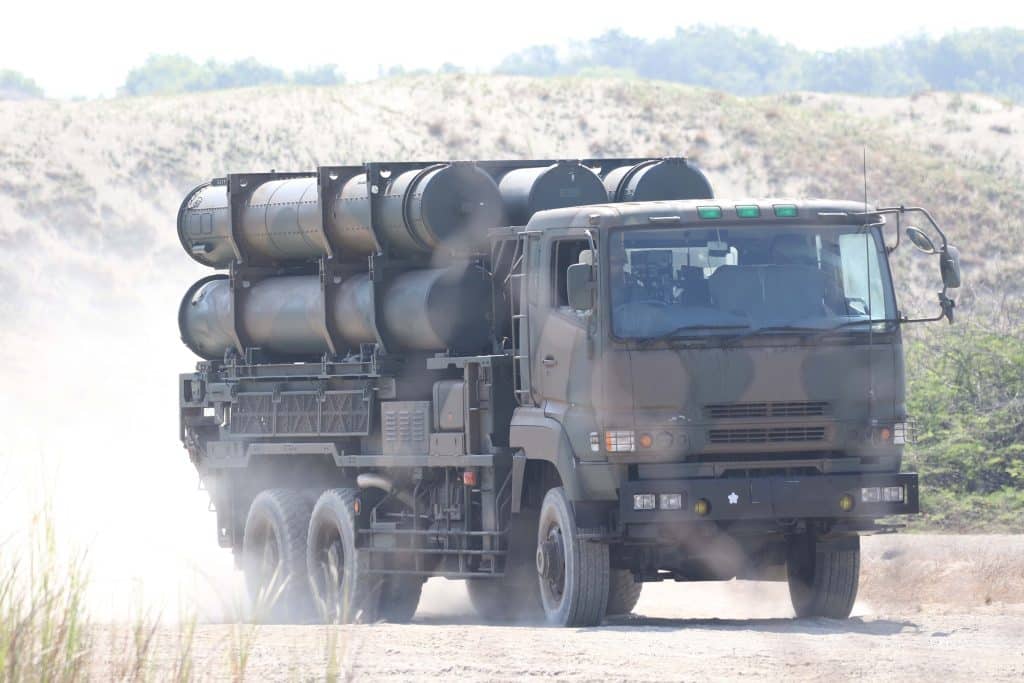
The live missile firing occurred on 6 May, and it took place from the Culili Point sand dunes just south of the city of Laoag in northwestern Luzon. A single 6×6 launcher vehicle belonging to the Japan Ground Self-Defense Force (JGSDF) fired a pair of missiles at a ship target 75km away in the South China Sea, also known locally as the West Philippine Sea.
Officials reported that the target – the ex-Philippine Navy vessel BRP Quezon (‘PS-70’), and formerly a US Navy Auk-class minesweeper constructed in World War II – was successfully hit six minutes later, and that it was sunk by the pair of Japanese missiles.
Although not present at the same site, an American HIMARS launcher had previously fired a GMLRS rocket at the target. Notionally, a Philippine Navy C-Star anti-ship missile and a NMESIS (standing for Navy/Marine Expeditionary Ship Interdiction System) belonging to the US Marine Corps (USMC) had simulated their own missile firings beforehand.
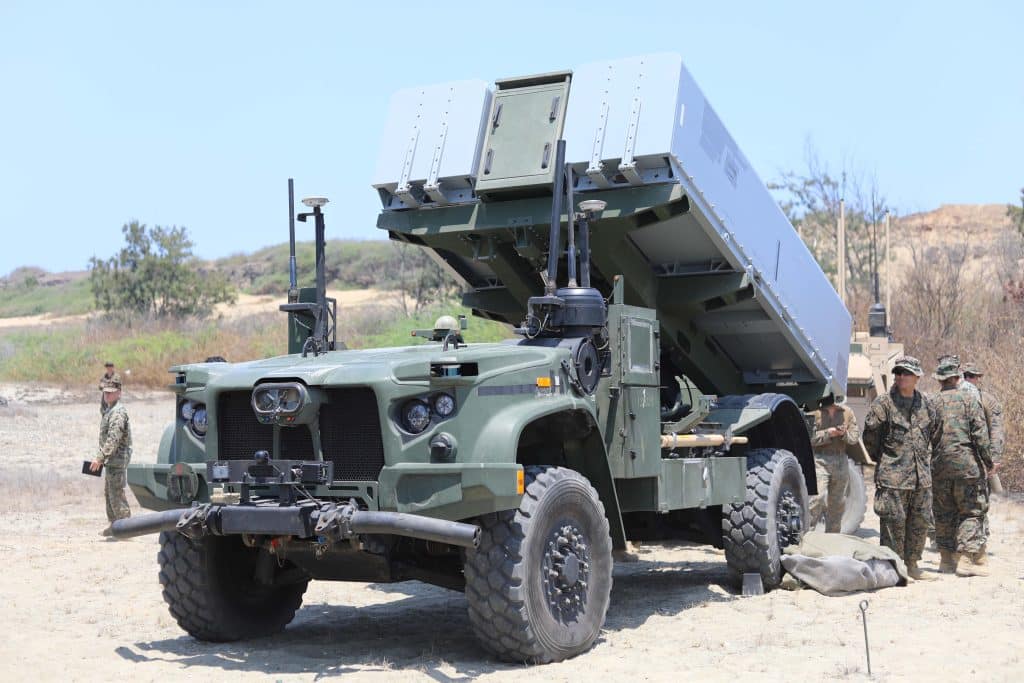
Indeed, a NMESIS was present at the maritime strike event at Culili Point. It hailed from the Hawaii-based 3rd Marine Littoral Regiment of the USMC. Naval News understands that the NMESIS platform has never been fired from the Philippines to date. The NMESIS carries Kongsberg’s Naval Strike Missile, with a single unmanned JLTV 4×4 vehicle carrying two NSMs.
This joint task force maritime strike live-fire exercise was one of the capstone events in Exercise Balikatan, an annual series of multilateral war games held in the Philippines. This year’s exercise took place from 20 April to 8 May, and it involved approximately 17,000 troops from seven countries.
Balikatan means “shoulder to shoulder” in Tagalog, and this was the first time that Japanese combat troops have actively participated in this exercise, which until recently involved just Australia, the Philippines and USA. Other first-timers in 2026 were Canada, France and New Zealand.
It is also notable that this was Japan’s first deployment of combat troops onto Philippine soil since the end of World War II. Japan contributed approximately 1,400 troops to Exercise Balikatan 2026, but the missile firing involved 70 Japanese personnel on the day. The participation of Japanese personnel was permitted by the ratification of a reciprocal access agreement on 11 September 2025.
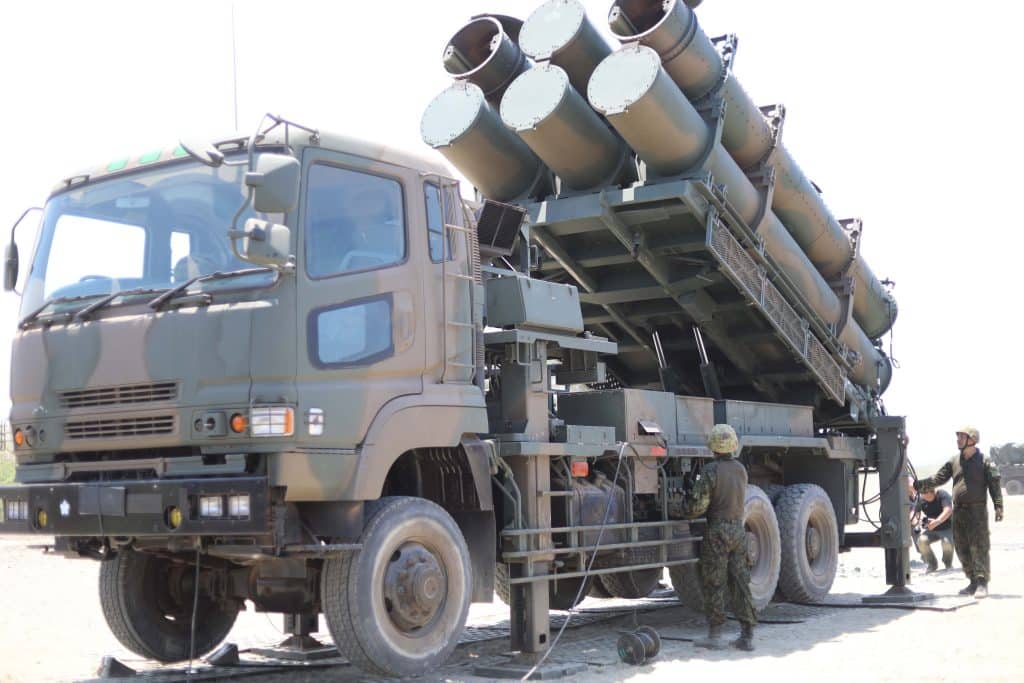
The Type 88 manufactured by Mitsubishi Heavy Industries (MHI) is a relatively old anti-ship missile system, as it has been around more than 35 years. It will be progressively replaced in the JGSDF by the more modern and capable Type 12, also a product from the MHI catalogue.
This coastal defence missile system carries six launch tubes mounted on a 6×6 chassis, and the Type 88 missile’s range is listed as 180km. The 5.08m-long missile travels at high subsonic speeds, and it carries a 225kg high-explosive warhead.
The maritime strike exercise fitted within the wider construct of the Balikatan exercise. Two days earlier, for example, American, Canadian and Philippine forces prosecuted a counter-landing live-fire exercise against a fictional enemy amphibious force. Longer-range missiles like the Type 88 and BrahMos would be used to attrite any invasion fleet long before they reached the Philippine coast.
Another important aspect to the exercise were maritime key terrain seizure operations. These were conducted on remote islands in the Luzon Strait, where equipment such as HIMARS and NMESIS were transported in landing craft or on C-130J Hercules aircraft for short missions.
The aim, if it were a real-world scenario, would be to seal the Luzon Strait, a key maritime chokepoint through which the Chinese navy would have to pass to break out into the Pacific Ocean. Containing Chinese military forces within the so-called First Island Chain, of which the Philippines represents an important link, would be imperative in any conflict engulfing Taiwan. It would also prevent the People’s Liberation Army from conducting an amphibious invasion of Taiwan from the east.
In attendance for the dual missile firings on 6 May were Philippine Defense Secretary Gilberto Teodoro Jr. and his Japanese counterpart Shinjiro Koizumi.
After witnessing the firing, Teodoro said, “We have seen how it works and it is something that we can interoperate with in the future.” He also noted, “From planning to forming to resource management, it will only get smoother and better.”
The defence secretary also told media, “So it’s a complex exercise, actually. The culmination was simple – a missile firing – but to get there was very difficult and we surmounted the obstacles.”
Japan has recently relaxed its restrictive policy on selling lethal weapons to overseas customers, and this was a topic of discussion between the two ministers when they met a day earlier in Manila. Tokyo has revised its Three Principles on the Transfer of Defense Equipment and Technology, as well as its Implementation Guidelines.
Teodoro and Koizumi signed a statement on further promotion of defence equipment and technology, and the Philippines is already eyeing second-hand equipment such as TC-90 (King Air) light aircraft and Abukuma-class destroyers from Japan. The Philippines previously received five such retired TC-90 aircraft from Japan, which it uses for maritime patrol. The Philippine Navy is also beefing up its weight and scale as it confronts Chinese belligerence within its own exclusive economic zone.
However, the Type 88 will not be on the Philippine shopping list, for it already has the BrahMos missile system that it procured from India.
Earlier, General Romeo Brawner Jr., Chief of the Armed Forces of the Philippines, explained that Balikatan’s “real value is showcasing our resolve to work together to defend the Philippine archipelago and to uphold the rules-based international order. So that’s the more important aspect of all the exercises we’re doing here.” The general added: “It’s really very important that we defend this territory of the Philippines, and we’re very fortunate that we have with us partners from like-minded nations.”