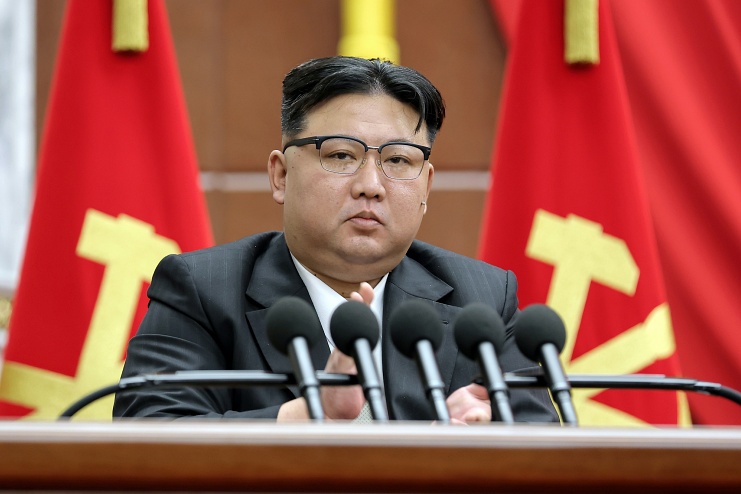
Ninth Party Congress purge signals sweeping overhaul of provincial party officials
The sweeping personnel overhaul launched at the Ninth Congress of the Workers’ Party of Korea (WPK) is now pushing into the provinces. The North Pyongan provincial party committee recently convened an emergency training session for party officials across all cities and counties in the province
Daily NK
75
4 min read
0 views

The sweeping personnel overhaul launched at the Ninth Congress of the Workers’ Party of Korea (WPK) is now pushing into the provinces. The North Pyongan provincial party committee recently convened an emergency training session for party officials across all cities and counties in the province, a source told Daily NK Tuesday.
“The provincial party committee summoned all responsible secretaries, organizational secretaries, propaganda secretaries, and youth league secretaries from every city and county party organization in the province in mid-March for an emergency two-night, three-day training session,” the North Pyongan province-based source said.
According to the source, the hastily organized session was designed to extend to local party organizations the unprecedented personnel shake-up carried out at the Ninth Party Congress, where roughly half of the full and alternate members of the WPK Central Committee were replaced. The explicit purpose, the source said, was to signal that a generational turnover toward officials demonstrating both loyalty and practical competence would be pushed through without exception.
From the opening day of the training, provincial party officials delivered a pointed warning: “If even the central party has been half replaced, the provinces cannot consider themselves exempt.” Attendees were told the session amounted not to routine instruction but to a “combat order” foreshadowing a sweeping replacement of responsible officials across local party organizations.
The provincial party committee framed the directive in stark terms, stating that the central authorities were demanding the elimination of bureaucratic dysfunction inherited from older cadres and a fundamental restructuring of how local party organizations operate. “The era of reviewing nothing but reports sitting on a desk is over,” officials said.
Personnel shake-up reaches the provinces
Officials who rely on subordinates’ written reports without grasping conditions on the ground were condemned as committing “a grave challenge to the party’s leadership.” Attendees received specific instructions: all responsible officials would henceforth be required to conduct direct field inspections and would face regular “competency examinations” to verify the specialized knowledge the party center now demands.
The final day of the session closed with another sharp warning. Officials were told to stop copying administrative reports “like a mimeograph machine” and to become subject-matter experts capable of carrying out party directives on their own authority.
“The hundreds of city and county party officials who attended the training all sat with their heads bowed, writing furiously in their notebooks, and some were visibly shaking,” the source said, describing the atmosphere as deeply intimidating.
After the session concluded, anxious remarks circulated among attendees. “Now you really have to stake your life on proving your competence or you won’t survive,” some were heard saying. Several older officials reportedly told colleagues they were suffering severe stress over the prospect of being removed under the banner of generational renewal.
In the days following the training, propaganda slogans appeared at party organs at all levels: “Officials who do not study, officials who do not know the field, are enemies of the party.”
Ordinary North Korean people who saw the slogans were said to have reacted with a mixture of dark humor and unease. “The party is pushing officials in a completely different way than before,” some said, while others remarked, “The days when being a party official meant doing whatever you wanted are over.”
A Note to Readers

