North Koreans abandoning market stalls drive surge in Hyesan street trading conflicts

Street vendors in Hyesan are clashing over prime selling spots as growing numbers of North Koreans abandon state market stalls they can no longer afford, spilling out into the city’s streets and alleyways. A source in Ryanggang province told Daily NK that fistfights between street traders have

Daily NK
75
4 min read
0 views
North Koreans abandoning market stalls drive surge in Hyesan street trading conflicts
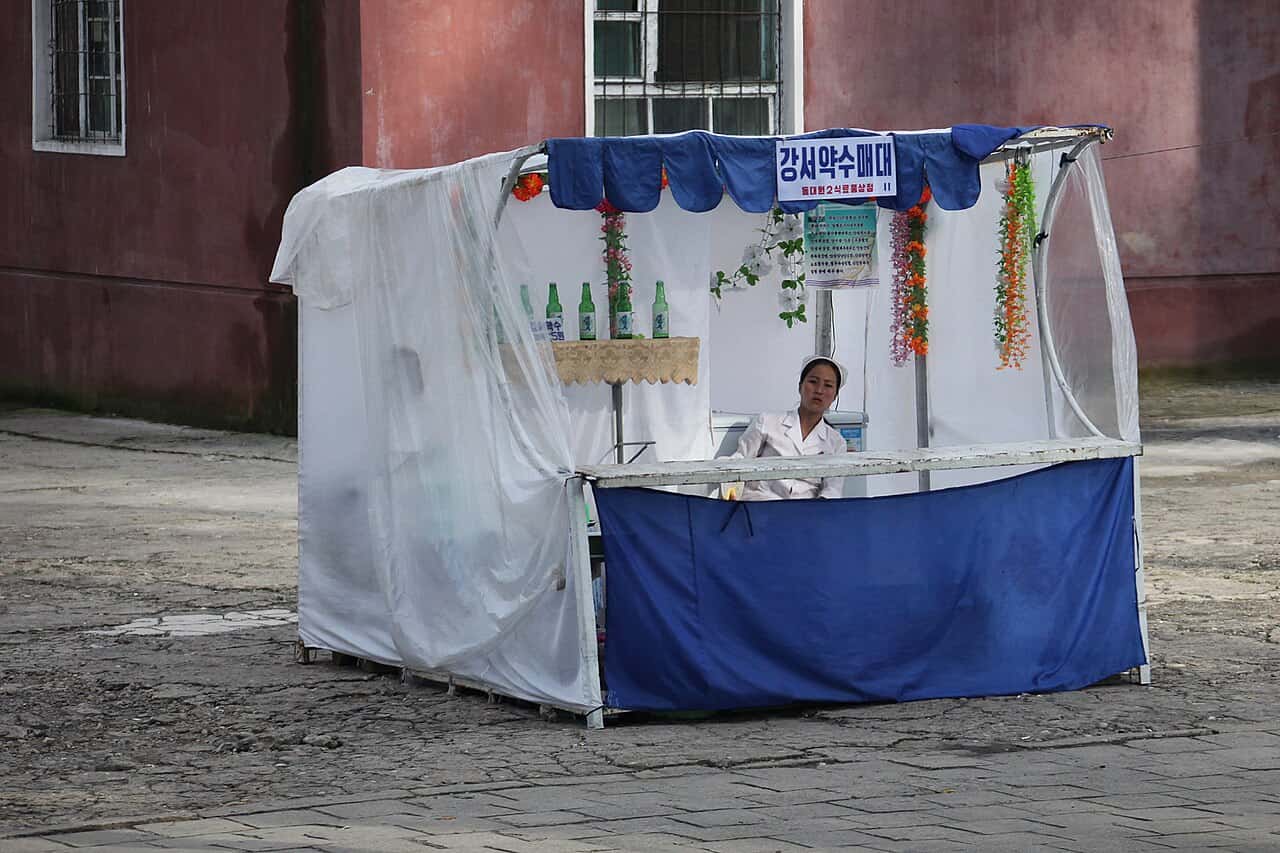
A vendor sits at a street stall selling Gangseo mineral water in Pyongyang, North Korea
A street vendor at a stall in Pyongyang. Photo: Roman Harak (CC BY-SA 2.0)

Street vendors in Hyesan are clashing over prime selling spots as growing numbers of North Koreans abandon state market stalls they can no longer afford, spilling out into the city’s streets and alleyways.

A source in Ryanggang province told Daily NK that fistfights between street traders have become a common sight in Hyesan. Established vendors claim informal ownership of spots they have used for years, while newcomers refuse to give way. “The people who have been there a long time insist the spot is theirs,” the source said. “The newcomers push back and say no one owns a piece of street, and it ends in physical fights.”

The influx of new street traders stems from the cost of operating a stall inside one of North Korea’s official markets, known as jangmadang. Vendors with assigned stalls inside jangmadang are required to pay daily market fees regardless of how much they sell. With business slow, many have decided to sell or rent out their stalls entirely and move their operations to the street, where there are no fixed daily fees.

Street trading carries its own risks: spots are not guaranteed and the threat of enforcement crackdowns is constant. But for people without the cash to cover stall fees, it has become the only viable option.

Fights break out as competition intensifies

The tension came to a head on May 15 at a wholesale trading area in Hyesan. A vendor who had recently moved from a jangmadang stall to the street had grown frustrated that established traders were behaving as though unassigned public spots belonged to them. The person arrived before dawn to claim a desirable location. When a regular occupant of that spot arrived and demanded the person leave, a fight broke out. Bystanders described the confrontation as serious enough to leave both parties with facial injuries before others pulled them apart. The dispute was eventually resolved when nearby traders persuaded both sides to divide the space and continue selling side by side.

The source said the underlying pressure driving the conflict is stark. “Everyone out there is fighting over whether their family eats or goes hungry,” the source said. “There is no room to think about the other person’s situation.”

Market enforcement units, which patrol trading areas and disperse unlicensed vendors, occasionally intervene in such disputes. The source noted that enforcement has been relatively light recently, but that when crackdowns intensify, street traders face the compounded pressure of holding their spot while simultaneously evading officials. “When enforcement is heavy, it’s like living in a battlefield all day long,” the source said.

Read in Korean

A Note to Readers

Reporting from inside North Korea

Daily NK operates networks of sources inside North Korea who document events in real-time and transmit information through secure channels. Unlike reporting based on state media, satellite imagery, or defector accounts from years past, our journalism comes directly from people currently living under the regime. We verify reports through multiple independent sources and cross-reference details before publication.

Our sources remain anonymous because contact with foreign media is treated as a capital offense in North Korea — discovery means imprisonment or execution. This network-based approach allows Daily NK to report on developments other outlets cannot access: market trends, policy implementation, public sentiment, and daily realities that never appear in official narratives.

Maintaining these secure communication channels and protecting source identities requires specialized protocols and constant vigilance. Daily NK serves as a bridge between North Koreans and the outside world, documenting what’s happening inside one of the world’s most closed societies.

Original Source

Daily NK

Share this article

Related Articles

North Korean defectors in China alarmed as Kuaishou messages reach police
🇰🇵🇰🇷North vs South Korea
Daily NK

North Korean defectors in China alarmed as Kuaishou messages reach police

Chinese authorities are monitoring North Korean defectors through Kuaishou, a popular Chinese short-video and messaging platform, raising alarm among defectors hiding in China. According to a Daily NK source inside China, a defector living in Jilin province used Kuaishou on May 11 to exchange messag

१ दिन पहले4 min
Fuel price surge strips North Koreans of intercity bus connections
🇰🇵🇰🇷North vs South Korea
Daily NK

Fuel price surge strips North Koreans of intercity bus connections

Rising fuel prices in North Korea are forcing state-run long-distance bus services to cut or cancel routes, significantly worsening intercity travel conditions across the country. According to a Daily NK source in North Pyongan province, privately operated revenue buses — state-sanctioned vehicles t

१ दिन पहले4 min
🇰🇵
🇰🇵🇰🇷North vs South Korea
38 North

Project Anthracite: Analyzing North Korean Patents and Academic Journals for Evidence of Chemical Weapons Potential

This research draws on Project Anthracite, a multiyear initiative funded by Global Affairs ... The post Project Anthracite: Analyzing North Korean Patents and Academic Journals for Evidence of Chemical Weapons Potential appeared first on 38 North.

४ दिन पहले1 min
North Korea’s wheat and barley acreage shrinks in key farming regions, satellite data shows
🇰🇵🇰🇷North vs South Korea
Daily NK

North Korea’s wheat and barley acreage shrinks in key farming regions, satellite data shows

Satellite imagery analysis of three major North Korean agricultural regions in May 2026 shows that spring wheat and barley cultivation has declined overall compared to the same period in 2025, with gains in Pyongyang offset by significant reductions in South Hwanghae and South Pyongan provinces. Usi

४ दिन पहले5 min