
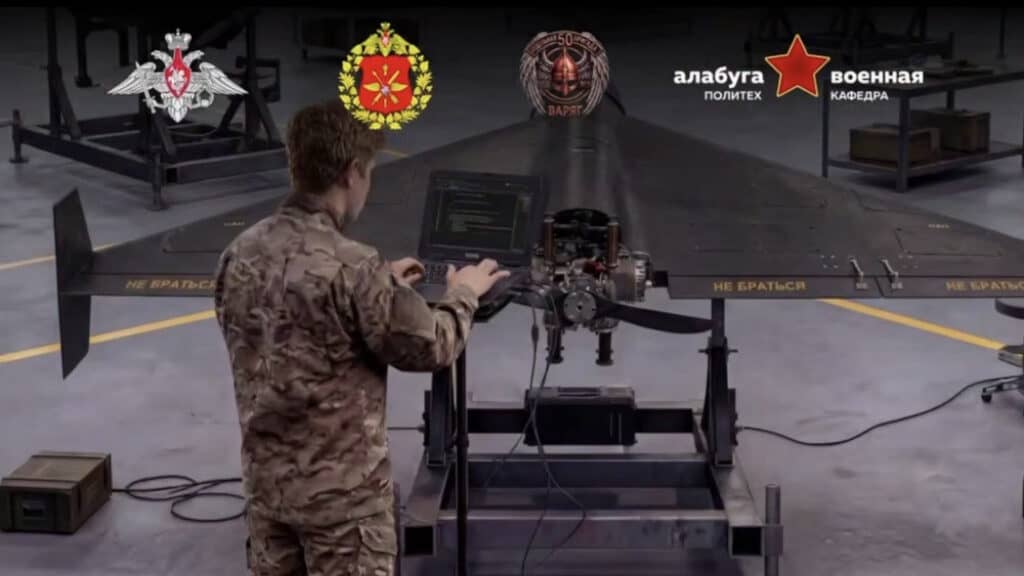
An organization affiliated with Russia’s main producer of Shahed-type drones has launched a recruitment drive for a new unmanned systems brigade, promising young men the chance to earn risk-free cash while avoiding mandatory conscription. This campaign is part of Moscow’s larger effort to expand its drone forces, a top priority for the Russian military.
Alabuga Polytech is a vocational training center that supplies workers — including teenagers and young foreign women — for a drone factory in Russia’s Alabuga Special Economic Zone, located in the Tatarstan region. Opened in 2023 with Iranian assistance, it is one of two Russian plants producing Geran-2 one-way attack (OWA) drones, heavily modified versions of Tehran’s Shahed-136. The factory also manufactures various jet-powered Geran variants and the Gerbera multifunctional unmanned aerial system (UAS).
Thanks in part to the labor supplied by Polytech, Russia has surged Geran production, churning out 2,700 per month, along with a similar number of Gerberas as of mid-2025, according to Ukrainian intelligence.
Since mid-April, Polytech has begun recruiting not just workers but troops as well. It is advertising on popular Telegram channels, with some messaging designed to appeal to video gamers. The institution claims that while its recruits will support Moscow’s so-called “special military operation” in Ukraine, they will not be sent to the front line.
Polytech pitches enrollment in its “military department” as a lucrative alternative to conscription. In Russia, men aged 18 to 30 must complete mandatory conscription service lasting one year, though these conscripts — unlike mobilized reservists or “kontraktniki” (enlisted troops serving under contract) — are not supposed to be deployed to Ukraine. By law, men who complete military training at a civilian educational institute are exempt from conscription.
In essence, Polytech is purporting to offer a loophole whereby young men can knock out their mandatory military service while earning kontraktnik-like pay but without the associated danger. One ad shows a young computer gamer who receives a notification from his local military commissariat warning that he will soon be conscripted. He considers shelling out a handsome sum to obtain a medical diagnosis declaring him unfit for service, but instead he decides to sign up with Alabuga Polytechnic, allowing him to make good money and “help [his] country.”
For one year of service as a Geran drone operator, Polytech offers enrollees a monthly stipend of 150,000 rubles, about 50 percent more than the average monthly salary in Russia in 2025. These recruits will supposedly serve at the “command center of Alabuga Polytech.” For engineers, the stipend doubles to 305,000 rubles per month. Those troops are told they will work in Oryol Oblast, where Russia has a Geran launch facility.
Whether this scheme will work as advertised remains to be seen.
According to Polytech, the recruits will serve in the new “Varyag” Brigade. The establishment of this unit, officially named the 50th “Varyag” Separate Unmanned Systems Brigade of the Supreme High Command, was announced in February.
Reportedly, Russia is forming the Varyag Brigade on the basis of another drone unit called GROM Kaskad, which is being expanded. Varyag’s website and Telegram channel indicate that, in addition to long-range one-way attack (OWA) drones such as the Geran, the brigade is equipped with shorter-range copter-type and fixed-wing OWA, reconnaissance, and interceptor UAS. The brigade will likely also operate uncrewed ground vehicles and possibly even maritime drones.
Polytech’s recruitment drive comes as Moscow is seeking to swell the ranks of its Unmanned Systems Forces (USF). This is a new branch of arms (“rod voysk”) comprising personnel dealing with drones of all types across the Russian military. Defense Minister Andrei Belousov first unveiled plans to establish the USF in December 2024, echoing a similar step by Kyiv.
Since 2024, Russia has formed numerous new drone units and expanded existing ones, a process that is ongoing. These include, inter alia, various combat detachments under the elite “Rubicon” center, along with unmanned systems regiments and battalions under military districts and armies, respectively. Meanwhile, the Russians have been developing new ways of organizing and employing drone forces, often drawing on Ukrainian examples such as the “Drone Line” initiative.
According to General Oleksandr Syrskyi, the Russian USF totaled around 80,000 troops as of January and had grown to 101,000 by early April. Moscow aims to reach 165,000 troops by the end of 2026 and 210,000 by 2030, he says. A leaked Russian document indicates Moscow intends to form more USF brigades, regiments, Rubicon detachments, and other units, many of which will likely be based on existing units.
Recruiters are aggressively targeting colleges and universities, promising students lucrative pay and assurances that they will not be assigned to the infantry and can be discharged after one year. In practice, USF recruits will likely have to serve until the war ends.
John Hardie is the deputy director of FDD’s Russia Program and a contributor to FDD's Long War Journal.
Tags: russia, Russia vs Ukraine, Russian drones, ukraine


