
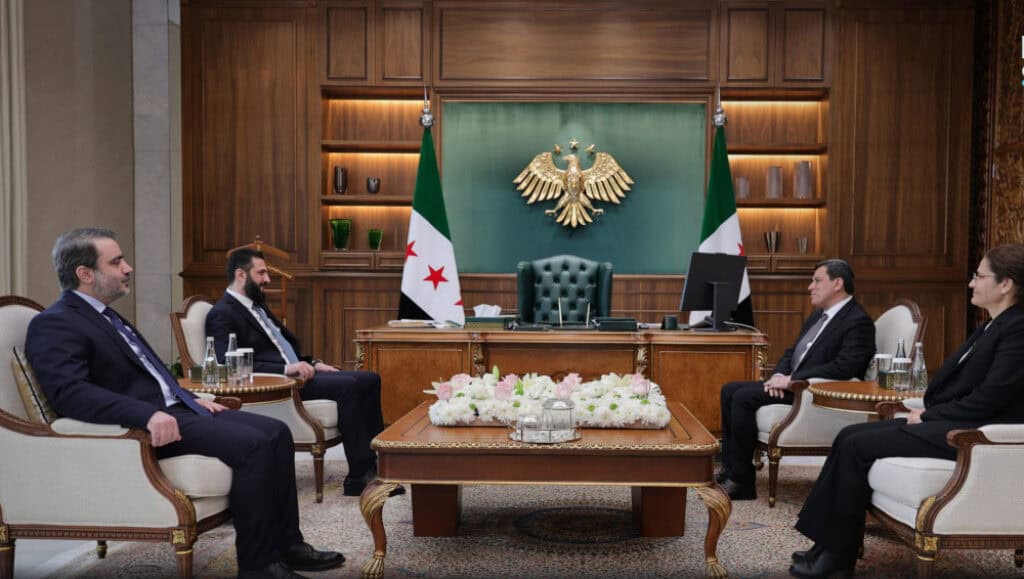
Syrian President Ahmad al Sharaa met with Syrian Democratic Forces (SDF) commander Mazloum Abdi in Damascus on April 16. The meeting came two and a half months after an agreement between the SDF and the Syrian transitional government in late January. The meeting also took place as Syrian security forces took control of Qasrak Air Base in eastern Syria, where US forces had previously been present.
The meeting in Damascus included Ilham Ahmad, who has served as the co-chair of the Foreign Relations Department of the Democratic Autonomous Administration of North and East Syria (DAANES). DAANES is the primarily Kurdish-led administration that has run eastern Syria for the last decade, while the SDF is a US-backed group that has fought the Islamic State since 2015.
“On January 29, the Syrian government announced an agreement with the (SDF) on a ceasefire as part of a comprehensive deal,” the Syrian Arab News Agency (SANA) noted on April 16. “The agreement includes phased integration of military and administrative structures into state institutions, the deployment of security forces to the centers of Hasakah and Qamishli, and the transfer of all civil and government institutions, as well as border crossings and entry points, to state control.”
The meeting took place amid other significant changes in eastern Syria. The Syrian government is taking control of the Samalka border crossing between eastern Syria and the Kurdistan Region of northern Iraq. The Rabia border crossing, which is north of the Iraqi city of Mosul on the Syrian border, is also expected to reopen on April 20.
The Turkish state-owned Anadolu Agency reported that Syrian government forces also took control of Qasrak Air Base in eastern Syria. “Local sources said that after US forces evacuated the base,, elements affiliated with the YPG[People’s Defense Units]/SDF terror group set fire to some vehicles inside the facility,” the report noted. Turkey has designated the SDF and the YPG as terrorist organizations over their affiliations with the Kurdistan Workers’ Party (PKK), which had long fought an insurgency against Turkey. The PKK announced an intention to disband and disarm in May of last year.
Photos from Qasrak Air Base showed vehicles burning after the US left. Over the last few months, the US has withdrawn from numerous facilities in eastern Syria. Video from eastern Syria’s North Press Agency claimed to show the last convoy of American armored vehicles being transported from the base.
Syria has also continued to struggle with security and economic issues, as well as foreign relations. On April 15, Syrian officials said they had intercepted a shipment of 6,000 explosive detonators that could be used in improvised explosive devices. These items were reportedly destined for Lebanon.
In addition, the first shipment of Iraqi fuel oil arrived at the Syrian port of Baniyas on April 15 after being transported overland from Iraq. Iraq has faced a crisis in oil exports due to Iran’s blockade of the Strait of Hormuz. It has begun to truck oil overland to Syria.
Syria has also reopened its airspace in the wake of the US ceasefire with Iran. In addition, Syrian officials and Jordanian government ministers held a series of meetings on April 14 focused on increasing cooperation between the two countries.
Reporting from Israel, Seth J. Frantzman is an adjunct fellow at FDD and a contributor to FDD’s Long War Journal. He is the senior Middle East correspondent and analyst at The Jerusalem Post, and author of The October 7 War: Israel's Battle for Security in Gaza (2024).
Tags: Ahmad al Sharaa, Iraq, Mazloum Abdi, SDF, Syria, ypg


