
Kim Jong‑un looks so fat that if news broke tomorrow of his death from cardiac failure—amid cheese, cigars, and a stalled treadmill—the world would barely blink; many would simply shrug and say, "Well, that tracks." Public appearances and open‑source estimates place the supreme leader at roughly 170 cm in height and around 130–140 kg in weight, a profile consistent with severe obesity. Add to that a long‑running pattern of heavy smoking, alcohol use, calorie‑dense diets, irregular sleep, chronic stress, and prolonged sedentary work, and the cardiovascular math becomes uncomfortably straightforward. In an ordinary political system these would remain private failings; in a hyper‑personalized autocracy where a single body doubles as the state's command center, however, they become public risks—and the country itself ends up hostage to one man's cholesterol.
Authoritarian regimes often project an image of durability. Measured against the resilience that flows from democratic accountability, however, autocracies tend to be more brittle than they appear: they look solid until they suddenly are not. Rather than eroding gradually, they are prone to fracture once critical thresholds are crossed. History offers a consistent pattern. When a leader's health deteriorates at the top of a highly personalized system, the effects propagate outward through the state—from Joseph Stalin's strokes and paranoia distorting late‑stage governance, to Mao Zedong's physical decline hollowing out decision‑making at the end of the Cultural Revolution, to Hugo Chávez's prolonged illness paralyzing succession and policy in Venezuela, and to Egypt's King Farouk, morbidly obese, dying young of heart failure after years of excess.
Taken together, these precedents underscore a sobering lesson for today's axis of autocracies. China, Russia, Iran, North Korea (often grouped as the so‑called "CRINK" states), and increasingly Venezuela all face succession risks that could generate abrupt discontinuity. Pyongyang, however, remains distinct. Extreme personalization of power, the absence of routinized succession mechanisms, and the centrality of nuclear weapons compress uncertainty rather than allowing it to unfold gradually. This makes any leadership shock uniquely costly: decisions that elsewhere play out over months could be forced into days, with nuclear security, alliance management, and great‑power signaling converging simultaneously.
Were Kim to die suddenly on an ordinary day, succession ambiguity, elevated military alert postures, and nuclear command questions would surface at the same time. The situation is further complicated by the lack of transparent health disclosure, delegated authority, or institutionalized handover—constraints that narrow elite bargaining space and push the system rapidly toward one of three familiar pathways. Two plausibly involve internal stabilization: the "Bloodline Restoration" Scenario, in which the Kim dynasty re‑consolidates power around a designated heir (possibly Kim Jong‑un's daughter, Kim Ju‑ae); or the "Collective Politburo Governance" Scenario, in which elites coalesce into a technocratic leadership coalition. Absent either, the remaining outcome is the "Warlordization" Scenario—factionalized military chaos and internal collapse, with no coherent authority able to negotiate with or control events.
If Kim's obesity‑related health risks intensify yet sheer luck keeps him upright through 2026, and President Trump floats a tongue‑in‑cheek confidence‑building gesture—say, an effective weight‑loss drug to keep Kim Jong‑un literally alive, repurposed as diplomatic leverage (sigh)—it would merely confirm how thin the margin for error has become.
And if Kim's uncontrollable waistline were to achieve what special operations could not, even the most optimistically stable outcome—where President Trump still maintains a hotline with a familiar counterpart, the Kim dynasty—would read like a strange footnote. Washington would not be negotiating with a general or a committee, but with the dynasty's next custodian—perhaps facing Kim's daughter, Kim Ju‑ae, across the table—where a Barbie doll slides forward as an icebreaker, along with talk of opening a Toys"R"Us in Pyongyang.
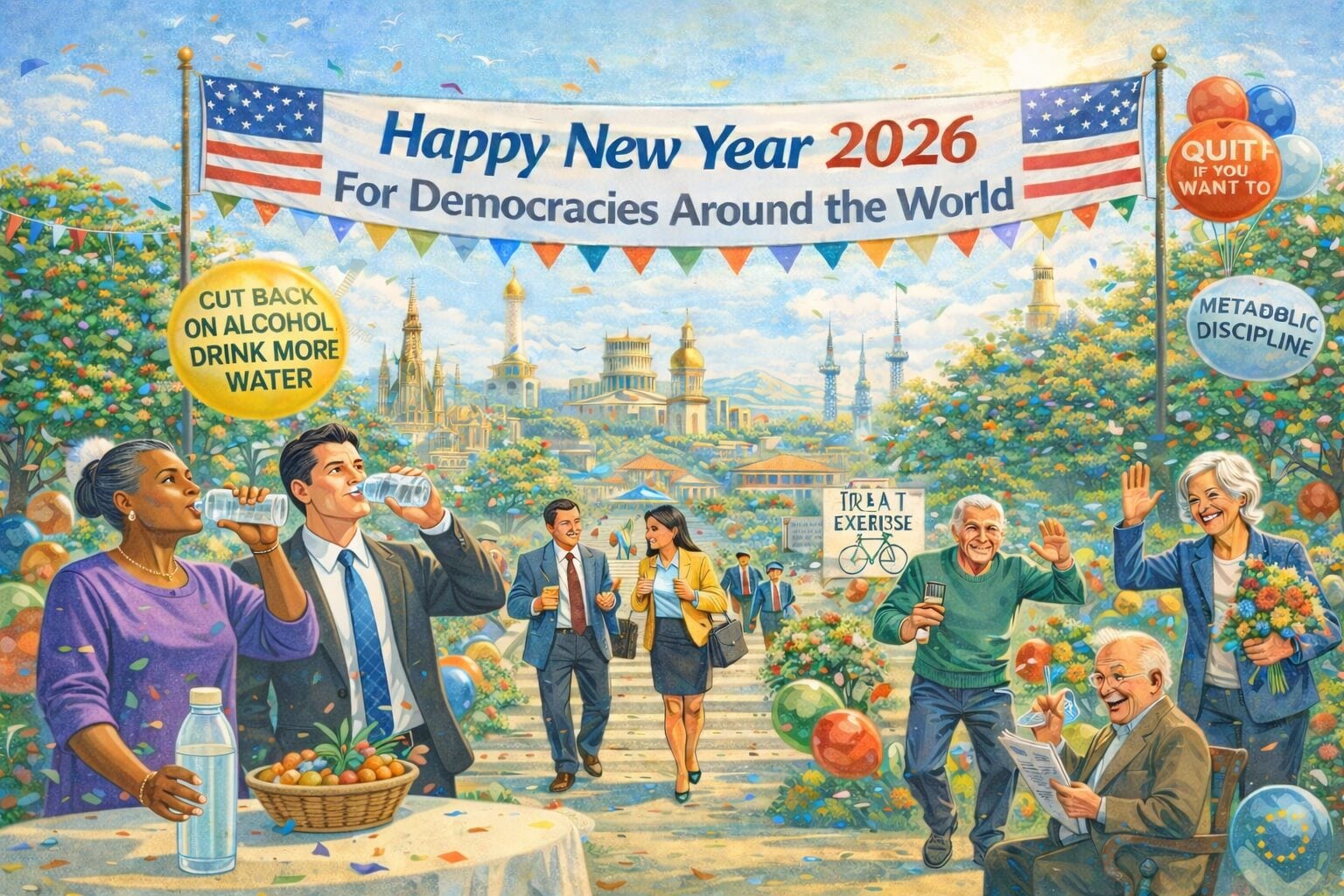
Democracies outlast autocracies thanks to fewer fragile bodies at the top
For policymakers in democracies—where sustainable, healthy lifestyles are not only possible but institutionally supported—the contrast with autocracy carries a dry irony. When power is dispersed and institutions absorb shocks, one leader's cholesterol no longer qualifies as a strategic variable. After all the grand theory and high geopolitics, the conclusion is stubbornly mundane: democracy lasts not because it is wiser, but because its risks are distributed across many bodies. It is, in the end, dispersed biological durability—not ideology or strategy—that makes democracy more endurable than autocracy.
Thus, this structural advantage is worth taking seriously in 2026 for decision‑makers in democracies. If there is a New Year's resolution worth making, it is this modest one. Cut back on alcohol, drink more water. Walk between meetings. Treat exercise not as lifestyle branding but as occupational hygiene. Metabolic discipline is not self‑help; it is risk management. Strategic discipline, in turn, begins with bodily discipline. And because power is not trapped in one body, democracies retain a merciful escape hatch: if the job becomes unbearable or the public turns hostile, leaders can step aside, retire, or lose an election, rather than allowing a failing body to linger as a national‑security variable.
The world has no shortage of contingency plans. What it lacks are authoritarian leaders secure enough in both their institutions and their health not to turn their own waistlines into a geopolitical variable.


