
Hamas claimed on July 6 it was ready to transfer authority and dissolve its government in Gaza. The announcement appeared to be in line with the US-brokered ceasefire that envisions Hamas transferring its authority to a new technocratic government in the territory. The US-backed Board of Peace said it had “taken note” of the announcement, adding, “Ultimately, our assessment will be guided by actions, not promises.” Israeli Foreign Minister Gideon Saar panned the Hamas announcement on July 7, saying that the group would also need to disarm as part of the ceasefire agreement agreed to in October 2025.
Hamas’s statement was made at a press conference by Ismail Thawabteh, the head of the group’s media office. He “announced that government institutions had completed all legal and administrative preparations required to transfer their responsibilities to the proposed National Committee for the Administration of Gaza,” The New Arab noted. Mohammed Abdul Khaliq al Farra, the leader of the Emergency Committee, which functions as Hamas’s local government, had “submitted his resignation, while the committee itself was formally dissolved.”
The Hamas announcement appeared aimed at complying with the demands of the October ceasefire. Under that US-backed 20-point plan, supported by United Nations Security Council Resolution 2803, governance is supposed to transfer to the National Committee for the Administration of Gaza (NCAG). “The committee of technocrats, which is based in Cairo, is chaired by Ali Shaath, a Gaza-born engineer and former official with the Palestinian Authority. It has a mandate to restore essential services and oversee civilian affairs under the supervision of the U.N. and the Board of Peace,” the Associated Press reported.
Hamas’s statement on the dissolution of its government in Gaza was widely reported. However, there was a lack of clarity on “when and how the handover would take place,” Germany’s Deutsche Welle noted. “Despite the announcement, the date for the transfer of power to the committee remains unclear, given the ongoing disagreements over the implementation of the agreement’s provisions, especially with the stalling of the second phase, which stipulates the withdrawal of Israeli forces from the Gaza Strip,” the UAE’s Al-Ain News added.
The Board of Peace, established in January as part of the US-brokered ceasefire plan, issued several additional comments on Hamas’s statement. “Decisions must be comprehensive with respect to the requirements as set out in the Roadmap for advancing governance, security, and transition in Gaza,” the Board said on July 6. “We look forward to the successful conclusion of discussions on this Roadmap, including on the implementation mechanisms necessary to enable the National Committee for the Administration of Gaza to assume full governing authority.” The Board added that all weapons in Gaza would need to be under the control of the NCAG.
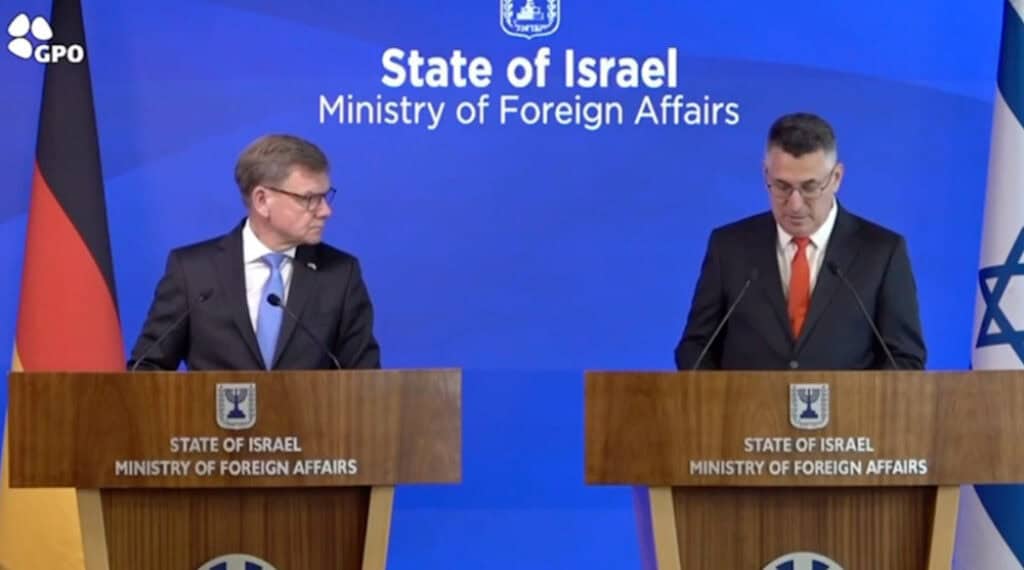
Israeli Foreign Minister Saar issued a statement about the Hamas announcement alongside German Federal Minister for Foreign Affairs Johann Wadephul on July 7. “Israel remains committed to implementing President Trump’s plan in full, with the disarmament of Hamas and all other terrorist organizations and the complete demilitarization of the Gaza Strip at its core,” Saar said. He also said that Hamas was seeking to avoid disarming, accusing the group of engaging in a “trick” in which it walks away from governance but keeps its weapons and control of the area behind the scenes. Hamas’s control of Gaza has been reduced to as little as 30 percent, according to a report by The Jerusalem Post in late June.
On July 5, prior to Hamas’s announcement, Israeli Prime Minister Benjamin Netanyahu had demanded Hamas disarm prior to any reconstruction taking place in Gaza. “There will be no reconstruction in Gaza without dismantling and demilitarizing the Strip,” the Israeli leader said, according to Israel’s Ynet.
As Gaza’s governance and Hamas’s disarmament remain in the spotlight, the Israel Defense Forces (IDF) continued strikes in Gaza. On July 5, the IDF said it had recently eliminated two terrorists in Gaza. On July 6, the IDF said it eliminated a Hamas commander of the group’s training department. On July 7, the IDF said a Hamas Nukhba force commander and a Hamas intelligence unit commander were killed in recent strikes.
Reporting from Israel, Seth J. Frantzman is an adjunct fellow at FDD and a contributor to FDD’s Long War Journal. He is the senior Middle East correspondent and analyst at The Jerusalem Post, and author of The October 7 War: Israel's Battle for Security in Gaza (2024).
Tags: Board of Peace, Gaza, Gaza Peace Plan, Hamas, IDF, Israel, Israel Hamas


