
The Syrian Interior Ministry and General Intelligence Service thwarted a plot by a Hezbollah cell, Syrian state media reported on April 19. Four days later, Syria’s permanent representative to the United Nations, Ibrahim Olabi, told the UN that Damascus was continuing its counterterrorism operations against the Islamic State, Hezbollah, and other groups. Syria has continued to crack down on smuggling in the country and says it has busted a number of terrorist cells recently. These developments come as Syrian President Ahmed al Sharaa traveled to the Gulf states to deepen regional ties and diplomatic support.
The Syrian Arab News Agency (SANA) reported on April 19 that Syria had “foiled a sabotage plot by a cell linked to the Hezbollah terrorist militia, a source at the Interior Ministry said Sunday.” The cell had reportedly planned to carry out rocket attacks, apparently targeting Israel from the area of Quneitra near the Golan, although the report did not mention Israel. An Israel-Lebanon ceasefire began on April 15 after a month and a half of clashes between Israel and Hezbollah.
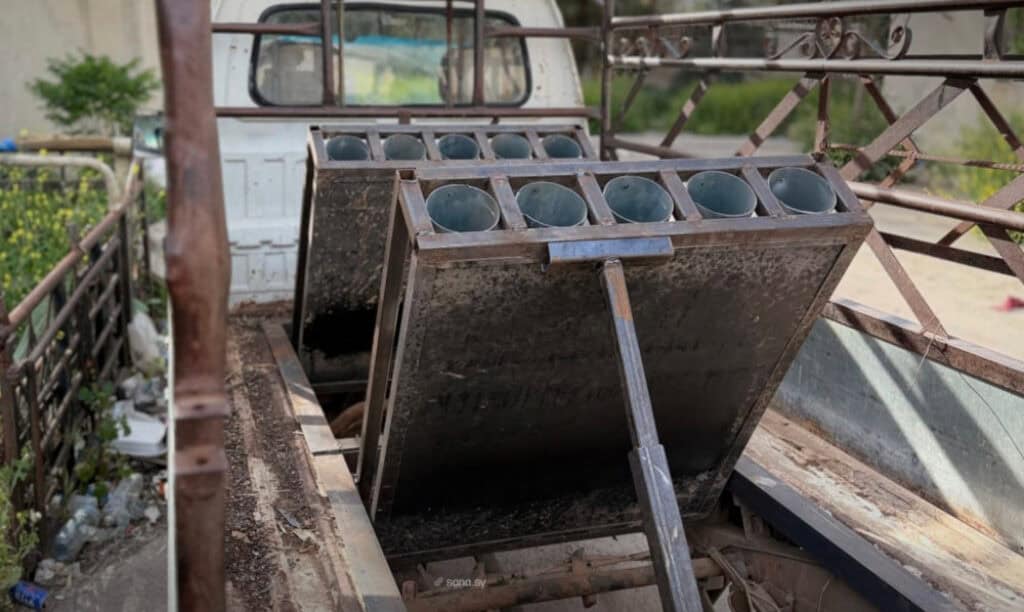
“Five members [of the Hezbollah cell] were arrested as part of ongoing efforts to disrupt terrorist activity,” SANA added. Photos showed an improvised multiple rocket launcher embedded in the back of a small commercial truck and a number of rockets. The munitions appear to be similar to the common 107-millimeter rockets that have been used by Iranian-backed militias in Iraq and trafficked by Iran to various terrorist groups.
In a separate report on April 18, Syria’s Interior Ministry said it had busted a terrorist cell and found weapons and military gear. Authorities suspect the cell was preparing improvised explosive devices (IEDs) and other explosives. “A security source later told SANA that the dismantled cell was linked to another terrorist group that attempted to carry out a sabotage attack by planting an explosive device near the home of a religious figure in the vicinity of the Mariamite Church in Bab Touma on April 11.”
In a third incident, Syrian and Iraqi authorities cooperated to intercept a smuggling operation and uncovered 500,000 Captagon pills. Manufacturing and smuggling the illegal stimulant was common in Syria during the previous regime of Bashar al Assad. Although the new government in Damascus has vowed to crack down on the trade, smuggling has continued over the last year.
“The operation, part of ongoing efforts to dismantle drug trafficking networks, led to the arrest of two suspects,” Syria’s Interior Ministry said. The bust illustrated recent cooperation between Iraq and Syria on smuggling, a development that comes as the countries are reopening border crossings. The Rabia crossing, north of Mosul, was reopened on April 20 after being closed for 12 years. The Syrian government has also begun to play a role at the Semalka crossing between eastern Syria and the Kurdistan Region of northern Iraq. Previously, the Semalka crossing was administered by the Kurdish-led Syrian Democratic Forces.
On April 22, Ibrahim Olabi, Syria’s envoy to the UN, told a UN Security Council session about developments in Syria, describing counterterrorism operations and discussing Israel’s continued operations in the country.
“We call for an end to Israel’s aggressive policies through compliance with international legitimacy and Security Council resolutions,” Olabi said. After the fall of the Assad regime, Israel took over a buffer zone along the length of the 1974 Syria-Israel ceasefire line that runs near the Golan Heights. The Israel Defense Forces has carried out operations near the buffer zone in Syrian villages over the last year and a half. Olabi also said, according to a report at North Press Agency, that Damascus was “preventing the use of Syrian territory to launch external attacks and strengthening the state’s sovereignty over all its territory.”
Also on April 22, Syria’s president arrived in the United Arab Emirates for meetings. His visit is part of a larger Gulf tour to discuss regional issues. Syrian state media noted that Sharaa will meet with UAE President Sheikh Mohamed bin Zayed Al Nahyan, Saudi Arabian Crown Prince Mohammed bin Salman, and Qatari Emir Sheikh Tamim bin Hamad Al Thani during the trip.
Reporting from Israel, Seth J. Frantzman is an adjunct fellow at FDD and a contributor to FDD’s Long War Journal. He is the senior Middle East correspondent and analyst at The Jerusalem Post, and author of The October 7 War: Israel's Battle for Security in Gaza (2024).
Tags: Ahmad al Sharaa, Captagon, Hezbollah, Islamic State, Syria, un


