
In a first, the African Land Forces Summit was held in Europe and included representatives from the defense industry.
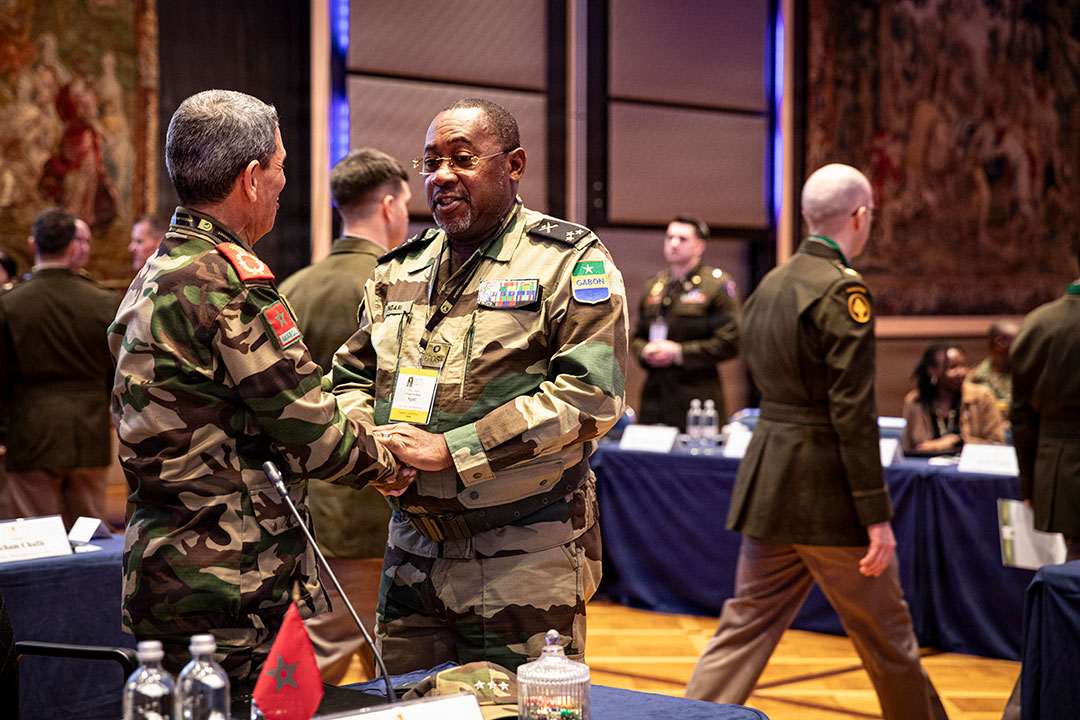
The annual summit, sponsored by U.S. Army Southern European Task Force, Africa (SETAF-AF), took place March 23 and 24 in Rome and drew more than 300 participants from 47 countries. It was the 13th iteration of the event and the first to take place outside of Africa since 2022.
Col. William Daniel, SETAF-AF’s director of security cooperation, said the goal of the event was to match ideas with “proven, scalable solutions” to Africa’s security challenges.
Of the industry leaders there displaying cutting-edge technology, Daniel said: “Their purpose is to help us move from identifying challenges to deploying solutions.”
Several speakers emphasized the importance of technological tools. Nigerian Maj. Gen. Saidu Audu, force commander of the Multinational Joint Task Force (MNJTF) said unmanned aerial vehicles have proved vital to intelligence gathering. The MNJTF, a four-nation regional alliance to combat terrorism and crime in the Lake Chad Basin, received eight drones from the European Union, which also trained operators using a simulator and held courses on drone maintenance.
In remarks to attendees, Audu called for greater international support to secure the Lake Chad Basin. “African security issues are not just African concerns,” he said, according to a report by the Italian news service Nova.news.
During his opening remarks, Gen. Christopher Donahue, commander of U.S. Army Europe and Africa, unveiled a plan to support the training of drone operators on the continent. During the annual African Lion exercise set to take place in Ghana, Morocco, Senegal and Tunisia in April and May, there will be a drone training module for about 16 participants.
The U.S. plans to build off that effort and establish a regional training center in Morocco with the goal of establishing centers in other parts of Africa.
“It is about a sustainable, enduring capability that, once we prove its effectiveness, we can take to other parts of Africa,” Donahue said.
Donahue said he envisions the Morocco-based training center as a place where stakeholders can identify pressing security problems and bring to bear a wide range of assets and ingenuity to solve the problems.
 It will offer “a different approach to train each other, to learn from each other and to share information to solve a problem,” Donahue said. “That is what we’re going to start in Morocco.”
In closing remarks at the two-day conference, Lt. Gen. John W. Brennan Jr., deputy commander of U.S. Africa Command, stressed the importance of innovation that outpaces adversaries.
“The ongoing technical revolution is relentless, and changes are now occurring in a matter of months. This is a challenge, but also an opportunity to innovate and maintain our advantage,” Brennan said. “We must work with an intelligent approach, including financial resources, so that empowered partners can advance and meet their needs”
In the face of these threats, Brennan called for deeper and more consistent alliances between security allies.
“We must build interdependent forces to ensure a more stable world for future generations,” he told attendees. “We must work together; there is no challenge too great. Unity is our strength.”


