The High Court of Justice on Friday allowed broader anti-war demonstrations to go ahead over the weekend under wartime restrictions, while making clear that the state still has not formulated a policy that balances security considerations with the fundamental rights at stake in the case.
In its latest decision, issued after a Friday hearing in the joined protest and Western Wall cases, the court said it had taken note of the state’s declaration that “at this stage” no policy had yet been formed that balances security considerations against the relevant rights, including freedom of protest and demonstration and freedom of religion and worship.
Given that position, and in light of clarifications provided by Home Front Command representatives during the hearing, the justices ordered that, absent a concrete warning, a protest at Haifa’s Horev Center must be permitted with no fewer than 150 participants, and that a protest at Tel Aviv’s Habima Square must be permitted with no fewer than the number approved by Home Front Command for gatherings in that area at the time of the protest. The court added that this should take into account the existence of a protected on-site space capable of accommodating a significant crowd.
The justices further clarified that turnout above those numbers does not necessarily mean the protest must be dispersed. Any such situation, they said, is subject to the discretion of the police commander on the ground, based on the assessed risk to protesters and to public order, while giving appropriate weight to the full range of relevant considerations.
The ruling followed a procedurally fraught stretch in which the state repeatedly sought additional time and drew open judicial criticism.
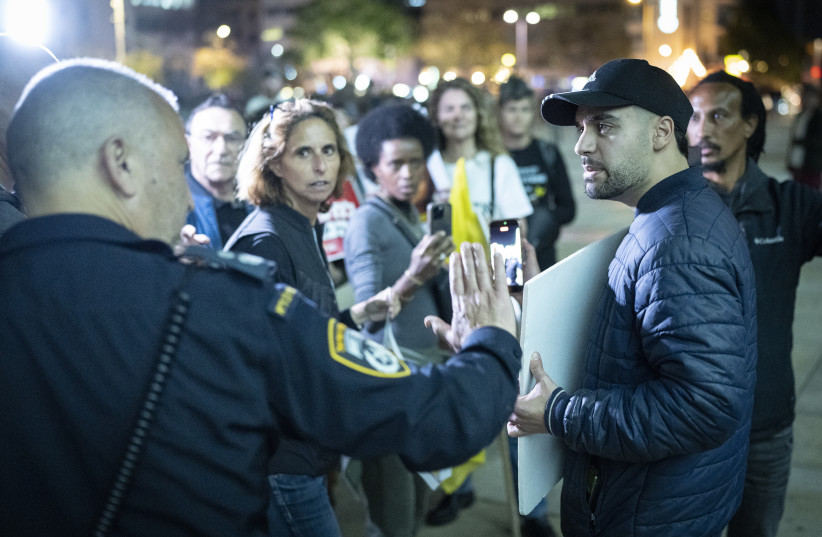
Friday ruling shows case is not over
On Thursday, the court said it was regrettable that “countless” extension requests had been filed in the proceedings, and warned that the latest request effectively cast doubt on the practical utility of holding the hearing the following day.
Despite what it described as considerable discomfort with the respondents’ conduct, the bench gave the state until 7 p.m. that evening to file response affidavits, and ordered the petitioners to submit an update by 8:30 p.m. addressing, among other things, whether there was still a need to hold the Friday hearing as scheduled.
Friday’s decision also makes clear that the case is not over. The state was ordered to submit full response affidavits by April 26. Those affidavits must address, among other things, questions raised by the bench regarding the enforcement of Home Front Command instructions elsewhere, as well as the distinction raised during the hearing by Home Front Command representatives between a standard protected space and other kinds of protected areas, including the underground parking levels at Habima. The petitioners in both cases, along with the fourth respondent in the Western Wall case, were given until April 29 to reply.
That means the court resolved the immediate issue of this past weekend’s demonstrations, but left open a broader examination of how wartime gathering restrictions are being set and enforced, what standard is being applied to requests for assemblies of this kind, and whether those restrictions are being implemented consistently.
Following the ruling, protest organizers announced that demonstrations would be held at multiple locations over the weekend. But the court itself confined its decision to the conditions under which such protests may proceed within the existing security framework.