L3Harris Delivering Clandestine Submarine-Launched AUVs to the U.S. Navy

NATIONAL HARBOR, MD — L3Harris is pushing forward with production of its Iver4 900 autonomous undersea vehicle (AUV) under a previously unknown Defense Innovation Unit effort that is looking to deliver a torpedo tube launch and recovery (TTL&R) autonomous drone to the U.S. Navy’s attack su

Naval News
75
4 мин чтения
0 просмотров
L3Harris Delivering Clandestine Submarine-Launched AUVs to the U.S. Navy

NATIONAL HARBOR, MD — L3Harris is pushing forward with production of its Iver4 900 autonomous undersea vehicle (AUV) under a previously unknown Defense Innovation Unit effort that is looking to deliver a torpedo tube launch and recovery (TTL&R) autonomous drone to the U.S. Navy’s attack submarine fleet.

The AUV will be delivered across multiple classes of attack submarines that will operate the drone as an underwater loyal wingman performing mine warfare, forward intelligence, and seabed mapping missions. Naval News received an update on the program’s status with JR Gear, VP and General Manager of Integrated Systems and Encryption during the Sea Air Space 2026 Symposium in National Harbor, Maryland.

“When a diver is out there in the ocean, a lot of times they have a dive buddy for safety,” Gear told Naval News on the show floor. “[and] unmanned systems are really good for the dull, dirty, and dangerous business. So you think of all those things together—what’s the dive buddy that a submarine has?”

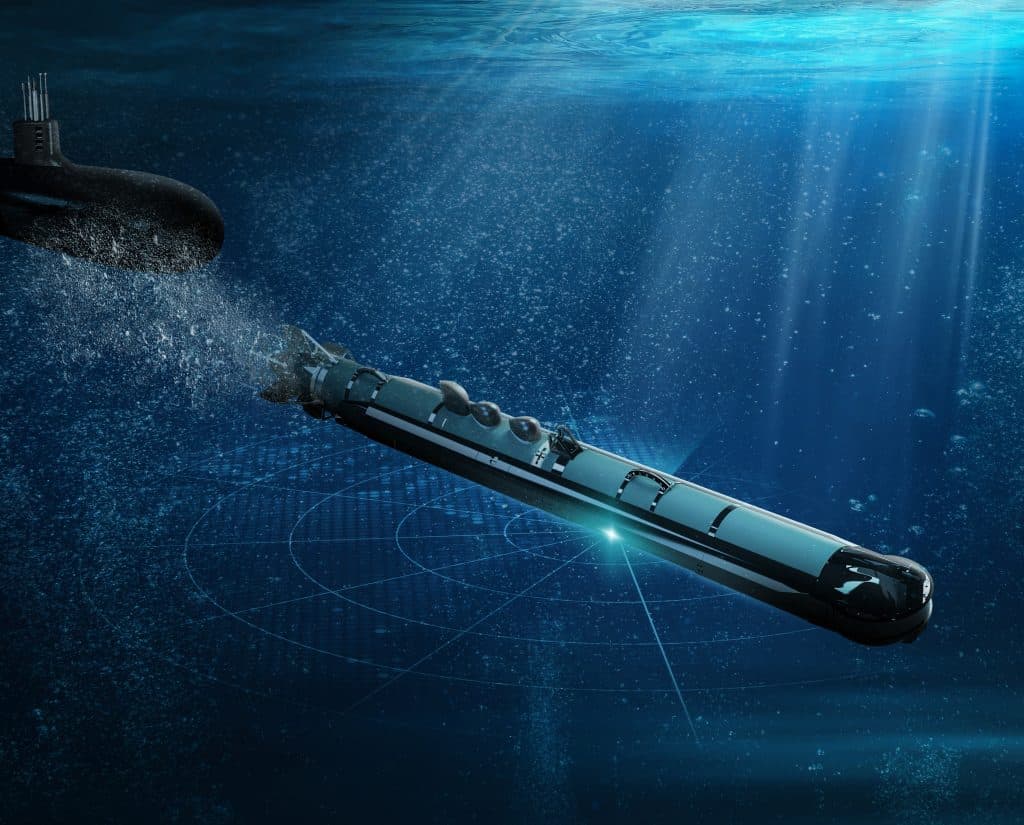
L3Harris rendering of a U.S. Navy submarine launching an Iver4 900 AUV.

The Iver4 900 is one of several solutions being pitched for the U.S. Navy’s subsurface fleet of submarines as the force continues to iterate its current portfolio of launched effects, including a portfolio of new weapons designed to increase each submarine’s individual kill-chain and targeting capabilities.

As an organic element of a submarine’s sensors, Iver4 900 is capable of performing the “dirty work” of high-risk missions like seabed mapping, forward intelligence gathering, and other classified missions that U.S. Navy submarines often complete during routine deployments.

The Iver4 900, according to Gear, is being proven out in exercises with the U.S. Navy, iterating the design and its concept of operations through at-sea availabilities with Virginia-class submarines. The most important part of these exercises will inform how the AUV is used in real-world scenarios—leveraging its multi-mission and modular capabilities.

Modularity for a broad range of missions

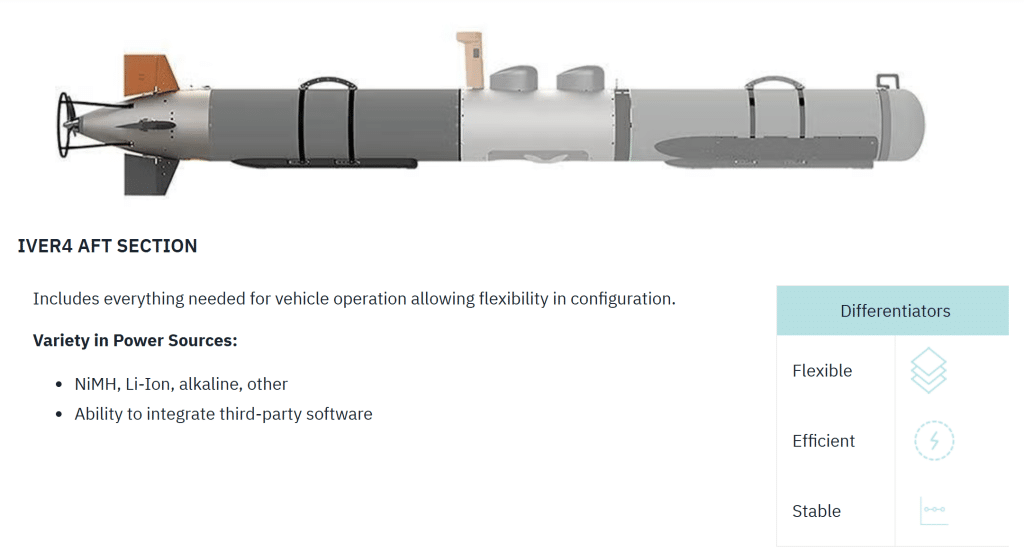
The Iver4 900 has swappable payloads for sensors along the side of the AUV, in the nose, and in the tail, which are all removable and swappable for different configurations. This includes various types of ISR payloads, including sonar arrays, seabed mapping systems, minesweeping capabilities, and other, third party platforms that can be installed outside of L3Harris.

Powered by lithium-ion batteries, the AUV can operate between 16 and 24 hours independent of the submarine. With a mission minimal payload, the AUV can operate for 40 hours on one charge.

L3Harris graphic.

“We’re proving them with the U.S. Navy in exercises. We’re iterating with them—what’s the capability [the Navy] needs?”

JR Gear, L3Harris VP and General Manager of Integrated Systems and Encryption

The Defense Innovation Unit has led development for the U.S. Navy so far, with contracts signed to deliver several to the fleet for evaluation and early operational use. L3Harris has been developing Iver4 900 for several years prior, according to Gear, with the main focus tied to freeing up sailors and their current workload to focus on higher priority missions by leveraging Iver4 900’s autonomy and automatic launch and recovery capability.

“Lets let the sailor do the mission and concentrate on the threat,” Gear told Naval News. “Lets not have the sailor worry about how to fly, drive, or steer.”

The Iver4 900 is untethered, enabling the extended range operations for dozens of miles in any direction. Gear could not elaborate on the methodology of communication with the AUV at the extended ranges expected, and referred Naval News to the U.S. Navy for further questions on operational use during fleet exercises.

Its benefits come with few drawbacks, including the benefit of not losing space in the torpedo room to store each Iver4 900 AUV, and the added benefit of being able to swap powerplants, sensor payloads, and antennas for various use cases in contested and denied environments. L3Harris is continuing to develop new payloads alongside third parties, and hopes additional partners will deliver on the leap in capabilities the Iver family of AUVs offers.

Оригинальный источник

Naval News

Поделиться статьей

Похожие статьи

🔬
🔬Weapons & Technology
Defence Blog

North Korea built its own version of America’s HIMARS system

North Korea tested three different weapons systems on May 26 under the personal supervision of leader Kim Jong Un, including a lightweight multipurpose missile launcher that analysts have compared to the American HIMARS rocket artillery system, a new 240mm guided rocket with expanded range, and a ta

около 4 часов назад1 min
🔬
🔬Weapons & Technology
Defence Blog

Lockheed gets new U.S. Army funding for MLRS engineering work

One of America’s most battle-tested rocket artillery systems just got a new round of engineering investment, with the U.S. Army awarding Lockheed Martin a $14 million contract modification to sustain and improve the Multiple Launch Rocket System across all its production variants. The award, i

около 4 часов назад1 min
🔬
🔬Weapons & Technology
Defence Blog

Roshel develops LUV that converts to armored truck in 2 hours

Canadian armored vehicle manufacturer Roshel will debut three new military platforms at CANSEC 2026 in Ottawa, leading with a modular light utility vehicle that can convert from a standard unprotected configuration to a STANAG Level 2 armored vehicle in approximately two hours, offering NATO-aligned

около 4 часов назад1 min
🔬
🔬Weapons & Technology
Defence Blog

Pentagon pushes domestic rare earth magnet production

Every cruise missile, every fighter jet, every missile defense interceptor, and every military helicopter flying today depends on a class of magnets so powerful and so small that the weapons systems built around them would be unrecognizable without them. For most of the past two decades, almost all

около 4 часов назад1 min