
A tender for a solitary frigate for the Royal Thai Navy (RTN) closed on 21 April, with the possibility of winning a deal proving a popular drawcard for shipbuilders from around the world.
The following day, in an effort to advance transparency and accountability, the RTN provided an update on the frigate procurement project. Rear Admiral Paraj Ratanajaipan, from the Office of the Royal Thai Navy Spokesperson, stated:
“As part of the process, invitations were extended to eleven qualified and experienced international shipbuilding companies to submit proposals. The submission period has now concluded, with a total of six companies formally submitting proposals.”
Two contenders originate from each of South Korea and Türkiye, plus there is a single Singaporean and Spanish bidder to round out the six competitors. Ratanajaipan listed the bidders as follows:
The spokesperson added that three companies formally notified the RTN that they would not submit proposals, while another two “did not submit proposals within the specified timeframe”.

HD Hyundai Heavy Industries told Naval News that it is offering a customised design based on the HDF-3600 frigate being constructed for the Peruvian Navy. The Korean shipbuilder had displayed scale models of HDF-3200, HDF-3600 and HDF-4000 designs at last year’s Defense & Security show in Bangkok. Meanwhile, Hanwha has offered the Ocean-40F that displaces 4,000 tonnes.

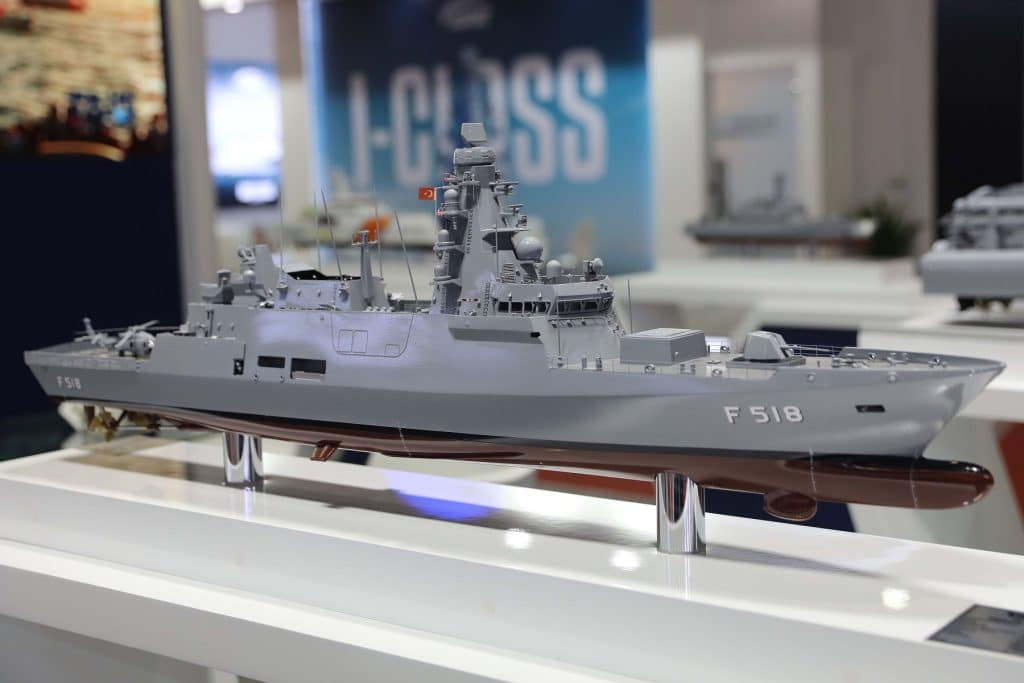
As for state-owned ASFAT, it is offering the the I-class frigate, which the 5th unit for the Turkish Navy was launched earlier this year. It has linked up with Thai firm United Defense Technology. Turkish compatriot TAIS is believed to be offering the 115 Bora to Thailand.
ST Engineering’s offering remains unclear also, as it did not display any ship models at last year’s Defense & Security exhibition. However, it has enjoyed previous success in the Thai market, delivering the 7,600-tonne HTMS Angthong landing platform dock in 2012.

Finally, Navantia has the Alfa 3000 on offer. The Spanish company enjoyed success in the Thai market last year when it was appointed to install Catiz combat management systems Dorna fire control systems on two Pattani-class offshore patrol vessels (OPV) under a US$85 million contract. Prior to that, it was chosen in April 2025 to install combat management, surveillance, fire control, weapons and gyro systems on the Chinese-built Type 071E amphibious ship HTMS Chang.
Ratanajaipan explained what will happen next with the Thai frigate project. “In the next phase, a committee appointed by the Royal Thai Navy will conduct a comprehensive evaluation of all submitted proposals. This evaluation will cover key aspects, including bidder qualifications, technical proposals, offset proposals and pricing.”
He said this review process would take just over one month “to ensure thoroughness, due diligence and the best possible outcome for the nation”. Some reports suggest a selection could be made on 22 May.
Ratanajaipan added, “The Royal Thai Navy reaffirms that this procurement aims to enhance national defence capabilities and safeguard the country’s maritime interests.” The tender outlined a minimum level of 20% indigenous content and the transfer of technology.
This tender is just the first instalment of a shipbuilding “spree” of surface combatants. The RTN actually wants four new frigates in service by 2037, according to a navy white paper published in 2023. It needs them to help secure both its Andaman and Gulf of Thailand coastlines. However, Thailand is tendering the frigates individually due to budgetary constraints.
The navy approved a FY2026 budget of THB17.5 billion (US$534 million) for this first phase of the frigate project. Beyond this, the RTN requested THB35 billion (US$1.07 billion) under the 2026-32 budget to construct the first two frigates.
The RTN commissioned a single Bhumibol Adulyadej-class frigate, built by Daewoo Shipbuilding & Marine Engineering (now Hanwha Ocean) in January 2019, but the navy always anticipated additional hulls even back then.
The RTN has older vessels like four Chao Phraya-class frigates (these Chinese-built Type 053HT warships dating from 1990-91) and two Naruesan-class frigates (Chinese-built Type 053s commissioned in 1994-95) that need replacement.
Eleven companies had been invited to submit bids for this frigate programme. These included Fincantieri of Italy, Rosoboronexport from Russia, and SK Oceanplant of South Korea. Others previously registering their interest in the effort included Babcock with the Arrowhead 140; the China Shipbuilding Trading Corporation (CSTC); Damen with the SIGMA 10514; and TKMS with the MEKO A-100.
It is not known which three declined to enter and which two failed to meet deadlines. However, China is a notable absentee. Of course, the RTN endured a serious kerfuffle with China over its S26T diesel-electric submarine. A Chinese-built frigate would add unnecessary complication for the RTN too, since it would have no Western sensors and armaments in common with Western-derived warships.
In preparation for this frigate programme, a memorandum of understanding was signed between eight domestic shipbuilders and the Thai Shipbuilding and Repairing Association on 5 March 2025. The parties said the agreement “seeks to consolidate private-sector expertise and resources in preparation for complex naval programmes, including the potential construction of frigates for the Royal Thai Navy”.
The eight companies include Asian Marine Services, Marsun, Seacrest Marine, Unithai Shipyard and Engineering, Thai International Dockyard, Mariart (Thailand), Lantacruz and Prakarnkonlakarn Shipyard.
Marsun stated, “Their capabilities span ship construction and repair, advanced engineering, systems integration and specialised maritime services. By combining their strengths, the companies aim to build a coordinated national capacity capable of delivering complex, large-scale naval projects within Thailand.” The most sophisticated naval vessels that Thailand has built so far are two 2,000-tonne Krabi-class OPVs in conjunction with BAE Systems.
