
After 39 days of fighting between the United States and Israel on one side and Iran on the other, the US and Iran have agreed to a two-week ceasefire. While there are conflicting reports regarding the opposing conditions demanded by the US and Iran for lasting peace, and Israeli and Iranian strikes continued after the deal’s announcement, the ceasefire and a reopening of the Strait of Hormuz to international shipping appear to be agreed-upon items.
The ceasefire took place just hours before US President Donald Trump’s deadline of 8 pm Eastern on April 7, as US bombers were reportedly in the air and headed toward Iran. Trump had threatened to bomb Iran’s power plants, oil infrastructure, and bridges if Iran refused to reach an agreement.
Trump announced on April 7 that he would “hold off the destructive force being sent tonight to Iran, and subject to the Islamic Republic of Iran agreeing to the COMPLETE, IMMEDIATE, and SAFE OPENING of the Strait of Hormuz,” adding that he “agree[d] to suspend the bombing and attack of Iran for a period of two weeks.” Negotiations between the US and Iran were brokered by Pakistan.
The US has “already met and exceeded all Military objectives,” Trump continued. At the outset of the war, US Secretary of War Pete Hegseth announced that the conflict’s objectives were the destruction of Iran’s nuclear and ballistic missile capabilities, along with Iran’s naval forces and “other security infrastructure.” Regime change was not on the table, Hegseth noted. However, after the assassination of numerous Iranian leaders, including Supreme Leader Ali Khamenei, Trump stated on April 8 that the US “determined [Iran] has gone through what will be a very productive Regime Change!”
Trump claimed on April 8 that Iran would not enrich uranium, and that “the United States will, working with Iran, dig up and remove all of the deeply buried (B-2 Bombers) Nuclear ‘Dust,’” a reference to the enriched Iranian uranium that was struck during US bombings of Iranian nuclear enrichment sites.
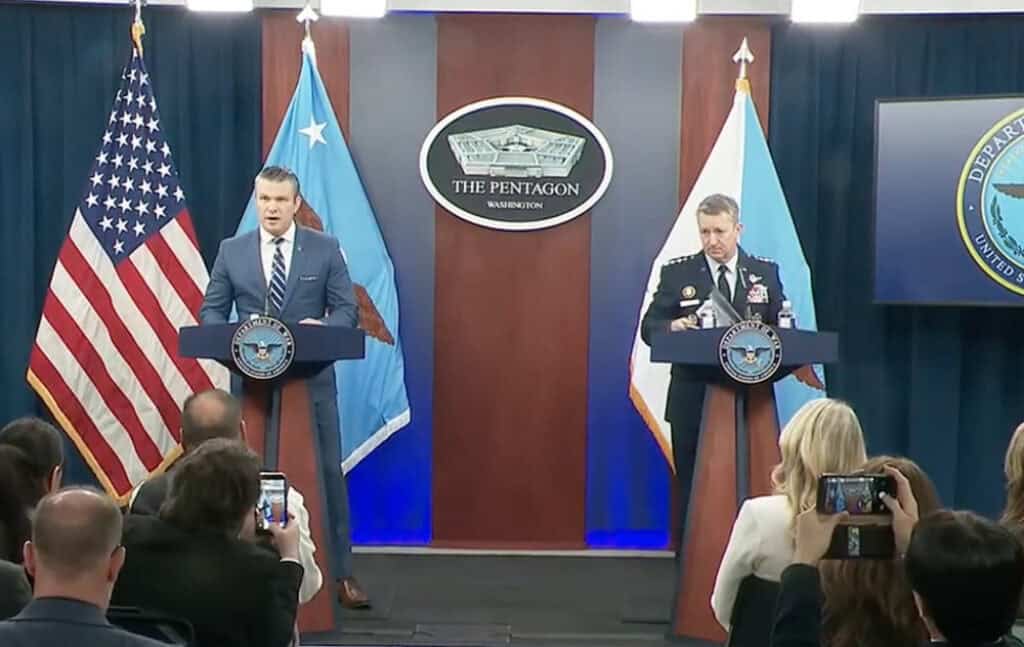
During today’s press conference by Hegseth and Chairman of the Joint Chiefs of Staff General Dan Caine, Hegseth touted the destruction of Iran’s conventional military capabilities and the killing of key Iranian leaders, including Khamenei and numerous military commanders.
“This new regime is out of options and out of time, so they cut a deal,” Hegseth said. He also stated that the terms of the deal will include the removal of any nuclear material and prevent Iran from developing nuclear weapons.
Iran’s response to the deal
Iran, like the US, views the ceasefire as a victory and claims that the US has agreed to its terms. Most Iranian conditions are directly contradictory to the US position.
Nour News, an outlet affiliated with the Islamic Republic’s Supreme National Security Council, published a statement on April 7, moments after Donald Trump announced the ceasefire, hailing it as an American defeat. The statement claims Tehran rejected Washington’s 15-point proposal and instead submitted its own 10-point plan, alleging the US accepted the regime’s counterproposal as “the basis of negotiations […] despite all apparent threats.”
The statement listed the following as Tehran’s 10 points:
The statement concludes that Tehran and Washington are set to meet on April 10 “with complete distrust toward the American side,” adding that “our [Iran’s] hands are on the trigger.”
Iran’s Armed Forces General Staff and its Khatam al Anbiya Central Headquarters said in a statement that, following what they described as the defeat of US and Israeli forces and the acceptance of Iran’s 10-point plan as the basis for a ceasefire, they also remain “hand on the trigger.”
Mohsen Rezaei, a member of Iran’s Expediency Discernment Council and a senior Islamic Revolutionary Guards Corps (IRGC) figure, stated that Trump was ultimately forced to accept Iran’s 10-point plan as the basis for negotiations and repeated the assertion that “the hands of the armed forces remain on the trigger” until there is full assurance that the regime’s interests are secured.
Ali Akbar Velayati, a member of the Expediency Discernment Council of the System, which advises the supreme leader, posted on April 8 that the “The United States was compelled to accept a ceasefire,” adding, “In the new global power structure and the shift toward a multipolar order, Iran is no longer merely a country; rather, it is acting as the central power of the Islamic world.”
Similarly, Kazem Jalali, Tehran’s ambassador to Russia, said during the Moscow Economic Forum on April 8 that the United States had presented a 15-point plan while Tehran put forward its own 10-point proposal to end the war. He said Iran rejected Washington’s proposal and stood firm against threats, ultimately forcing the United States to accept Iran’s 10-point plan as the basis for discussions.
The Islamic Republic’s parliament echoed these sentiments, with senior parliamentary figures, including the head of the Commission on National Security and Foreign Policy, stating that Washington had no option but to submit to Iran’s demands. The committee’s spokesperson similarly said that the enemy had no choice but to surrender and that Iran would determine the outcome of the conflict. A Tehran parliament member also warned that despite the reported acceptance of Iran’s 10-point framework, the United States is unlikely to uphold its commitments and should be approached with full distrust.
Even regime officials who had argued against a ceasefire before the agreement were quick to backpedal on their rhetoric.
Regime ideologue Hossein Shariatmadari, editor of the hardline Kayhan newspaper, had argued just hours before the deal, in an article titled “A Ceasefire Is a Multi-Layered Gift to the Enemy,” that any ceasefire or negotiation would benefit the United States. He wrote that Washington cannot be trusted to honor any commitments, the conflict is existential and cannot be resolved through agreements, and a ceasefire would give the United States time to regroup, create divisions inside Iran, embolden pro-compromise factions, and allow the enemy to portray itself as victorious. However, Shariatmadari quickly reversed course after the agreement, hailing it as a victory and claiming Tehran forced the United States to accept its terms.
Bill Roggio is a Senior Fellow at the Foundation for Defense of Democracies and the Editor of FDD's Long War Journal. Janatan Sayeh is a research analyst at the Foundation for Defense of Democracies focused on Iranian domestic affairs and the Islamic Republic’s regional malign influence.


