
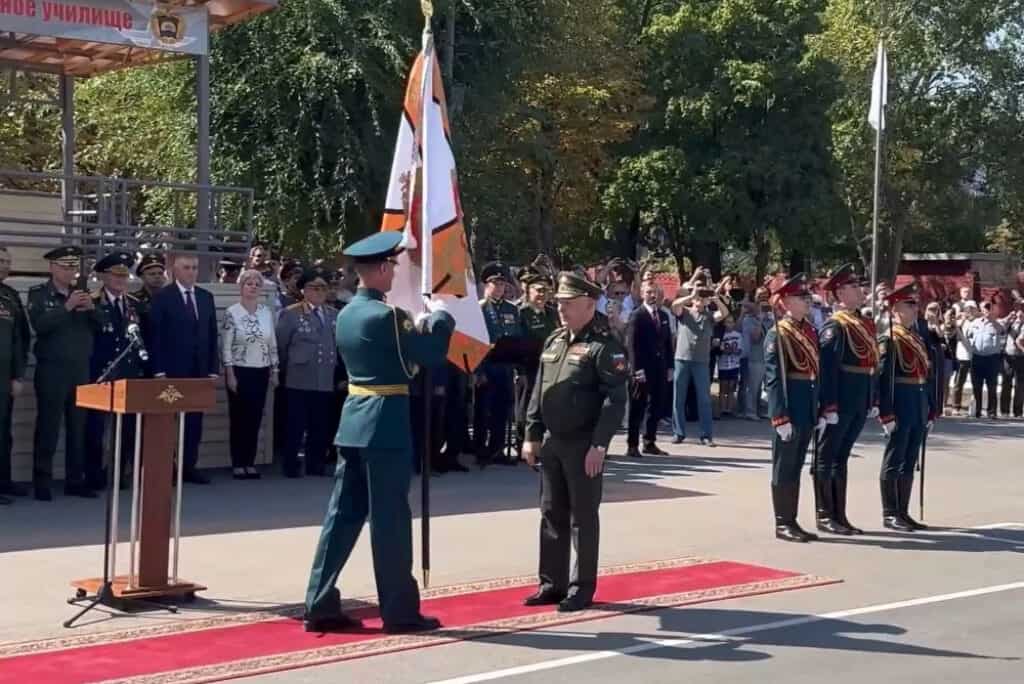
The Russian government announced last week that it will re-establish the Chelyabinsk Higher Tank Command School (ChVTKU) this year. It is one of 16 military schools and academies that Moscow has recently opened or plans to stand up in the coming years, many of which had previously been shuttered. Russia is seeking to expand its officer training pipeline to meet the needs of a larger planned force that has been heavily attrited by the war in Ukraine.
The revival of ChVTKU
In an order published on May 28, Russian Prime Minister Mikhail Mishustin directed the Ministry of Defense (MoD) to establish ChVTKU by August 1. The MoD must approve the school’s charter within four months and provide it with the necessary real estate within six months, the order says.
Located in the city of Chelyabinsk in west-central Russia, ChVTKU traces its roots to the Soviet Union’s “Great Patriotic War” against Nazi Germany. Moscow shuttered what was then called the Chelyabinsk Tank Institute in 2007 following a hazing incident that left a serviceman maimed, though its closure had already been planned as part of a broader consolidation of military schools inherited from the Soviet Union. The institute’s land and buildings were later sold at auction.
According to the Chelyabinsk regional governor, ChVTKU will enroll its first 200 cadets this year and use the premises of another previously shuttered military school. Colonel Leonid Ryzhov, decorated for his service as a brigade commander in Ukraine, will reportedly lead ChVTKU.
Other schools being opened
The move to revive ChVTKU follows the establishment of several other schools that had been disbanded earlier this century. The Saratov Higher Artillery Command School officially reopened in August 2024, followed a year later by the Saratov Higher Military Engineering School of Radiological, Chemical, and Biological Protection and the Nizhny Novgorod Higher Military Engineering Command School.
In 2026, in addition to ChVTKU, Russia plans to reopen the Novocherkassk Higher Military Command School of Communications. It has begun recruiting cadets. Russia is also establishing the Ulyanovsk Higher Military Aviation School of Pilots by splitting off a department from another school responsible for training Military Transport Aviation and Long-Range Aviation pilots.
Next year, Russia intends to stand up a higher military school in Moscow Oblast to train officers for Russia’s new Unmanned Systems Forces. The Omsk Higher Combined Arms Command School, closed in 1999, reportedly will be revived in 2028. In 2029-2030, the MoD reportedly intends to form the Krasnoyarsk Higher Military Artillery Command School and re-establish the Krasnoyarsk Higher Military School of Air Defense Radio-Electronics.
Russia reportedly will then create the Pushkin Higher Military School of Aerospace Defense in 2032 and revive the Tomsk Higher Military Command School of Communications in 2034. Finally, four branches of the Military Medical Academy are reportedly set to open in Sevastopol, Samara, Novosibirsk, and Khabarovsk in 2029-2034.
Of course, these plans may change with time.
Russia’s officer shortage
Whereas non-commissioned officers are the backbone of Western militaries, Russia relies more heavily on its officer corps. Before receiving their commission, officer cadets are generally supposed to train for four to five years at a specialized military higher educational institution.
Russia is currently short on qualified officers, especially at the junior levels. Since 2022, its military has grown by 40 to 50 percent, with the ground forces roughly doubling in size. Russia has created many new units and enlarged existing ones, a process that is ongoing. Meanwhile, heavy casualties have decimated the junior officer corps.
Although the precise shape of Russia’s post-war military remains to be seen, all indications are that it will remain substantially larger than pre-2022 levels. Most of the infantry regiments formed during the autumn 2022 mobilization will presumably be disbanded, but Russia probably will retain the new armies, corps, and other formations it has created since the war began. Moscow also appears intent on continuing to expand many of its brigades into divisions, a trend that predates the 2022 invasion.
Officers will be needed to lead this larger force. While Russia will likely remain unable to resolve its officer shortage before the conflict with Ukraine ends, having additional training capacity can help in the years-long process of post-war reconstitution.
John Hardie is the deputy director of FDD’s Russia Program and a contributor to FDD's Long War Journal.
Tags: russia, Russia vs Ukraine, ukraine


