
The U.S. Navy’s Medium Unmanned Surface Vessel (MUSV) program selected 7 separate designs to advance towards at sea testing, with further scaling following suit as a part of the several billion dollar initiative to regain the U.S. Navy’s mass.
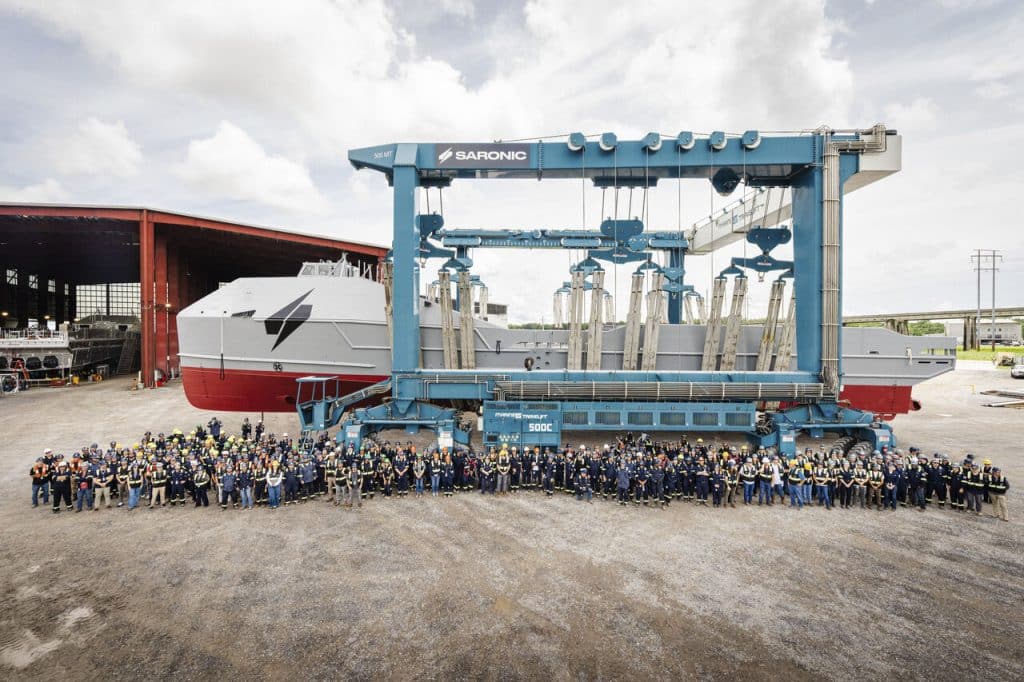
The 7 companies selected by the Navy include, Sea Machines, Leidos, Saronic Technologies, Galliano Marine Services, PacMar Technologies, Birdon, and Huntington Ingalls Industries (HII). The selection of these firms represents a mix of already established and large scale defense firms and the introduction of several newer companies.
After selection, these companies are slated to receive an additional $15 million dollars each to support testing activities, which are due to start in June and conclude by October of this year. Following the roughly 4 month testing period, each of the designs put forward will be eligible for follow on production.
The common requirements for each of the MUSV designs stipulates that the vessels will have a range of 2,500 nautical miles with a 25 metric ton payload in Sea State 4 at a speed of 25 knots with at least some form of autonomous operation. Each MUSV design will utilize the advancement of modular/containerized payloads to carry out a variety of missions including strike, ISR, and basic transport.
The implementation of a “marketplace” style program for procurement and development seeks to ensure that the Navy offloads research, development, and basic production risk onto industry, who now are responsible for providing proven designs, rather then the token fabrication of limited prototypes by the Navy itself.
Future Unmanned Force Structure
The U.S. Navy’s budget documentation and shipbuilding plan outline the multi-billion procurement and production plan for unmanned systems as a growing part of the U.S. Navy’s architecture. $1.950 Billion dollars was invested into the MUSV program in Fiscal Year 2026 alone, with an additional $3 billion allotted for the program over the next 5 years, geared towards an accelerated testing and production cycle.
Consequently, these funds provide for an ability to procure 81 MUSVs by FY 2031, with 36 procured in the FY 2026 budget cycle, 3 in FY 2027, 10 in FY 2028, 10 in FY 2029, 12 in FY 2030, and 12 in FY 2031. The detailed procurement plans for MUSV follow previous program re-orientations, with the current iteration born out of the ashes of the Modular Surface Attack Craft (MASC) program implemented in 2025.
“I’ve observed firsthand how Robotic Autonomous Systems deliver a wide array of capabilities that swing the advantage in conflict. The Commander’s ability to tailor these forces to meet unique security demands is essential.”
– Admiral Brad Cooper, Commander, U.S. Central Command (CENTCOM)The Navy projects a total of 83 unmanned vessels in active service by FY 2031 which includes various Unmanned Underwater Vehicles (UUVS) and smaller USVs alongside MUSVs, surpassing the number of auxiliary vessels operated by the U.S. Navy in FY 2030. The continued emphasis on putting unmanned systems into service underscores the U.S. Navy’s view in regards to the critical role that these vessels can play in revitalizing the U.S. Navy’s force numbers for a lower price.