
Naval Group is proposing its Blacksword Barracuda design to the Hellenic Navy for a four-submarine program intended to replace Greece’s aging Type 209 submarine fleet, following a request for information (RFI) issued in late 2025.
Naval Group has proposed its latest Blacksword Barracuda submarine design to the Hellenic Navy as part of the service’s next-generation submarine program for four new attack submarines, responding to a RFI issued to industry at the end of 2025. The future submarine program is expected to replace Greece’s existing fleet of four 50-year-old Type 209/1100 and Type 209/1200 submarines.
According to Naval Group Country Director David Pinot, the company determined that the Barracuda-derived design best aligns with the operational and technical requirements outlined by the Hellenic Navy.
“After carefully studying the specifications, it became clear that the requirements from the Hellenic Navy were more closely related to the Barracuda family than to other designs such as Scorpène. That is why we answered the Greek requirements with the Blacksword Barracuda design.”
David Pinot, Greece – Country Director at Naval GroupThe Blacksword Barracuda is derived from the nuclear-powered Suffren-class submarine but adapted as a conventionally powered platform. The same design family was selected by the Royal Netherlands Navy for its future Orka-class submarine program (4 boats too). They will be the first submarines of the RNLN that are built at a foreign shipyard.

The Blacksword Barracuda is described by the manufacturer as one of the quietest submarines in its class, combining significant firepower with next-generation lithium-ion batteries that enable high-speed submerged operations for extended periods, regardless the state of charge of the battery.
Focus on Lithium-Ion Battery Technology
Naval Group is placing significant emphasis on lithium-ion battery technology as a core capability of the Blacksword Barracuda design.
The company argues that submarine operations are shifting toward multi-mission flexibility. Modern submarines must be capable of adapting their mission profile after departure from base and executing multiple mission types, rather than being optimized for a single role.
According to Naval Group, lithium-ion battery systems enable greater operational flexibility compared to traditional Air Independent Propulsion (AIP) systems. AIP-based submarines typically require periodic return to port for refueling specific subsystems, while lithium-ion-equipped submarines can recharge batteries at sea.
Lithium-ion battery systems can store and deliver more energy while supporting faster charging than lead-acid batteries. They also require significantly less maintenance and offer approximately 40% longer service life.
Performance figures provided by the company include:

The submarine is designed with six 533mm torpedo tubes and a total payload capacity of up to 30 weapons. These may include torpedoes (F21), sub-launched missiles (EXOCET SM40, JSM-SL), cruise missiles (MdCN/NCM), offensive naval mines, and unmanned underwater vehicles (UUV), all launched via torpedo tubes.
Lithium-Ion Batteries vs AIP Systems
Naval Group noted that lithium-ion battery technology continues to evolve rapidly, with performance improvements expected over successive generations. In contrast, AIP technology is considered mature, having reached its performance limits with limited potential for further performance improvements.
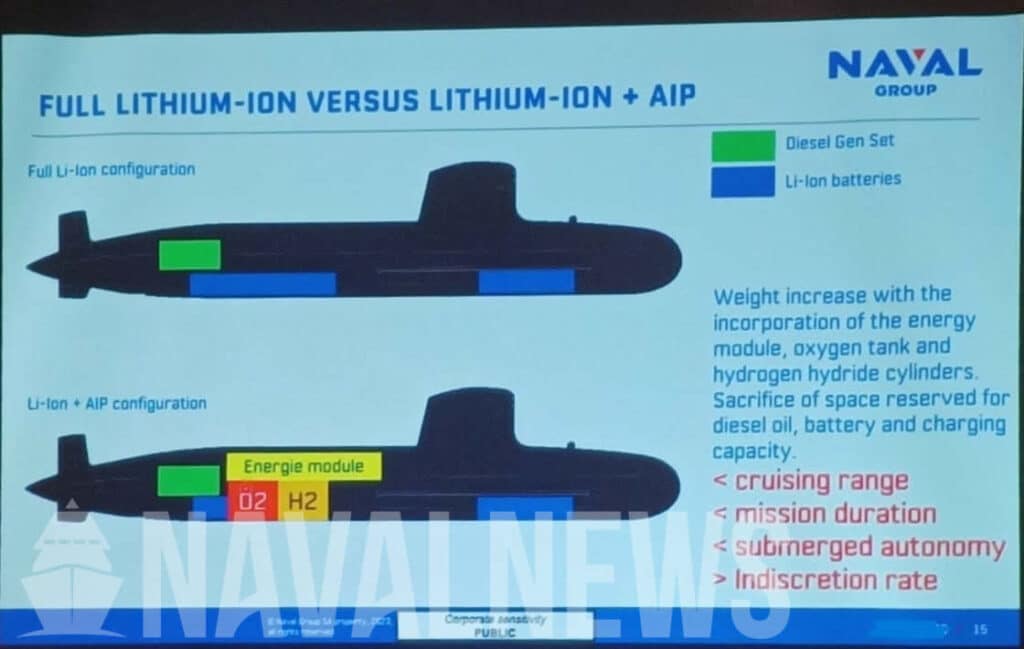
The company also highlighted the modular “plug-and-play” nature of lithium-ion battery systems, which allows battery modules to be replaced or upgraded during the submarine’s lifecycle.
Li-ion battery propulsion has already been adopted by the Japan Maritime Self-Defense Force and is planned for future submarine fleets in several countries, including the Netherlands (see video about Orka Class) and Indonesia.
Industrial Participation in Greece
Industrial participation remains a central component of Naval Group’s proposal. Following its involvement in the FDI HN frigate program, Naval Group has already established a network of Greek industrial partners. The company reports signing 120 contracts with more than 70 Greek companies, significantly expanding the Hellenic Industrial Participation (HIP).
Beyond the FDI program, this industrial plan has already had numerous and lasting economic benefits for the Greek industry by making it possible to integrate Greek companies into Naval Group’s supply chain for current and future French and export programs.
For the submarine program specifically, Naval Group has signed agreements with two major Greek industrial players:
Thanks to the above agreements, Naval Group has the foundations required to build submarines locally in Greece. Under the proposed model:
Naval Group aims to establish a long-term industrial ecosystem capable of supporting submarine construction and lifecycle support domestically.
Program Timeline and Delivery Outlook

Naval Group estimates that the first Blacksword Barracuda submarine could be delivered within 5–6 years after contract signature.
The company indicated that, if the Hellenic Navy intends to receive its first submarine by 2035, contract signature would likely need to occur no later than 2028. However, the timeline will depend on the signing of the final contract and the chosen shipbuilding model, either full domestic construction in Greece or a hybrid approach with the first submarine built abroad and the rest assembled in Greece, with the French proposal remaining flexible across options.
Naval Group also stated that maintenance and support activities could be conducted locally in Greece. The company believes lithium-ion battery-equipped submarines may offer lower maintenance requirements compared to AIP-equipped platforms.AIP submarines will require it to build complex offshore facilities to resupply the system since it is not possible to resupply an AIP system at sea.
Competitive Landscape

Naval Group expects strong international competition for the Greek submarine program. Likely bidders include:
Naval Group officials noted that Greece’s technical requirements indicate an ambition to field advanced multi-mission submarines suitable for regional sea control operations.
Interoperability and Strategic Considerations

Naval Group highlighted interoperability as a potential advantage if Greece selects the Barracuda family. Operating similar submarine designs alongside France and the Netherlands would allow operational cooperation, training exchanges, and shared user experience among allied navies which are also important NATO naval powers.
The company also assessed that transitioning from existing German-origin submarine systems to French technology would primarily involve training and adaptation rather than major technical challenges.
Naval Group believes the Greek submarine program is progressing steadily and expects to submit a more detailed proposal during the next phase of the procurement process (RFP stage), including pricing once final operational requirements are defined. Naval Group also added that it is open to any discussion on financing.
Company officials assess that the submarine program could exceed the scale of the ongoing frigate acquisition in both operational and industrial terms.“We are convinced that we will deliver the best value-for-money solution when final pricing is requested,” Pinot stated.
