Satellite data shows mixed reservoir levels ahead of North Korea’s planting season
An analysis of recent imagery captured by the European Space Agency’s Sentinel-2B and Sentinel-2C satellites shows that water levels at North Korea’s major reservoirs are generally higher this spring than they were a year ago, offering a positive signal for agricultural water supplies ah
Daily NK
75
4 min read
0 views
An analysis of recent imagery captured by the European Space Agency’s Sentinel-2B and Sentinel-2C satellites shows that water levels at North Korea’s major reservoirs are generally higher this spring than they were a year ago, offering a positive signal for agricultural water supplies ahead of the rice-transplanting season.
The analysis compared satellite imagery of eight sample reservoirs taken during the same periods in March and April of 2025 and 2026. Average water surface area across the eight sites increased by approximately 5% year-on-year.
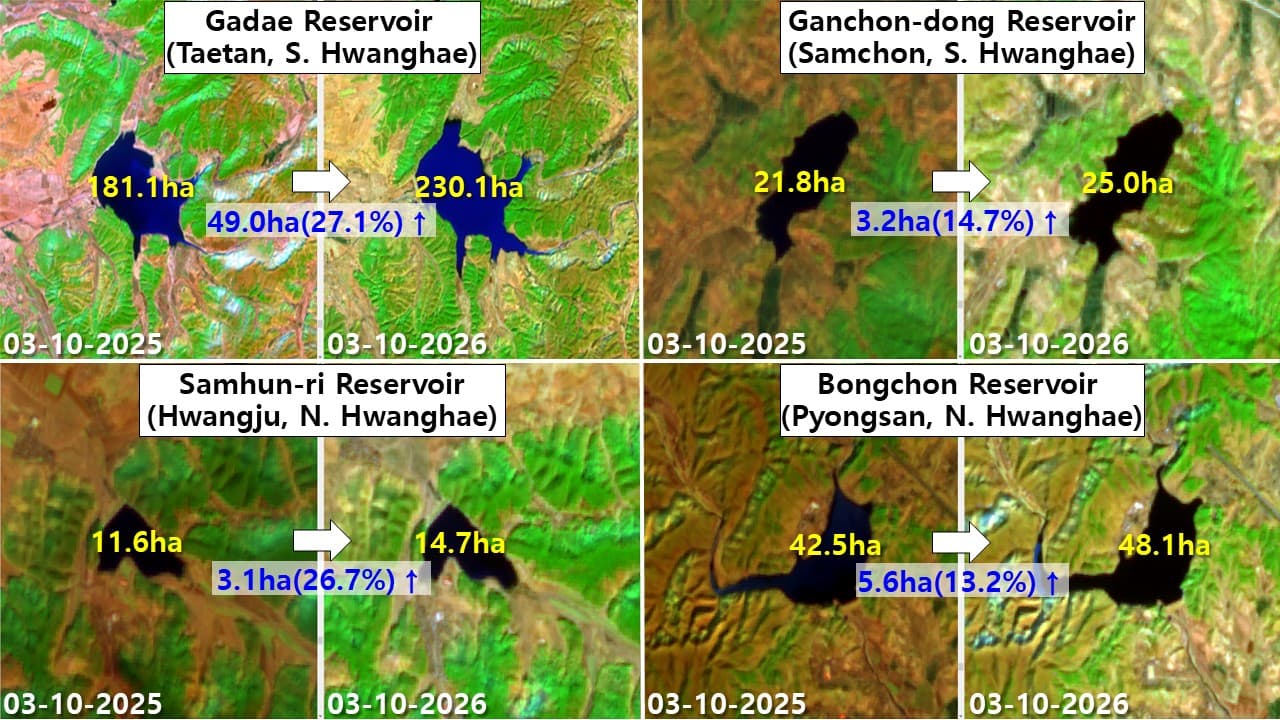
Reservoir water levels across Hwanghae province have risen sharply compared to last year, a positive sign for agricultural water supplies ahead of this spring’s rice-transplanting season. The Gadae and Samhun-ri reservoirs each expanded by roughly 27%, suggesting early rice cultivation in North Korea’s main grain-producing region is likely to proceed smoothly. Photo: Sentinel-2B/2C (ESA)
In South Hwanghae province, the Gadae Reservoir in Taetan county expanded by approximately 27.1% and the Ganchon-dong Reservoir in Samchon county by about 14.7%. In North Hwanghae province, the Samhun-ri Reservoir in Hwangju county grew by roughly 26.7% and the Bongchon Reservoir in Pyongsan county by about 13.2%. The gains across Hwanghae province are particularly significant: the region is North Korea’s largest grain-producing belt, and the improved water levels are expected to allow stable irrigation supplies when the transplanting season begins in earnest. Conditions in Kangwon province also improved sharply, with the Santan-ni Reservoir in Kosan county recording the largest single increase among all sites measured, expanding by more than 37.6%.
Taken together, the data suggest that conditions for securing agricultural water in the Hwanghae region this spring have improved compared to last year, pointing to a smoother start for early rice cultivation in North Korea’s most important farming zone.
Regional disparities cloud overall picture
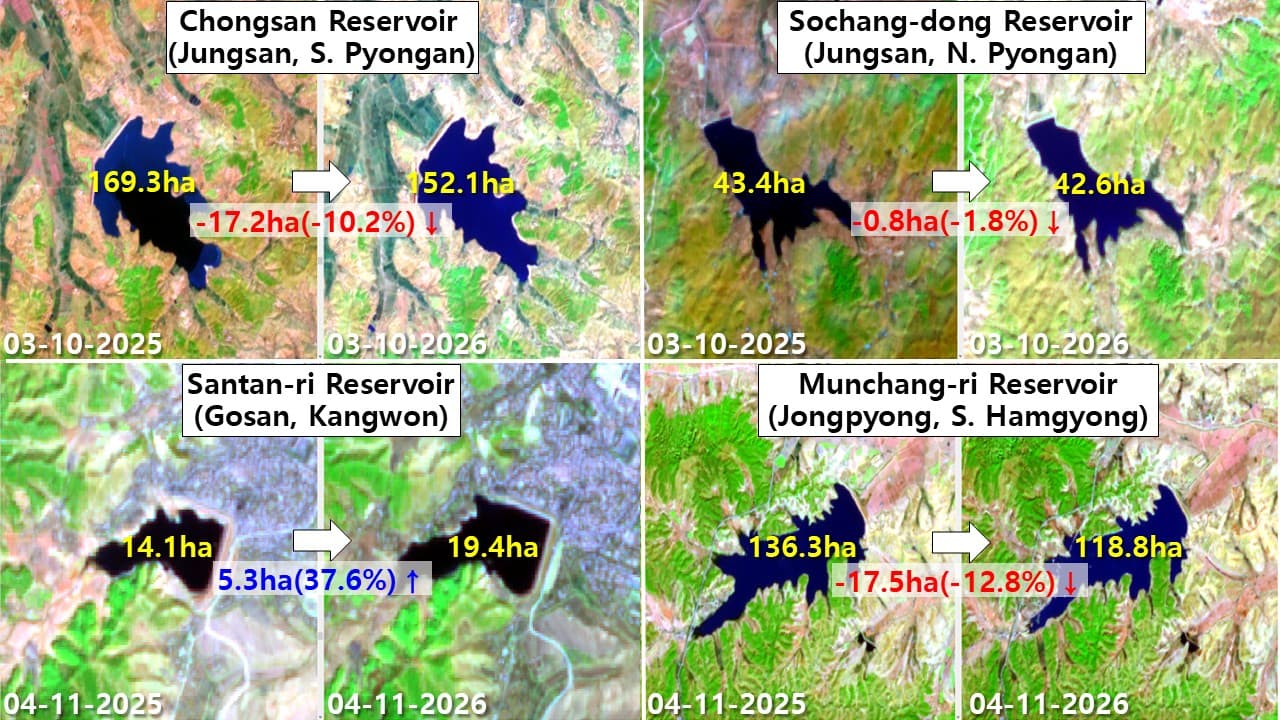
The aggregate improvement, however, masks a widening divide in water availability across the country. Three reservoirs recorded year-on-year declines: the Chongsan Reservoir in Jungsan county, South Pyongan province, fell by about 10.2%; the Sochang-dong Reservoir in Jungsan county, North Pyongan province, shrank by roughly 1.8%; and the Munchang-ni Reservoir in Jongpyong county, South Hamgyong province, contracted by approximately 12.8%. Satellite imagery shows water channels in those areas have visibly narrowed compared to the previous year.
While the Santan-ri Reservoir in Kangwon province expanded by more than 37%, reservoirs in South Pyongan and South Hamgyong provinces shrank by more than 10% compared to last year. The widening gap in water availability between regions points to potential difficulties securing irrigation water in some areas when the rice-transplanting season begins. Photo: Sentinel-2B/2C (ESA)
In the affected provinces, lower reservoir levels raise the prospect of water shortages during the critical transplanting window. Delayed transplanting can push back the growing calendar, and seedlings planted in insufficiently irrigated paddies may develop poorly. Whether those areas recover will depend heavily on how much rain falls in the weeks ahead.
A secondary concern is infrastructure. Even where reservoirs are well-stocked, North Korea’s aging irrigation systems may limit how effectively stored water reaches paddies. In areas where water levels have fallen, tailored water management and additional contingency measures will be needed as the transplanting season approaches.
Looking at the overall picture, reservoir conditions across the country in spring 2026 can be summarized in one phrase: polarization by region. The average water surface area across all eight sites rose by about 5% compared to last year, but the gap between well-supplied and water-stressed areas is significant.
In the Hwanghae zone — covering Thaetan, Samchon, Hwangju, and Pyongsan — water volumes have increased noticeably. The Kadae Reservoir in Thaetan county alone gained the equivalent of hundreds of soccer fields in surface area. Yet reservoirs in parts of South and North Pyongan and South Hamgyong provinces moved in the opposite direction.
For those water-stressed areas, the success of this year’s harvest will hinge on rainfall totals in the coming weeks. And even where water is available, aging irrigation infrastructure remains a key question: getting stored water efficiently from reservoirs to paddies will be as important as how much water those reservoirs hold.