
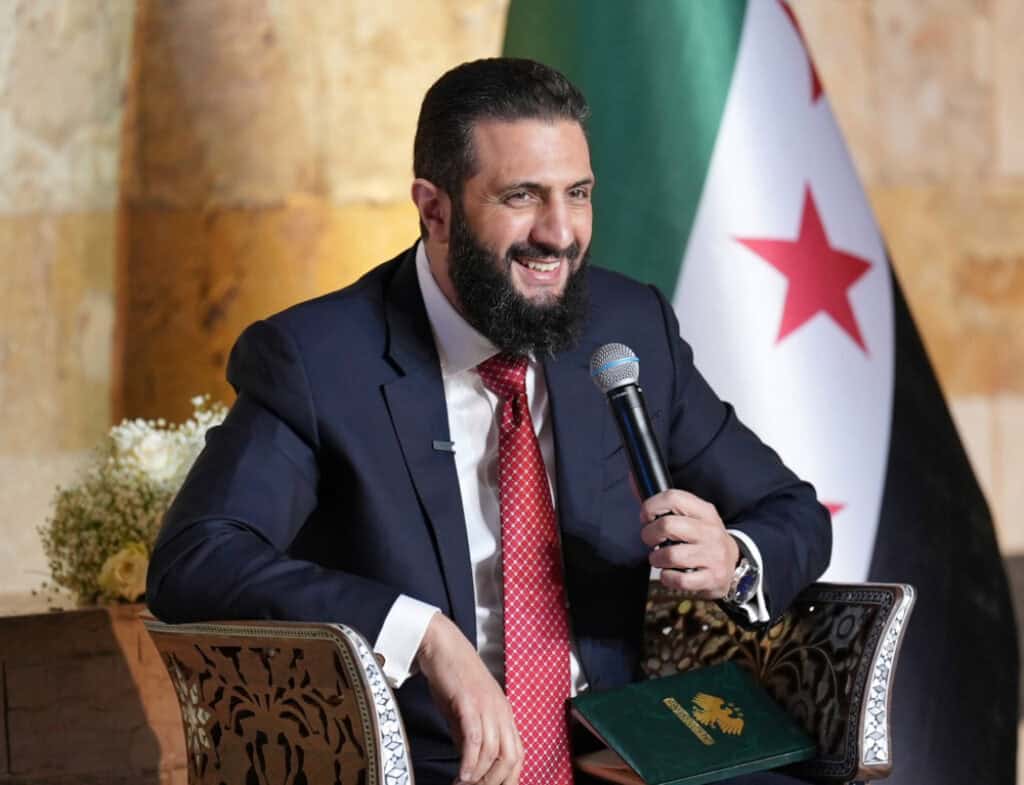
On May 31, President Donald Trump said he was naming US Ambassador Tom Barrack as special presidential envoy to Syria and Iraq. The announcement came a day after it had appeared that Barrack’s role as envoy was due to expire and the same day the Syrian government said President Ahmed al Sharaa had spoken with Trump. The developments represent another phase in US-Syria relations and Syria’s continued focus on investment and political transition.
Ambassador Barrack initially assumed his role as special envoy to Syria in May 2025. This came in the context of new US-Syria relations that began after the fall of the Assad regime in December 2024 and with the appointment of Sharaa as the country’s transitional president. In May 2025, Trump met Sharaa in Saudi Arabia. They met again at the White House in November 2025, when Syria announced it would join the US-led Global Coalition to Defeat ISIS (the Islamic State). The two leaders have continued to remain in touch, with Sharaa receiving a shipment of Trump-branded cologne in mid-May 2026.
Barrack’s role as envoy was due to expire at the end of May because it is a six-month appointment that can be renewed once. Barrack wrote that he was honored to continue serving in the expanded role as envoy to Syria and Iraq. “In the tradition of those who have long studied the Levant and Anatolia — Iraq, Syria, and Turkey remain the strategic fulcrum upon which any enduring Middle East stability must pivot,” he stated on social media.
“Balancing these three nations requires a single, consistent point of American contact and leverage — transcending tribal, religious, or sectarian differences,” Barrack added, also stating that the current US mission in the region envisions weaving “disparate threads into one coherent tapestry of order and mutual interest.”
Trump and Sharaa held a call on May 31. “President al-Sharaa stressed the importance of continued international support for Syria during the reconstruction and recovery phase, noting that the lifting of the remaining sanctions constitutes a fundamental step toward enabling the Syrian economy to regain its vitality and improve the living conditions of Syrian citizens,” the Syrian Arab News Agency (SANA) noted.
The Syrian leader discussed the importance of creating an environment for investment in his country. Trump and Sharaa also discussed regional security, although Syrian state media provided no specifics on what aspects they discussed. “For his part, President Trump expressed his interest in following developments in Syria and the wider region, affirming the importance of safeguarding stability and supporting Syria’s recovery and reconstruction efforts,” SANA’s report added.
Syria continues to face several important trends in the region. First, Iran tensions have shifted flight routes over Syria and some energy trade from Iraq through Syria. The Syrian government has been outspoken in condemning Iranian attacks in the region, including an attack on Kuwait on June 1.
Damascus also continues to deal with integrating the Kurdish Syrian Democratic Forces (SDF) and clamping down on terrorist threats. The SDF is supposed to integrate into Syria’s new security forces as part of a roadmap agreed to in March 2025 and a deal in late January 2026.
The Lead Inspector General report to Congress on Operation Inherent Resolve, released in late May, describes the current US goal in Syria. Operation Inherent Resolve is the US anti-Islamic State campaign that has been conducted in Iraq and Syria since 2014, and the new report covers the period January-March 2026. The report noted that “the United States continued to work toward a bilateral U.S.-Syria relationship that supports the mutual objective of suppressing ISIS remnants in Syria.”
The US is also working on a defense partnership with Syria that “could include improving Syria’s command and control over its forces, securing Syria’s borders to counter terrorist infiltration, narcotics and weapons smuggling, and the movement of displaced persons to and from Syria.”
Reporting from Israel, Seth J. Frantzman is an adjunct fellow at FDD and a contributor to FDD’s Long War Journal. He is the senior Middle East correspondent and analyst at The Jerusalem Post, and author of The October 7 War: Israel's Battle for Security in Gaza (2024).
Tags: Ahmad al Sharaa, SDF, Syria, US-Syria


